Elon Musk managed to cancel the Cybertruck three separate times in five days. First it was ending next summer, then in eight months, and finally through late summer 2027 after an online petition pushed back.
That is quite an exit for a pickup that was supposed to redefine American manufacturing. What started as a promised $40,000 stainless-steel wedge ended up as a $110,000 novelty whose deliveries cratered nearly 47% last year.
Tesla builds electric cars, solar systems, and stationary batteries, but none of those explain its market presence. The company is valued as the physical operating system of artificial intelligence—a bet that it will command a nationwide fleet of driverless robotaxis and humanoid robots.
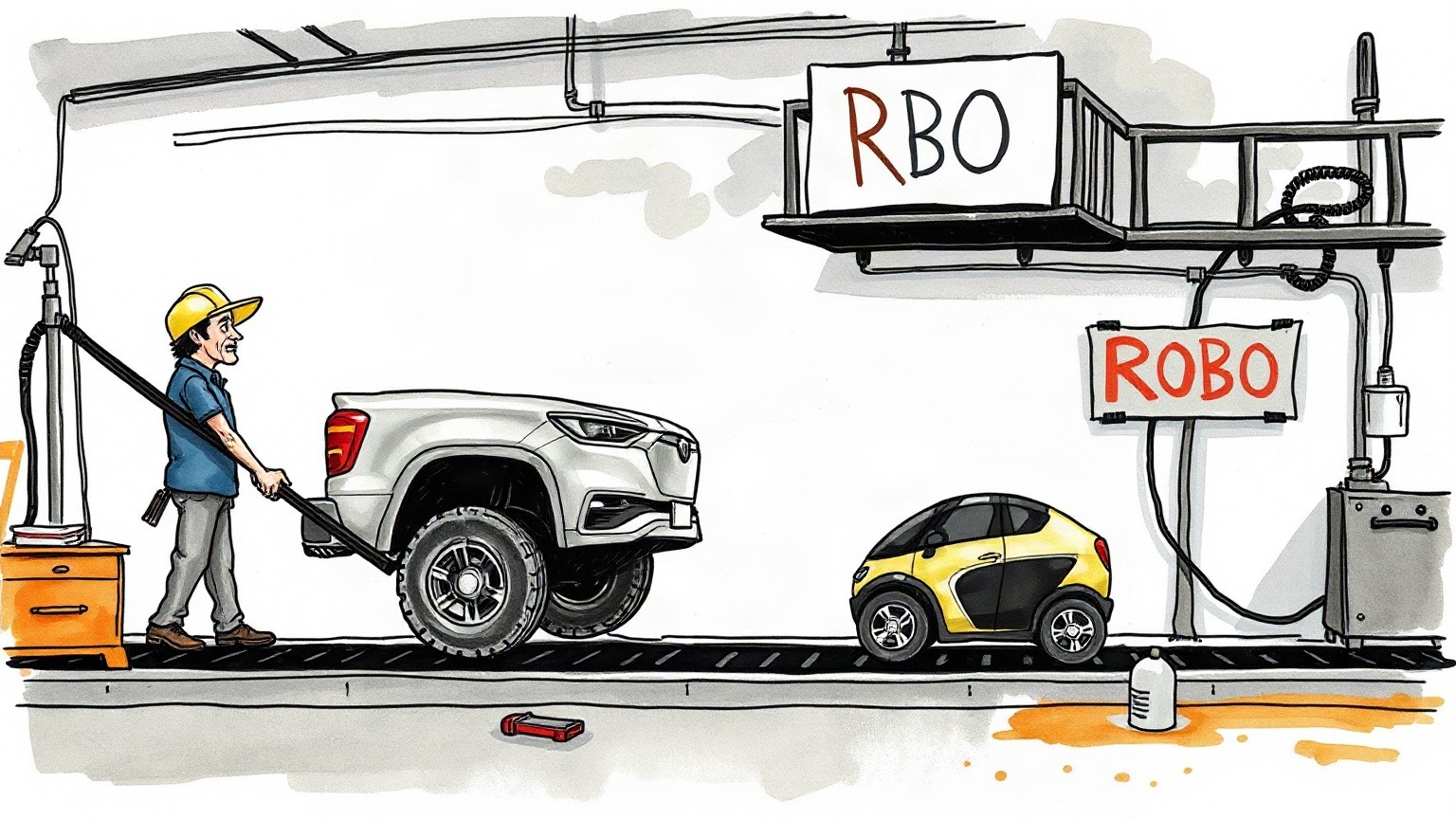
Every bolt turned in Texas is judged through that single prism. Cancelling a truck is not an operational retreat; it is an eviction notice to clear floor space for the Cybercab.
| Price | $390.22 LIVE |
| Market Cap | $1.54T |
| Forward P/E | 180.7x |
| Total Revenue (TTM) | $103.6B |
| 52-Week Low | $297.38 |
| 52-Week High | $498.83 |
| Analyst Consensus | Buy (44 analysts) |
| Analyst Target Mean | $412.48 |
Think of it like a restaurant gutting its kitchen to install automated vending machines before anyone has tasted the food. Tesla already killed the Model S and Model X, and now the Cybertruck joins the scrap heap. After 2027, its consumer automotive business leans on just two mass-market vehicles designed in 2017 and 2020.
Factory lines built for 125,000 trucks a year were idling at a quarter of their capacity. The assembly floor is being handed over to robotaxis because the core auto business has run out of new tricks.
Yet the business replacing it is behaving strangely. In ride-hailing, you care about paid miles because paying customers prove product-market fit. Empty test cars circling a cul-de-sac are just operating expenses wearing a seatbelt.
In the second quarter of 2026, Tesla’s cumulative paid robotaxi miles dropped 36% quarter over quarter. Instead of explaining the slump, Tesla simply pulled the chart from its shareholder deck. In its place appeared a chart of "cumulative unsupervised miles," counting every vehicle on the road whether a paying rider is inside or not.
The physical reality on the ground is just as narrow. Outside of Austin, which accounts for nearly 80% of all driverless miles, the footprint is microscopic. Miami has five cars. Fort Worth has two dozen.
Meanwhile, Alphabet's Waymo runs roughly 4,000 commercial vehicles across 15 cities, logging seven times Tesla's best weekly mileage and handling highway traffic that Tesla's geofence strictly avoids. Tesla's cabs still detour around at-grade rail crossings. Bad weather parks them.
Even the consumer version of the Cybercab looks less like freedom and more like a locked smartphone ecosystem. Tesla opened orders at $29,990, but the vehicle physically will not operate without a mandatory $299 monthly autonomy subscription. Over five years, that two-seater actually costs you nearly $48,000.
It is geo-fenced, prohibited from commercial ride-hailing, and carries a $50,000 penalty if you resell it without permission. Tesla is selling hardware at a discount just to trap buyers inside a mandatory software lease.
That dynamic is why this pivot matters to the equity. At 468 times trailing free cash flow, the stock is priced as a pure software monopoly. Not an automaker dealing with a 2.6% operating margin and shrinking vehicle revenue.
For shares to re-rate higher, Tesla has to prove that autonomy is a high-margin cash machine rather than a localized novelty. If paying riders multiply, trading metal-bending for autonomous software margins is an obvious masterstroke. If they do not, the market is paying software multiples for an aging car fleet.
The bear case is that Tesla is liquidating its vehicle catalog to fund an autonomous experiment whose real traction is moving backwards. Short sellers see a company that hid its paid-demand metric the moment adoption stalled. It leans on Texas and SpaceX related-party purchases to mask soft demand while its operating margin thins.
Waymo has already accumulated 87 times more driverless miles, navigates freeways, and operates in twice as many markets. If Tesla cannot run a robotaxi profitably without geofencing out railroad tracks and rain, it has sacrificed its factory capacity for an unusable prototype.
What we are watching is late January 2027, when Tesla reports fourth-quarter results and faces the music on whether paid autonomous miles returned to the shareholder presentation.
Until those paid miles inflect, Tesla is trading real factory output for an unproven subscription loop.
Disclosure: The Signal holds no position in TSLA. Positions may change. This is not financial advice.