Here's what almost nobody is talking about: Rocket Lab just booked a ticket to geostationary orbit — 35,786 kilometers above Earth — and the U.S. Space Force is paying for the ride.
| Contract Value | $90 million |
| Customer | U.S. Space Force |
| First | Rocket Lab's first GEO satellites |
On May 21, Rocket Lab (NASDAQ: RKLB) announced a $90 million contract from the Space Force's Space Systems Command (SSC) to build, integrate, and operate two geostationary (GEO) satellites hosting the Heimdall space domain awareness payload. This isn't just another contract. This is Rocket Lab's first-ever GEO satellite program. Period.
"The award represents Rocket Lab's first satellite production program for geostationary orbit and extends the Company's vertically integrated mission model into a new orbital regime." — Rocket Lab press release
Why This Matters: GEO Is a Different Game
Most investors know Rocket Lab as an Electron launch company. They build small satellites for low Earth orbit (LEO). They've done 87 Electron launches and put 250+ satellites in space. Impressive, but that's the minor leagues compared to GEO.
GEO satellites are massively more complex. They need radiation-hardened electronics, precision station-keeping propulsion, thermal management systems that survive extreme temperature swings, and enough power to operate for 15+ years without maintenance. A single GEO satellite can cost $200M–$500M to build and launch. The barriers to entry are enormous.
Rocket Lab just cleared them.
The Deal Breakdown
The contract calls for two satellites built on Rocket Lab's Lightning bus — the same spacecraft platform already in production for the Space Development Agency's Tranche 2 Transport Layer-Beta and Tranche 3 Tracking Layer programs. But this version is adapted for GEO: hardened for radiation, fitted with higher-performance propulsion, and designed for the unique thermal and station-keeping demands of geostationary orbit.
- Contract Value: $90 million
- Customer: U.S. Space Force / Space Systems Command
- Program: Heimdall Space Domain Awareness (SDA)
- Satellites: 2 GEO spacecraft on the Lightning bus
- Payload: In-house Heimdall optical sensors from Rocket Lab Optical Systems
- Operations: Up to 5 years on-orbit after commissioning
- Prime Contractor: Rocket Lab (end-to-end mission provider)
This deal has a hidden backstory that makes it even more impressive. The Heimdall payload prototype was originally developed by GEOST — a company Rocket Lab acquired in 2025 and integrated as Rocket Lab Optical Systems. That acquisition gave them the optical sensor technology in-house. Now they're turning those prototypes into operational satellites. That's vertical integration at its finest.
"Rocket Lab will serve as prime contractor and end-to-end mission provider, responsible for spacecraft design and manufacture, integration of the in-house Heimdall optical payload, launch integration, and on-orbit operations."
What This Means for RKLB Stock
The market has been sleeping on Rocket Lab's space systems business. The narrative has been all about Electron launches and Neutron development. But the real value creation is happening in the spacecraft division — and this contract is a massive validation signal.
Rocket Lab now has active production lines for:
- SDA Tranche 2 (Transport Layer-Beta) — national security comms satellites
- SDA Tranche 3 (Tracking Layer) — missile tracking constellation
- Commercial constellations — anonymous customer programs
- Heimdall GEO — space domain awareness in GEO
That's four concurrent national security programs. The Lightning bus is becoming the go-to platform for U.S. government space programs. And now it's been qualified for GEO — the highest-value orbital regime in existence.
Here's what the math looks like. The global GEO satellite market is worth roughly $15–20 billion annually. Even a 5% share would represent $750M–$1B in annual revenue — double Rocket Lab's entire trailing twelve-month revenue. And Rocket Lab just demonstrated they can compete at that level.
The Competitive Angle
This is where it gets interesting. The traditional GEO primes — Lockheed Martin, Northrop Grumman, Boeing — build satellites that cost $300M+ each and take 3–5 years to deliver. Rocket Lab is bringing its manufacturing-speed ethos to a market that desperately needs disruption. Lightning buses are designed for rapid production using vertically integrated supply chains. If Rocket Lab can deliver GEO satellites faster and cheaper than the incumbents, they won't just be a player — they'll be the player in the next generation of national security space.
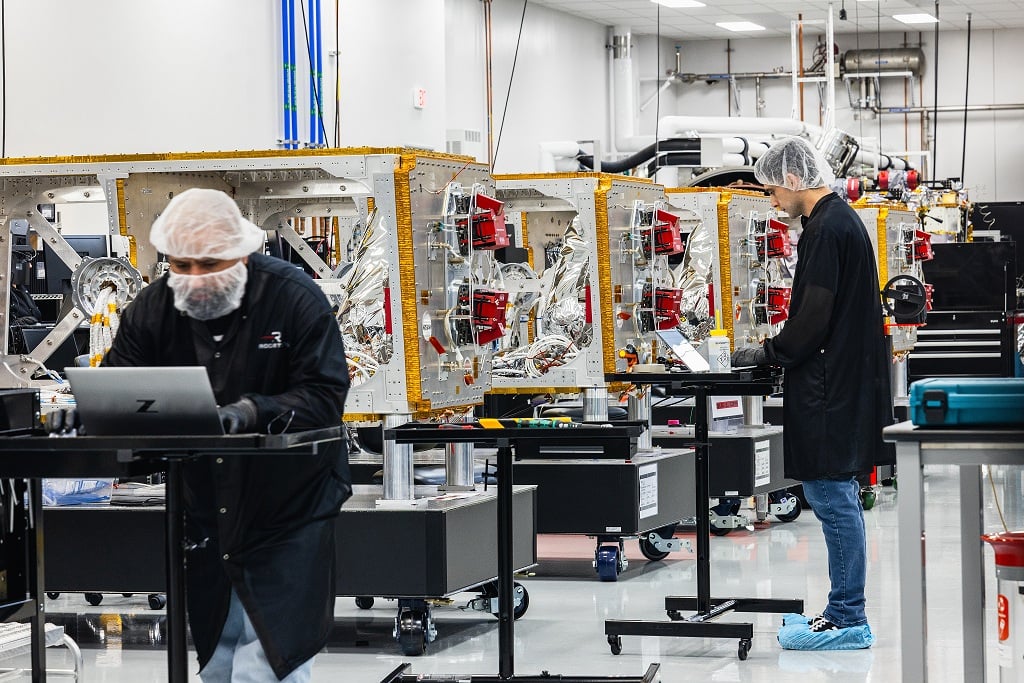
The Heimdall satellites will be assembled and tested at Rocket Lab's Long Beach Spacecraft Production Complex, with payload delivery from Rocket Lab Optical Systems and mission operations from Rocket Lab's own facilities. Every dollar of that $90M stays in-house.
This is the kind of moat that compounds.
The Bottom Line
Rocket Lab just crossed the Rubicon from LEO satellite builder to bona fide GEO prime contractor. The $90M contract value is meaningful — but the strategic signal is worth 10x that. The Space Force is betting on Rocket Lab to deliver one of its most important space domain awareness programs. That trust opens doors to every other high-value government space program in the pipeline.
At a ~$20B market cap, RKLB is still priced as a launch company with a satellite sideline. After Heimdall, that narrative doesn't hold. Rocket Lab is an end-to-end space systems prime with a growing backlog, a proven spacecraft platform, and now — for the first time — a GEO capability that puts them in direct competition with the industry's biggest names.
The skeptics will say one contract doesn't make a trend. They're right. But the trend was already forming. This is just the moment the market finally noticed.