Before Samsung stepped into the picture, Modine was in the middle of a brutal reckoning. Between early June and early November, the stock collapsed roughly 70% as Wall Street realized that keeping artificial intelligence from overheating is an expensive business. Even after shares jumped roughly 30% on Nov. 13 on reports of an impending takeover, the equity sits barely above where it traded a year ago. The headline pop rescued the chart, but it did not fix the underlying machine.
| Price LIVE | $106.10 |
| Market Cap | $7.3B |
| Forward P/E | 26.8x |
| Total Revenue (TTM) | $3.63B |
| 52-Week Low | $87.84 |
| 52-Week High | $323.25 |
| Analyst Consensus | Strong Buy (9 analysts) |
| Analyst Target Mean | $210.89 |
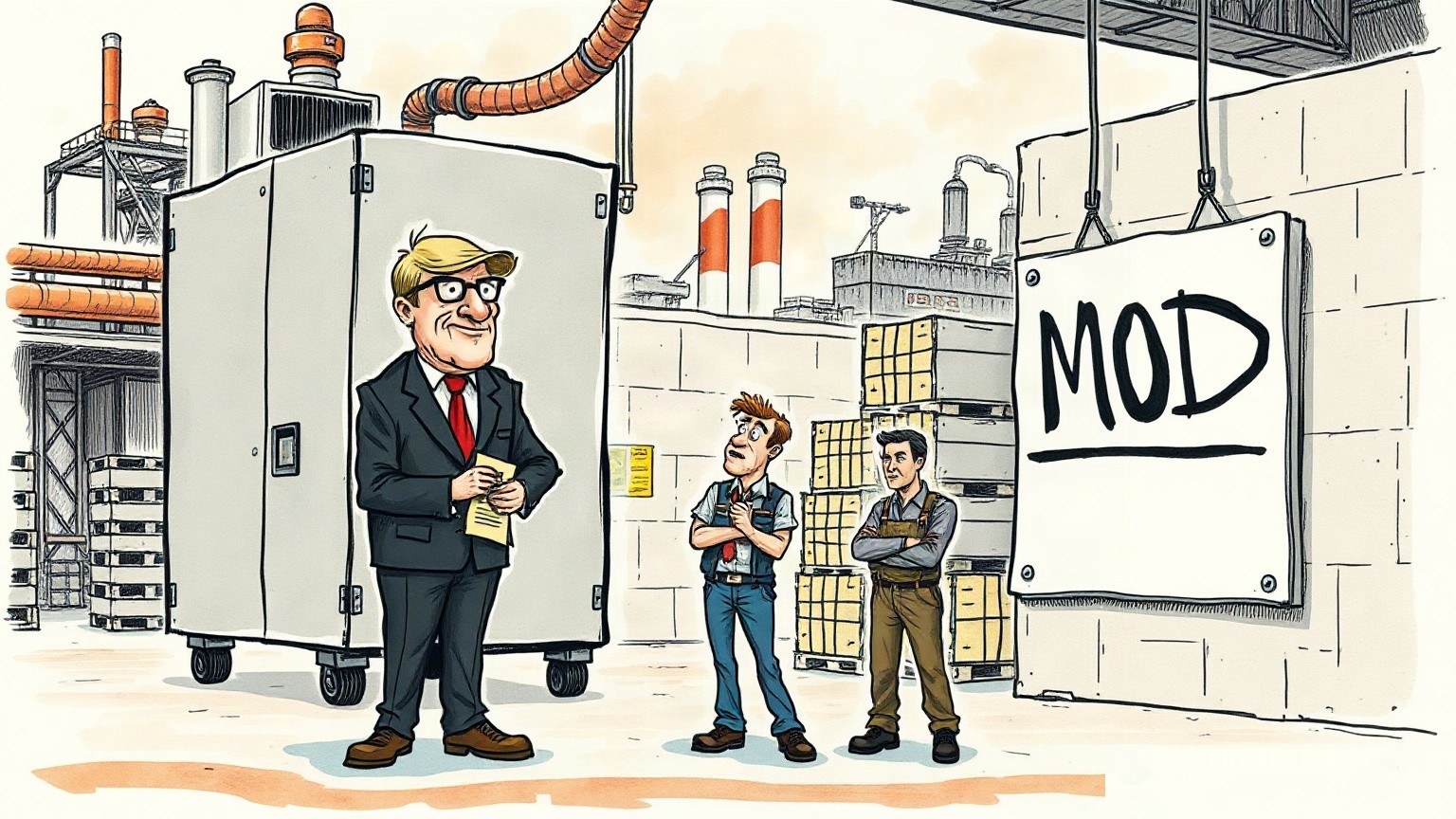
To understand what Modine actually does, picture your phone overheating while streaming a game, scale that problem up to an airplane hangar, and aim it at thousands of high-density chips. Modine builds the heavy machinery—chillers, coolant distribution units, fan walls, and heat exchangers—that keep AI servers from cooking themselves. Founded in Wisconsin in 1916, the company made its name selling radiators for the Ford Model T. It spent over a century cooling engines before spinning off its auto parts unit this October to focus entirely on commercial HVAC and data centers. If Nvidia designs the hypercar engine, Modine builds the radiator that keeps the hood from melting.
That role makes Modine a critical chokepoint in the AI hardware buildout. Modern server racks draw so much power that conventional air conditioning simply chokes; without liquid cooling loops and industrial chillers, compute clusters throttle. Modine’s data center revenue surged 95% year-over-year in its latest quarter to $439.7 million, powered by hyperscale cloud builders adding capacity. Back in May, the company signed a massive supply agreement worth more than $4 billion through 2029 with an unnamed strategic customer, taking a $165 million upfront payment to reserve manufacturing lines.
The catch is that Modine’s hypergrowth came with backwards economics. In its fiscal second quarter, Data Centers gross margin dropped 470 basis points to 19.7%, hit by rising component expenses and tariffs. Capital expenditures to expand manufacturing—including a sprawling plant in Grand Prairie, Texas—drained cash, pushing first-half free cash flow to negative $145.6 million. Net debt climbed by $210.9 million over six months to $573.7 million. While rival Vertiv converts data center demand into billions in positive free cash flow, Modine burned cash to fulfill orders, prompting analysts to slash price targets.
Enter Samsung Electronics. With a market valuation near $910 billion, Samsung wants high-growth infrastructure to diversify away from its volatile memory chip cycle. The conglomerate previously bought European air-handling specialist FläktGroup and joined a $1 billion consortium backing AI digital infrastructure. At the post-report valuation, Modine commands an enterprise value near $7.8 billion, or roughly 16 times its full-year adjusted EBITDA guidance midpoint of $485 million. For Samsung, swallowing Modine whole would secure a captive thermal vendor for its cloud operations while assembling an integrated hardware stack.
The bear case is that the run already priced in a full control premium, leaving public investors exposed to severe headline risk with virtually no arbitrage spread left. If takeover talks fall apart, the reference price is not the post-report level—it is the early-November closing low, roughly a third lower. Samsung reportedly kicked the tires on Johnson Controls' HVAC business in 2024 and came away with nothing, buying FläktGroup instead. Furthermore, customer concentration is acute, with the top ten accounts driving 49% of sales. Hyperscalers who compete directly with Samsung's cloud division could easily diversify away from a Samsung-owned cooling supplier. A business with negative trailing free cash flow, tightening margins, and rising debt is an industrial subcontractor absorbing operational risk, not a software utility with pricing power.
To justify a sustained re-rating without an outright acquisition, Modine has to prove it can scale without torching cash. That requires Data Centers gross margins to stabilize around 20%, capital expenditures to peak as the Texas facility ramps, and free cash flow to turn positive in the second half. Management’s Nov. 18 investor day is the first forum for multi-year targets. The real test is the December-quarter report in early February, where operating cash flow must prove that multi-billion-dollar backlogs turn into genuine working capital relief.
What we are watching is whether Samsung puts formal paperwork on the table before year-end, or whether Modine is left to navigate its capital-intensive ramp alone. A strategic check from Seoul would provide a clean exit, but on its own, Modine still has to show that keeping data centers cool can reliably generate cash.
Disclosure: The Signal holds no position in MOD. Positions may change. This is not financial advice.