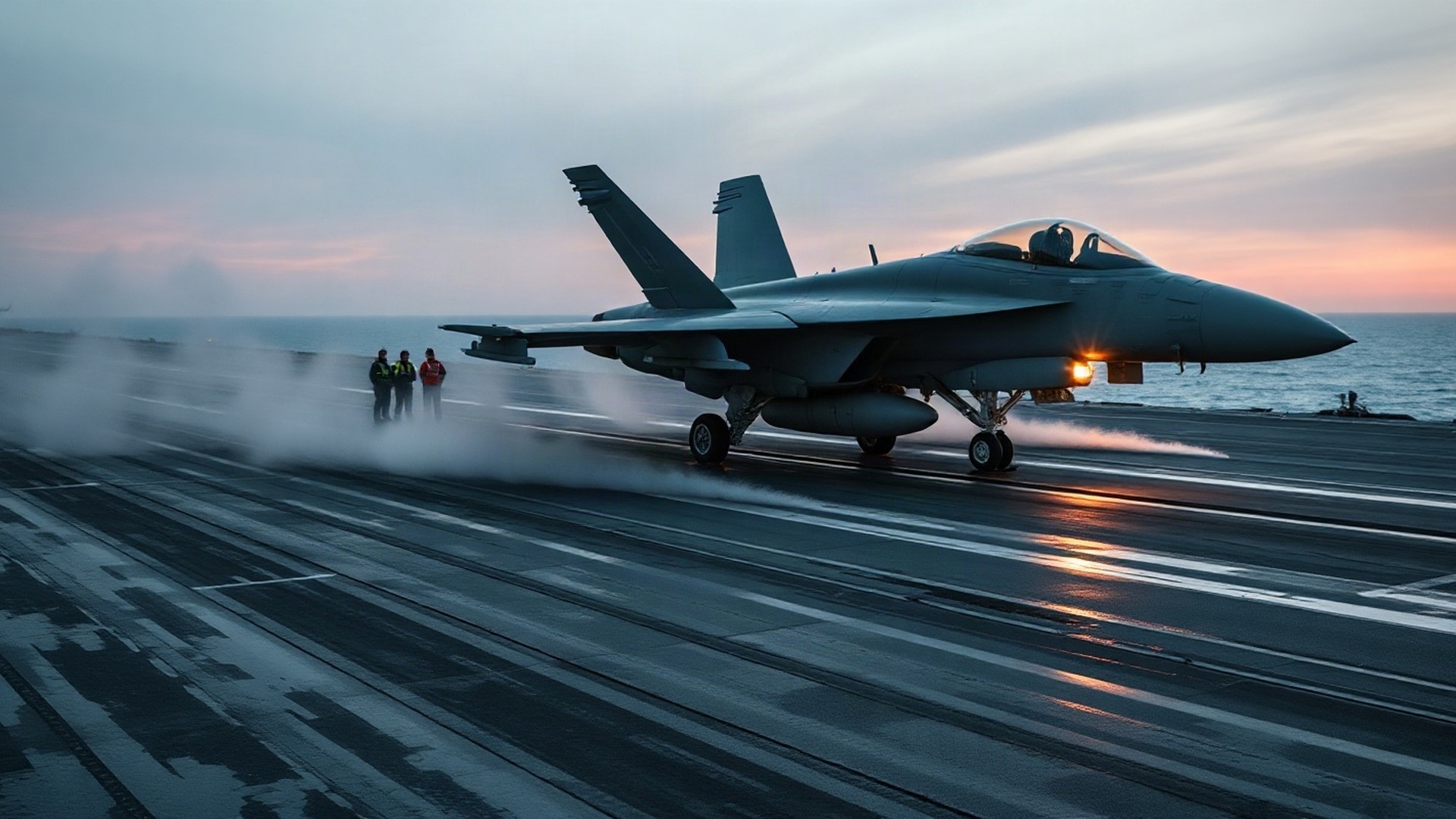
For a year the Pentagon tried to kill this program. In June 2025 it moved to freeze F/A-XX, the Navy's next-generation fighter, arguing the industrial base could not build two advanced fighters at once. Congress kept it alive, and on Sept. 29, 2026, the Navy handed Boeing the contract.
Boeing is the plane company. It builds the 737s and 787s most of us fly on, plus fighters, tankers, satellites and Air Force One. That defense arm now holds both of America's sixth-generation fighter programs.
The award is more than $20 billion and covers full-scale development. Deliveries begin in the 2030s, when F/A-XX replaces the Navy's Super Hornets and Growlers and flies alongside the F-35C.
It is Boeing's second sixth-generation win, with Northrop Grumman the losing finalist, after the Air Force picked Boeing for F-47 in 2025. Boeing's defense chief, Steve Parker, said "delivering two advanced fighters in parallel was always our plan," and that Boeing invested accordingly.
| Price LIVE | $187.68 |
| Market Cap | $148B |
| Forward P/E | 45.9 |
| Total Revenue (TTM) | $94.0B |
| 52-Week Low | $176.77 |
| 52-Week High | $254.35 |
| Analyst Consensus | Strong Buy (26 analysts) |
| Analyst Target Mean | $273.12 |
Now the part that reaches past aviation. The sixth-generation fighter is built to command autonomous drone wingmen, not to fly alone. The Pentagon says F/A-XX will be interoperable with Collaborative Combat Aircraft and lift every CCA it teams with.
The Navy's next fighter is an autonomy and mission-software problem wearing a titanium shell. Acting as an airborne controller for advanced drones is a core mission, and the Navy is firming up its CCA plans.
Development work is like catering a wedding at a fixed price. If twice as many guests show up, the caterer eats the difference. Boeing ate it on the KC-46A tanker and the VC-25B Air Force One.
Both losses sit in Boeing Defense, Space & Security, the point of this story. Fiscal 2025 revenue there was $27.2 billion, up 14%, at a negative 0.5% operating margin. The fourth quarter alone carried $0.6 billion of KC-46A tanker losses.
The second quarter of 2026 looked similar: $7.5 billion of revenue, up 13%, at a negative 0.2% operating margin. That included $280 million of VC-25B losses, with first delivery now pushed to 2028. Backlog is a record $85 billion, which is a promise, not a receipt.
If you have watched a stadium drone show, you have seen the coordination problem this jet is built to run. Put that at combat speed, with weapons.
Boeing is building a secure factory it calls the largest in the U.S. The Super Hornet line in St. Louis is winding down, so a plant without a program becomes a cost center.
The driver that re-rates this equity is not another award headline; it is the defense segment printing a positive operating margin. At roughly 46 times forward earnings, Boeing is valued on a company that stops losing money, not on defense margins.
Shares sit near the low end of their 52-week range, roughly a quarter below the January high. On Sept. 28 the FAA delayed 737 MAX 10 certification over a new software issue, and the stock fell about 7% in a session.
The bear case, argued the way a short-seller would argue it: Boeing won a trophy it may not be able to carry. Two clean-sheet stealth fighters at once is the hardest job in aviation, run by a segment that lost money on $27.2 billion of revenue last year.
Air Force Gen. Dale White repeated the industrial-capacity worry about F/A-XX and F-47 two weeks ago. Adm. Daryl Caudle, the Chief of Naval Operations, called the industrial base "compressed," and said the Navy has to learn to walk and chew gum with aircraft.
What proves the bears right is one number: that segment's operating margin. If it stays negative in the fiscal 2026 full-year print beside record backlog and two new fighter programs, the award was a liability dressed as a trophy.
The Pentagon is not pretending this is routine. Michael P. Duffey, its acquisition chief, said the platform "represents a crucial, non-negotiable investment in America's national security," and promised absolute air superiority.
The next checkpoint is the earnings report this fall: the defense segment's operating margin. Crossing zero is when this award stops being a headline and starts being earnings. The signals are a quiet charge line and Air Force One in 2028.
Boeing does not have a demand problem. It has record backlog, a second sixth-generation fighter and a factory rising in St. Louis. Backlog tells you what Boeing will build; margin tells you whether winning was worth it.
Disclosure: The Signal holds no position in BA. Positions may change. This is not financial advice.