You're out here watching retail investors chase pure-plays, watching companies bleed their capital dry trying to win the direct-to-device (D2D) cellular war. But if you want to read the board correctly, you stop looking at the soldiers and start looking at who is supplying the heavy artillery.
Enter MDA Space (TSX: MDA).
While the high-risk consumer network operators constantly dilute shareholders to fund their cash-burning paper constellations, the smart money is tracking the prime contractor actually manufacturing the infrastructure. MDA Space isn't a startup; they are a Canadian space heavyweight with a 55-year track record and over 450 successful missions under their belt. They are the undisputed arms dealer in the global space race, turning visionary talk into cold, hard orbital hardware.
Here is the deep dive into their tech, their brutal revenue growth, their massive backlog, and how they are single-handedly evening the playing field.
| Q1 2026 Revenue | $464.1M (+32.2% YoY) |
| Adjusted EBITDA | $90.6M (19.5% margin) |
| Backlog | $3.7 Billion |
| Market Cap | ~C$8.2B |
| Stock Price | C$59.11 |
| Blue Canyon Acquisition | $620M (all-cash) |
| Satellites Produced/Day | 2 |
The Growth Engine: Revenue and The Fortress Backlog
Let's talk numbers, because in the D2D space, the difference between the pure-plays and MDA is the difference between pitching a dream and depositing a check.
While competitors are burning cash, MDA is a revenue-generating machine. In the first quarter of 2026, MDA posted revenues of $464.1 million, a massive 32.2% year-over-year jump. Their adjusted EBITDA surged 32.1% to $90.6 million, running at a highly profitable 19.5% margin.
But the real flex is the visibility. MDA ended Q1 2026 sitting on a fortress-like $3.7 billion backlog. This isn't speculative income; this is contracted manufacturing that guarantees revenue visibility through 2026 and well into the future. They don't have to hope consumers buy a $15/month satellite cell plan; they get paid billions up front to build the grid.
The Tech Edge: Custom Silicon and Direct Sampling
You want to know why MDA is positioned as the kingmaker of the D2D sector? It's what is under the hood. MDA isn't just bolting together off-the-shelf parts; they own the core silicon. They are engineering the MDA AURORA line, a software-defined digital satellite powerhouse.
- The Prime 2.0 Chip: MDA designs their own space-grade ASICs. These custom chips process data right at the antenna, allowing the system to form and steer hundreds of beams simultaneously to hit exact locations on the grid.
- Direct Sampling Muscle: In the higher-frequency Ka-band, their tech utilizes direct sampling to steer beams without needing to convert to intermediate frequencies first. The result is a lighter, more lethal, lower-cost bird that requires less power.
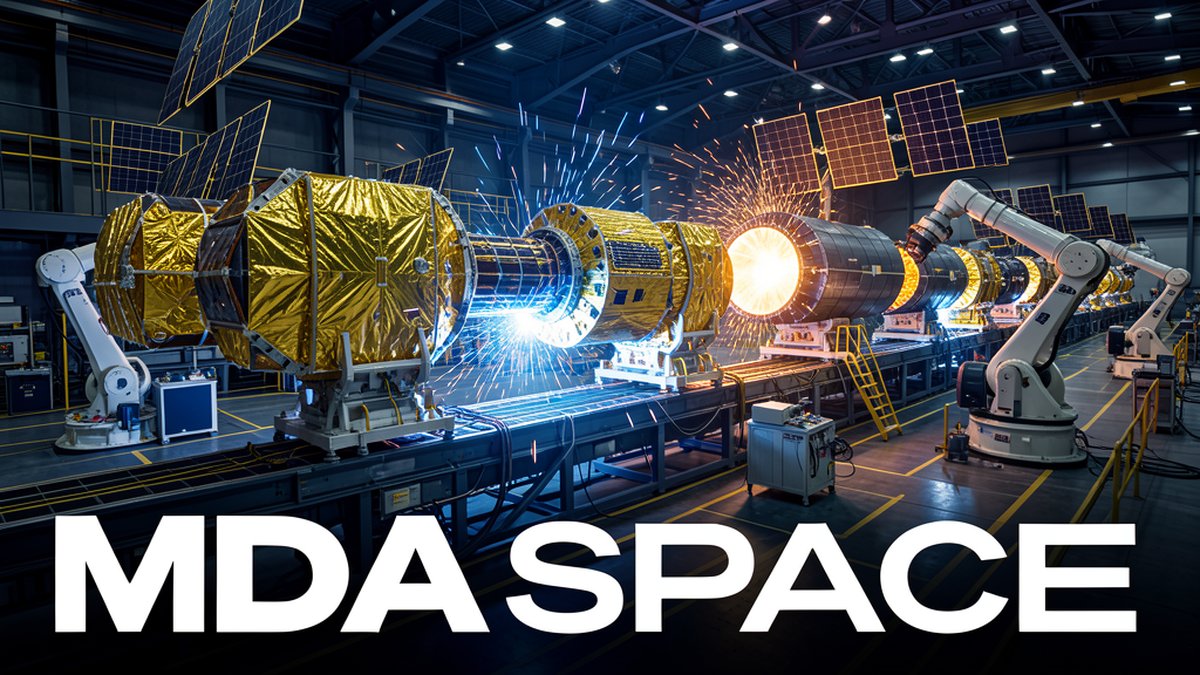
- The Assembly Line: They scale this tech through a massive Montreal facility leveraging Industry 5.0 robotics. This automated powerhouse spits out two fully assembled satellites every single day.
- Interoperability: These satellites are fully compliant with 3GPP 5G non-terrestrial network (NTN) standards. This means terrestrial smartphones can seamlessly connect without needing hardware modifications.
Where ASTS Fits Into This Picture
This is where AST SpaceMobile ($ASTS) enters the frame — and it's not as a competitor, but as proof the thesis works.
ASTS is building its own BlueBird constellation — the only space-based cellular network capable of connecting standard smartphones at broadband speeds. With ~$31 billion in market cap and a stock trading around $80, the market is already pricing in massive D2D adoption. ASTS is the pure-play that retail loves because the vision is clear: kill dead zones forever.
But the bottleneck isn't the vision; it's the manufacturing. ASTS is vertically integrating, building their own satellites — which is exactly the model that validates MDA's business. The D2D market is so enormous that no single constellation builder can satisfy the demand. Legacy telecoms like AT&T, Verizon, and T-Mobile need partners, and MDA is the one factory that can produce the 3GPP-compliant multi-beam satellites at scale. ASTS proves the demand exists; MDA proves the supply can be built.
Think of it this way: ASTS is the product, MDA is the factory that builds the factories.
The EchoStar Drama: Surviving the SpaceX Crossfire
If you want proof of MDA's resilience, look at how they handled the biggest tectonic shift the D2D market has seen to date.
In August 2025, EchoStar selected MDA as the prime contractor to build their new LEO constellation. It was a mammoth $1.3 billion (approx. C$1.8 billion) initial contract for over 100 AURORA satellites, with options that could have scaled it up to 200 satellites and $2.5 billion.
But the game changes fast. Out of nowhere, Elon Musk's SpaceX swooped in and struck a $17 billion deal to buy EchoStar's wireless spectrum licenses. Suddenly, EchoStar terminated the MDA contract due to this massive strategic pivot.
Retail panicked. MDA's stock took a rapid 20% hit, dropping from roughly $44 down to $35. But read the fine print: MDA stated the termination was completely unrelated to their performance, and they will be fully compensated for all termination costs and fees. Instead of bleeding out, MDA simply collected their cancellation check and immediately pivoted their manufacturing capacity back to their multi-billion dollar backlog. That is the power of being the arms dealer — you get paid even when the generals change their minds.
The Checkmate Move: Acquiring Blue Canyon Technologies
MDA isn't just defending its turf; it is actively conquering new territory. On June 19, 2026, MDA executed a ruthless expansion play by signing a definitive agreement to acquire Colorado-based Blue Canyon Technologies (BCT) in a $620 million all-cash transaction.
Here is why this acquisition is a masterstroke:
- The US Foothold: BCT gives the Canadian-based MDA a massive, immediate strategic footprint inside the highly lucrative U.S. defense market.
- The Talent and Infrastructure: The deal brings over 400 skilled employees and two active manufacturing facilities located in the Denver aerospace hub under the MDA umbrella.
- The Pipeline: BCT isn't a startup. They were previously part of RTX's Raytheon business, boasting an 18-year history and over 85 spacecraft already launched. This instantly injects an estimated $3.5 billion into MDA's opportunity pipeline.
The Verdict
By supplying this massive, multi-beam, 5G-compliant tech to the rest of the world, MDA is single-handedly evening the playing field. They are giving the legacy telecom giants the heavy artillery they need to go head-to-head with monopolies like SpaceX.
While companies like ASTS take on the immense execution risk of launching and managing consumer networks, MDA Space steps back. They secure the multi-billion dollar backlogs, buy up strategic U.S. infrastructure, mass-produce the fleets, and cash the checks.
Keep your eyes on the supply chain, because when the orbital war kicks off, the arms dealer always gets paid.
Disclosure: The Signal does not hold a position in MDA or ASTS. This is not investment advice.