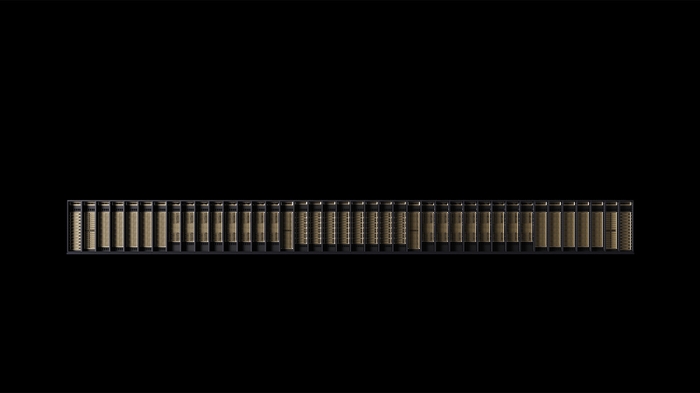
Few product cycles have generated as much anticipation—or revenue—as Nvidia's Blackwell architecture. The B200 GPU, now shipping to hyperscalers worldwide, is the centerpiece of what Jensen Huang calls “the first $1 trillion data center buildout in history.”
| blackwellAspLower | 30000 |
| blackwellAspUpper | 50000 |
| blackwellUnits2026 | 2000000 |
| dataCenterRevFy2027Lower | 105000000000 |
| dataCenterRevFy2027Upper | 120000000000 |
| forwardPeFy2027 | 32 |
| pegRatio | 0.71 |
| grossMargin | 74.9% |
| operatingMargin | 0.62 |
| forwardPE | 17.03 |
The Blackwell B200: Specs, Pricing, and Production
The B200 packs 208 billion transistors on TSMC's 4NP process, delivering 4.5 PFLOPS FP8 Tensor Core performance (2.5x vs H100), 192 GB of HBM3e memory at 8 TB/s, and NVLink 5.0 at 1.8 TB/s per GPU. Enterprises are paying $30,000–$50,000 per GPU, with DGX B200 systems north of $300,000. Demand outstrips supply: lead times run 36–52 weeks. Current estimates point to roughly 1.5–2 million B200 units shipping in calendar 2026, implying over $50 billion in Blackwell GPU revenue alone. TSMC's CoWoS-L packaging remains the primary bottleneck, though additional capacity from Amkor's new Arizona plant is expected in H2 2026.
Hyperscaler Demand: Who's Buying and How Much?
The ramp is driven overwhelmingly by the four major US hyperscalers, all accelerating CapEx for 2026:
- Microsoft — deploying B200s across Azure for Copilot, Bing, and OpenAI inference, with AI infrastructure spend tracking toward $60B+
- Google — adopting Blackwell alongside internal TPU v6, with 2026 CapEx guided at $55B+
- Amazon — offering B200 through EC2 P6, SageMaker, and Bedrock, with CapEx expected to exceed $65B
- Meta — committed to Blackwell for Llama 4 training and recommendation systems, with CapEx guided to $40B+
Beyond the hyperscalers, enterprise adoption is accelerating across financial services, healthcare, and energy. The “sovereign AI” wave—Japan, India, Saudi Arabia, and the UAE building national AI supercomputers—adds another demand layer.
Competition: AMD, Cerebras, and Custom ASICs
AMD's /ticker/AMD MI350, based on CDNA 4 and shipping late 2025, narrows the raw performance gap with up to 2.3x FP8 improvement over MI300X and 288 GB of HBM3e. AMD guided $15–18B in data center GPU revenue for 2026, but supply remains a major headwind: TSMC CoWoS allocation for AMD is roughly one-sixth of Nvidia's. ROCm software has made meaningful strides but still lags CUDA.
Cerebras has carved an inference niche with wafer-scale CS-3, claiming up to 10x lower latency vs H100 for LLMs, but remains a small player ($800M–1.2B estimated 2026 revenue). The more credible long-term threat is custom ASICs: Google's TPU v6, Amazon's Trainium 3, and Microsoft's Maia 100 are designed to reduce Nvidia dependence for specific internal workloads. We estimate custom ASICs will reach 15–20% of AI accelerator spending by 2028, up from ~8% today.
NVDA Valuation: The ‘70% CAGR’ Debate
Nvidia's data center revenue has grown from $15B in FY2024 to an estimated $78B in FY2026, on track for $105–120B in FY2027. Gross margins sit at 78–80% with operating margins near 62%. At ~$1,150, /ticker/NVDA trades at ~32x forward P/E with a PEG ratio of ~0.9x — defensible but not cheap.
The bull case argues AI compute is a structural multi-decade shift. The bear case points to inference efficiency gains, model commoditization, and capex ROI concerns that could trigger a correction. Our view: the bull case holds for 12–18 months, but the “70% CAGR” will decelerate to 25–35% growth from FY2028 onward as the base grows and competitive alternatives gain share.
“Nvidia’s competitive moat — spanning hardware, networking, and the CUDA ecosystem (4M+ developers) — will limit share losses to non-core workloads where hyperscalers can achieve meaningful savings through vertical integration.”
Beyond Blackwell, the Rubin architecture (2027, TSMC N3, up to 300B transistors, HBM4) and Spectrum-X networking (a $10B+ opportunity) extend the runway. We remain bullish on NVDA with a clear stop-loss framework — the franchise remains the defining bet of the AI era.
Disclosure: The Signal may hold positions in securities mentioned. This article is for informational purposes only and does not constitute investment advice.