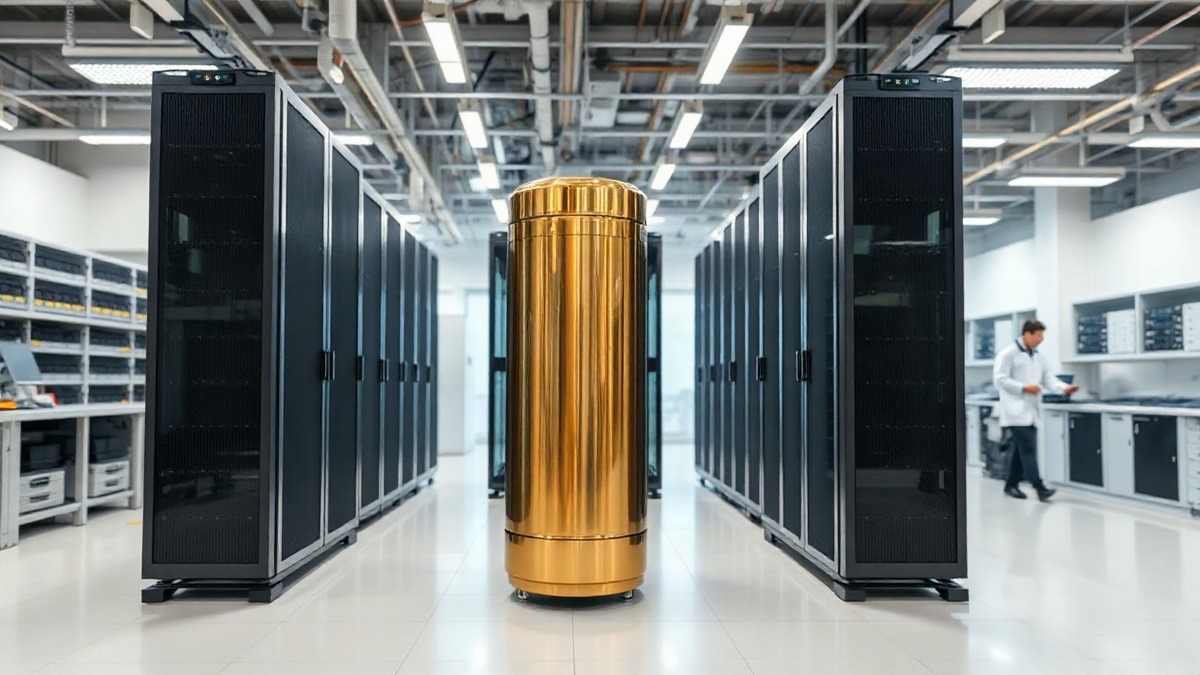
Nvidia builds the engines. Broadcom builds the highway, the power grid, and the entire city around them.
| marketCap | $1.83 Trillion |
| forwardPE | 19.93 |
| trailingPE | 63.94 |
| aiInfrastructurePlatform | $35 Billion |
| vmwareAcquisition | $69 Billion |
| keyCustomers | Google, Meta, Amazon |
That's the AI infrastructure story nobody tells you. Everyone's obsessed with GPUs — Blackwell this, Rubin that, Jensen's latest leather jacket. Meanwhile, $AVGO quietly amassed an $1.83 trillion empire selling custom AI chips, networking silicon, and virtualization software to every hyperscaler that matters. The moat sits at the intersection of three AI trends simultaneously.
Let the numbers hit: $1.83 trillion market cap. Forward P/E of 19.93. That's cheaper than Nvidia, cheaper than AMD, cheaper than most SaaS companies. The trailing P/E sits at 63.94 — VMware acquisition accounting still flowing through — but forward metrics tell the real story. This thing is undervalued.
The Custom Chip Kingdom
Broadcom doesn't sell chips off a shelf. It designs custom ASICs for individual hyperscalers. Google's TPU? Broadcom designed it. Meta's MTIA chips? Broadcom. Amazon's next-gen AI accelerators? Broadcom is deep in those conversations.
These aren't commodity parts you can swap next quarter. They're purpose-built for a single customer's specific AI workloads. Once a hyperscaler commits to a Broadcom-designed architecture, switching costs become astronomical. You can't just rip out your TPU infrastructure and drop in someone else's chip. That's not a product — that's a moat.
The Networking Layer Nobody Sees
AI data centers aren't just racks of GPUs. They're massive networking puzzles — thousands of chips communicating at mind-melting speeds. Broadcom owns that layer: switches, routers, optical interconnects. Every time a hyperscaler spends $10 billion on a new AI data center, Broadcom collects a check for the custom ASICs inside AND the networking infrastructure connecting everything. It's a double-dip on every AI infrastructure dollar.
The VMware Secret Weapon
When Hock Tan dropped $69 billion on VMware in 2023, the market scratched its head. A semiconductor company buying virtualization software? Now the picture is clear. VMware sits inside virtually every enterprise data center. As companies build hybrid AI infra — on-prem plus cloud — VMware is the orchestration layer. The subscription conversion is driving real software revenue growth that's exceeding expectations. That's the triple threat.
The $35 Billion Signal
This week, Apollo, Blackstone, and Broadcom launched a $35 billion AI infrastructure platform. That's not a press release about future possibilities. That's $35 billion in committed capital — with Broadcom as the foundational silicon and networking partner.
When the two biggest alternative asset managers on Earth write a $35 billion check to build AI infra and they pick Broadcom, the market should pay attention. This is institutional money betting Broadcom's role is structural, not cyclical.
The Bottom Line
Broadcom isn't a bet on one AI trend. It's a bet on three — custom silicon, networking fabric, and enterprise virtualization — wrapped in a single stock at a forward multiple that looks cheap against the AI growth runway. The custom ASIC business alone is a generational moat. Add networking dominance and VMware software revenue, and you've got a business that wins whether the hyperscalers build with GPUs or custom silicon.
Everyone talks about Nvidia. But while you're watching the GPU war, Broadcom is quietly collecting tolls on every lane of the AI highway. And at 19.93x forward earnings, that toll booth is still on sale.
Disclosure: The Signal does not hold a position in AVGO. This is not investment advice.