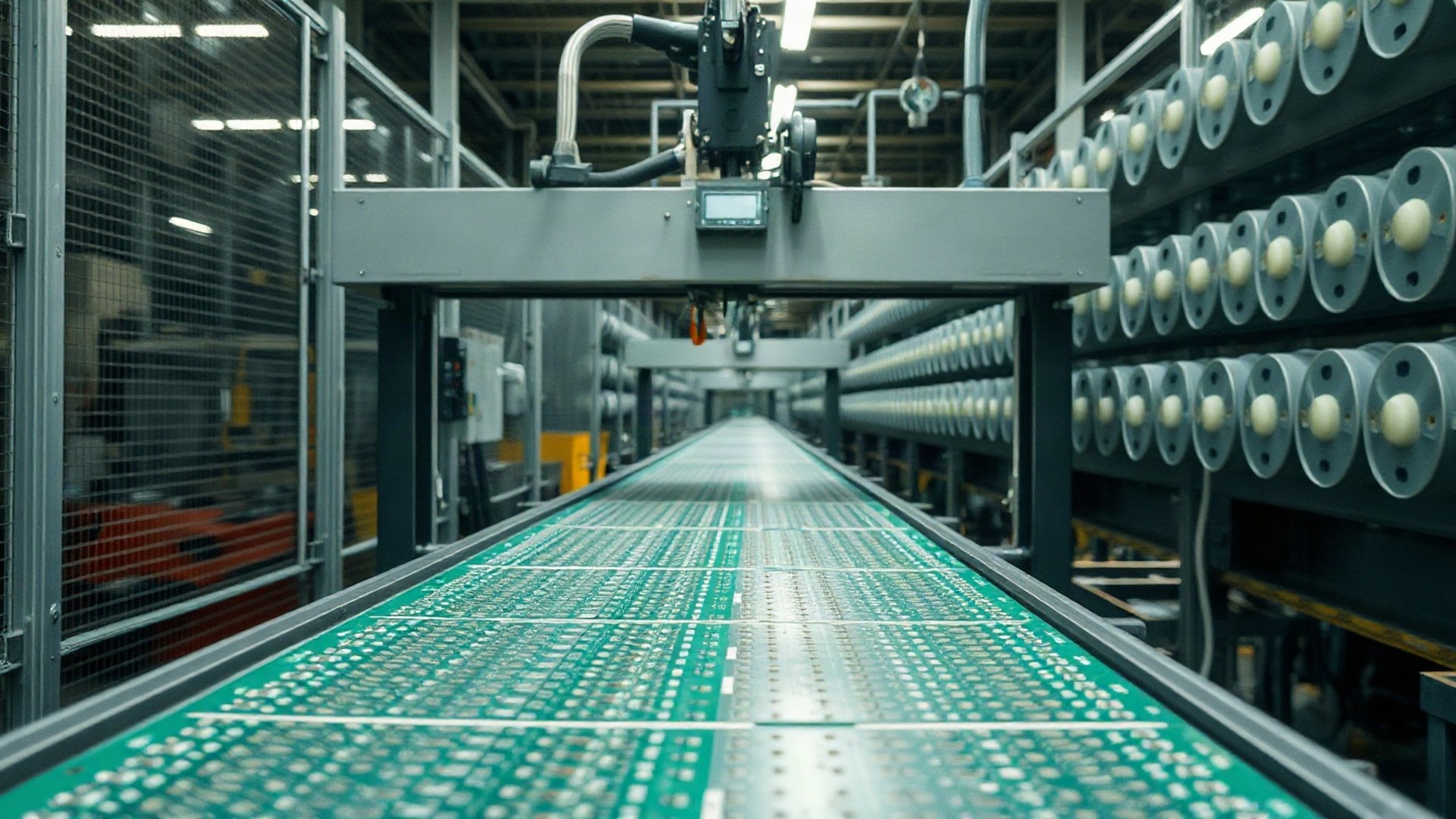
Every time you prompt an AI chatbot or stream video from the cloud, code runs on physical silicon sitting inside a metal chassis. That hardware does not assemble itself. Someone has to source the power supplies, run the optical cables, bolt the chassis into an eight-foot steel frame, and test the whole system before it ships to a data center.
Celestica is the industrial muscle doing that heavy lifting. Think of tech giants like architects drafting high-end blueprints; Celestica is the general contractor pouring the concrete and running the wiring. The Toronto-based manufacturer takes specs from cloud hyperscalers and turns them into 800-gigabit switches, custom AI servers, and complete server racks. Its Connectivity & Cloud Solutions unit brings in 84% of total sales, making the company an indispensable physical gateway for the entire AI buildout.
| Price | $246.65 |
| Market Cap | $31.1B |
| Forward P/E | 11.1x |
| Total Revenue (TTM) | $18.2B |
| 52-Week Low | $244.51 |
| 52-Week High | $474.03 |
| Analyst Consensus | Strong Buy (22 analysts) |
| Analyst Target Mean | $468.36 |
The speed of that buildout showed up in the third-quarter numbers. Revenue leaped 83% year over year to $5.83 billion, while adjusted operating margins hit a record 8.5%. The flagship Connectivity unit doubled its revenue to $4.87 billion, powered by data center switching and hyperscaler compute orders. The company also builds its own proprietary designs through its Hardware Platform Solutions group, which grew 70% to roughly $2.3 billion.
Then management dropped a forecast that stunned the street. For 2027, Celestica now projects $40 billion in revenue, roughly 90% growth over an already boosted 2026 target. That outlook blew past consensus estimates by billions. The chief executive described the current market as an infrastructure supercycle, noting that preliminary customer forecasts for 2028 look meaningfully higher still.
Yet the cost of funding that expansion triggered an immediate cash squeeze. While raising full-year revenue targets to $21 billion, Celestica cut its 2026 free cash flow forecast from $600 million down to $460 million. Because the company generated over $412 million in free cash during the first nine months, the updated target implies fourth-quarter free cash flow of only about $48 million. Management warned that 2027 will see a net use of cash as capital expenditures climb toward $2 billion.
That divergence gets to the core dynamic of physical manufacturing. To deliver billions of dollars in finished server racks next quarter, you have to buy billions of dollars in memory chips, processors, and circuit boards today. Inventory spiked 120% year over year to $4.5 billion, far outrunning quarterly revenue growth. Celestica leaned heavily on its vendors to bridge the gap, pushing accounts payable up 200%. Growth on this scale behaves like a working capital sponge, drinking up liquidity before generating receipts.
That dynamic explains why the equity trades where it does. Shares tumbled on Monday to finish roughly 48% below their June peak before staging a sharp premarket rebound. Even after that bounce, the stock trades at a low-teens multiple of guided 2027 earnings. That low multiple reflects a persistent valuation ceiling: 9% operating margins belong to a contract manufacturer, not an asset-light software platform. For the stock to re-rate, Celestica must prove that higher-margin, proprietary hardware designs can dominate the revenue mix and that today’s inventory surge will convert into cash by 2028.
A dedicated short seller would argue that Celestica is taking balance-sheet risks for customers who hold all the cards. Customer concentration is intense: a single buyer accounts for 35% of total revenue, and the top ten generate 85%. If that anchor customer delays an architecture shift or shifts volume to a rival, Celestica gets stuck carrying expensive components. Stretching payables by 200% works only as long as suppliers allow generous terms. Meanwhile, heavy capital expenditures will collide with a modest depreciation base, creating an earnings drag down the line. Add in an equity raise from August that diluted investors well above recent trading prices, and the risk is clear: the company is burning external capital to chase low-margin assembly.
The demand for physical computing infrastructure is undeniably real, but assembling the future requires someone to finance the parts upfront. Celestica has proved it can win the biggest server contracts in tech. Now it has to prove it can turn those shipments into actual bank deposits.
We are watching fourth-quarter free cash flow conversion to see whether inventory turns into collections before next year's capital spending ramps up.
Disclosure: The Signal holds no position in CLS. Positions may change. This is not financial advice.