NASA just launched its most powerful space telescope ever — and the company that built its eye is the one Wall Street has been ignoring. The Nancy Grace Roman Space Telescope rode a SpaceX Falcon Heavy off the pad at Cape Canaveral this morning, clean and on target, with the world's space press watching. Roman's mission: rewrite the map of the universe, one giant catalog at a time.
| LHX Price | $262.82 |
| Market Cap | $48.9B |
| Forward P/E | 19.5 |
| Total Revenue (TTM) | $22.9B |
| 52-Week Low | $258.54 |
| 52-Week High | $379.23 |
| Analyst Consensus | Buy |
| Analyst Target Mean | $339.50 |
Here's L3Harris in plain English. It builds the eyes, ears, and voice of the modern military — and, it turns out, of NASA's newest telescope. Its hardware connects space, air, land, sea, and cyber for national security customers: space optics and satellites, sensors and intelligence, communications, electronic warfare, avionics, and the solid rocket motors behind U.S. missile defense.
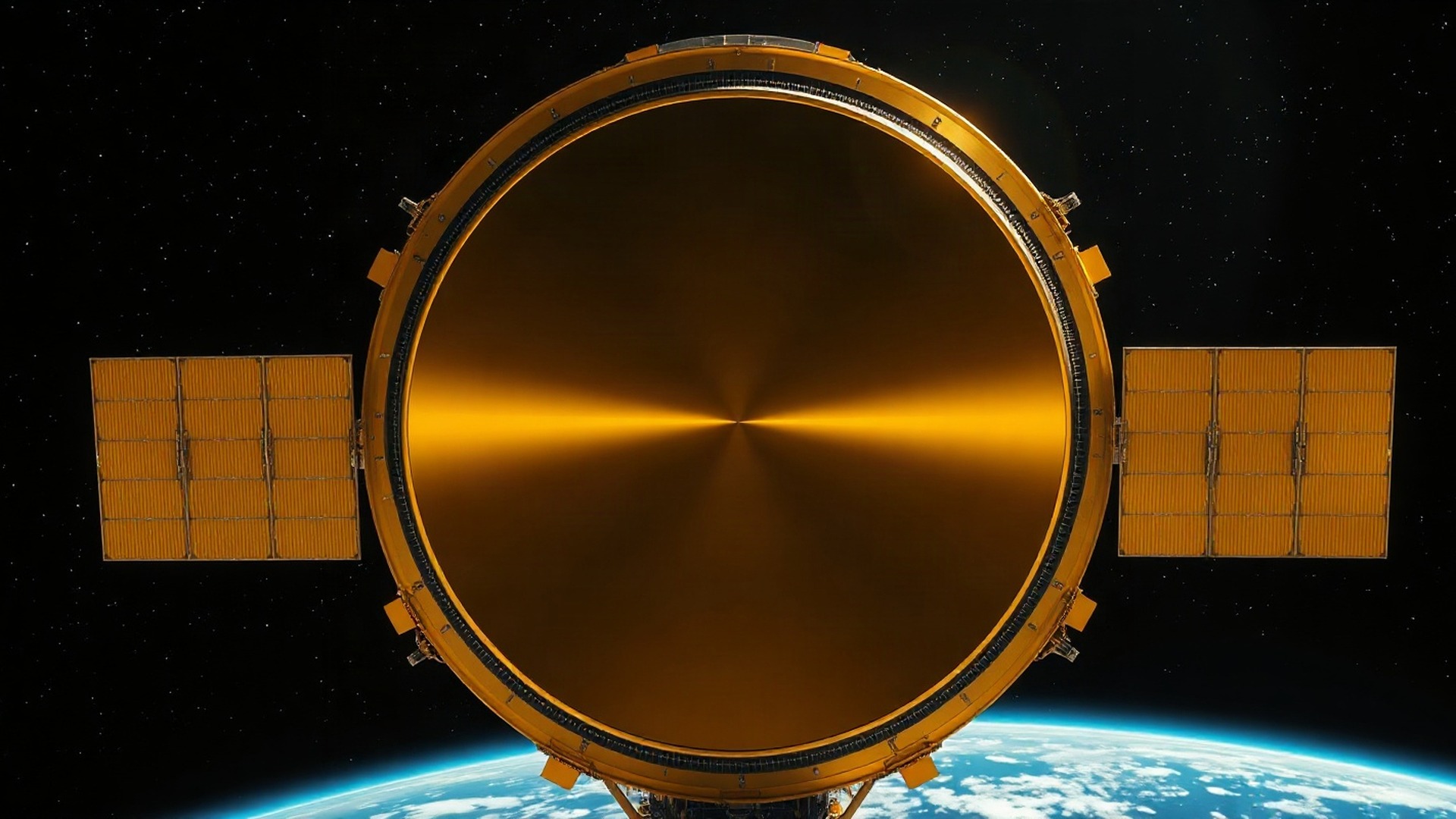
Roman's eye is L3Harris's work. The company built the telescope's 2.4-meter Optical Telescope Assembly — Hubble-class aperture with a game-changing field of view — plus the radiation-hardened electronics that keep it thinking a million miles from Earth. That's where Roman will live: a million miles out, past the moon, with no Earth glare in the way. Hubble sent us postcards of the cosmos. Roman is built to photograph the whole neighborhood.
The numbers are staggering. L3Harris says that eye "will survey the cosmos 1,000 times faster than the Hubble Space Telescope" — and is expected to unveil billions of galaxies, hundreds of millions of stars, and more than 100,000 distant worlds. Jeff Hanke, president of Space Systems within the company's Space & Mission Systems segment, called the launch a milestone more than a decade in the making — the payoff of the L3Harris–NASA Goddard partnership.
Roman's first act is three surveys that read like the greatest hits of astrophysics.
It will peer straight through the Milky Way's dense galactic center to compile the largest astronomical catalog ever built. It will scan roughly 12% of the entire sky in under 18 months to measure how fast the universe is expanding. And it will study supernova explosions from as far back as 8 billion years ago — reading the universe's diary in real time.
For L3Harris, Roman is the latest chapter in a quiet franchise. This is the company behind hardware on James Webb, the Mars Perseverance and Curiosity rovers, the GPS constellation, and the International Space Station. When America needs something that sees, talks, or protects — in orbit or on the battlefield — L3Harris is usually in the payload.
So why does the stock sit near its one-year low, roughly 30% below last year's high? Look at the summer the company just had.
CEO Chris Kubasik was ousted in mid-August over a code-of-conduct violation, forfeiting roughly $45 million in the process. Sam Mehta — the executive who previously led the very Space & Mission Systems unit that built Roman's eye — was named president and CEO on the spot. Shares still slid about 4.6% the next session despite reaffirmed guidance.
There was portfolio news to digest, too. It closed the sale of its Space Propulsion, Power, and Electronics units to AE Industrial Partners in early August — the business now lives on as Rocketdyne. And the planned IPO of its Missile Solutions business, home of the PAC-3 and THAAD solid rocket motors, is paused until mid-2027. Lots of moving parts. None of them touch the core franchise.
Now flip the story over and look at the fundamentals. More than $22 billion in trailing revenue, and a record backlog near $42 billion — years of work already sold. Guidance raised at the late-July print, with roughly $3 billion of free cash flow expected this fiscal year and a dividend yield near 1.9%.
Wall Street still says Buy: 12 analysts, with a mean price target around $339.50 — roughly 29% above where the shares trade today. This is not a broken company. It's a misunderstood one.
Zoom out and the story gets bigger. Space is the next infrastructure frontier — where the next decade of government and commercial money gets spent, from missile warning to internet constellations to science that rewrites textbooks.
Roman alone will compile the largest astronomical catalog ever created, and every mission like it needs hardware that can survive the trip. That makes L3Harris the pick-and-shovel of the space-and-defense boom — optics, satellites, sensors, and motors that NASA and the Pentagon both end up buying. That's the part you can invest in.
Here's the bottom line. The company that built the eye of humanity's most powerful telescope is sitting near its lows — priced like a problem child despite a record backlog and resolved CEO drama. The messy summer is in the price; the telescope is not. That gap is the signal.
Disclosure: The Signal holds no position in LHX. Positions may change. This is not financial advice.