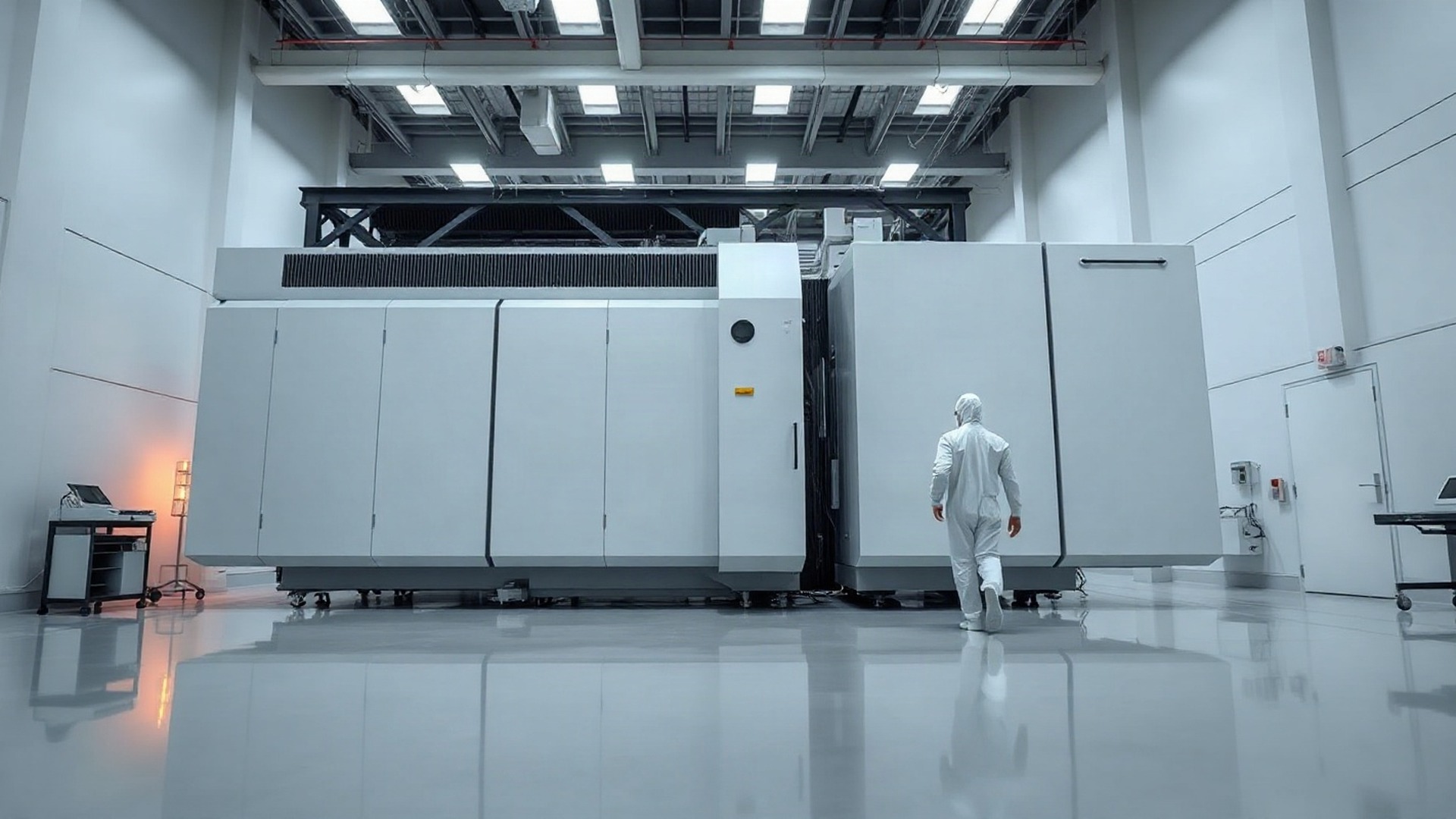
Every time you ask your phone to edit a photo or pay twenty bucks for an AI subscription, you are paying rent to a single Dutch company. ASML builds lithography machines. These bus-sized scanners use extreme-ultraviolet light to carve impossibly tiny circuit patterns onto silicon wafers. If a factory makes an advanced AI chip, it owns an ASML system. If it does not own one, it cannot make the chip. The company is the only landlord on the block, controlling 100% of the market for the cutting-edge gear.
| Price LIVE | $1,717.76 |
| Market Cap | $658.3B |
| Forward P/E | 29.16 |
| Total Revenue (TTM) | €39.47B |
| 52-Week Low | $946.11 |
| 52-Week High | $1,999.96 |
| Analyst Consensus | Strong Buy |
| Analyst Target Mean | $2,095.52 |
An advanced scanner costs hundreds of millions of dollars and takes months to assemble. Because the engineering is so complex, chipmakers like TSMC and Samsung have to plan their factory floors years in advance. When ASML reported record earnings this week, it dropped a detail that should have lit the sector on fire. Chief Executive Officer Christophe Fouquet revealed that customers have already started asking for machine deliveries in 2029 and 2030. Even better, ASML admitted its planned production for 2027 and 2028 is already too small to meet demand.
You would think Wall Street threw a parade. Instead, the US-listed stock opened down over 2% and spent the morning fighting just to get back to flat. The Philadelphia Semiconductor Index was sliding, and skittish traders caught a tiny scratch on the surface: quarterly revenue of €11.66 billion landed a fraction below the €11.72 billion estimate. When you run the toll booth for global computing, a hairline revenue miss will trigger headlines, even when net profit smashes forecasts at €4.96 billion.
Here is the twist that explains the stock's muted pulse. ASML used to be the market’s favorite window into the real health of the AI boom through its quarterly net bookings figure. Then, after 2025, management killed that disclosure, pushing backlog updates to once a year. The most recent visible backlog number sits frozen at €38.8B from late 2025. By pulling the blinds down, ASML forced its stock to trade on general market anxiety rather than verified incoming orders. You cannot verify order book momentum when the book is locked in a drawer.
For the shares to re-rate from here, management must turn informal customer curiosity into hard commitments. The key lever is ASML’s capacity target for 2028. Fouquet noted the company is looking at expanding 2028 output beyond the 30% jump it previously promised. If ASML formally hikes that capacity plan, it commits real capital to back up customer talk, directly raising future earnings power. Right now, trading around 29 times forward earnings, the market prices ASML like a standard cyclical supplier having a banner year rather than an indispensable monopoly at the base of a structural shift.
A dedicated short seller would point out that this quarter's earnings jump rested on a less durable foundation. While system sales hit €8.4 billion across 121 shipped tools, gross margin expanded to 57.5% largely because of Installed Base Management. That service and field-upgrade revenue reached €3.3 billion, beating guidance by roughly €400 million. Servicing machines already sitting on factory floors is high-margin work, but it often works like pulling tomorrow’s new-tool sales into today's maintenance check.
The bear case gets stronger when you look at the product mix. Earlier this year, management projected 2026 memory-related sales would grow over 75%, compared to just over 25% for leading logic chips. Memory is notoriously fickle and hypersensitive to inventory gluts. Asian memory peers just took a beating, with SK Hynix dropping roughly 10% and Samsung down about 7.4% in a single session on fears of overheating prices. High-NA EUV, ASML's next generation of ultra-precise machines, won’t see high-volume manufacturing at TSMC until 2030. If memory capex stumbles before those next-gen tools ramp, ASML's numbers are vulnerable.
What tests the bears is the full-year update arriving in January. That is when ASML must confirm whether it will formally expand its 2028 equipment capacity above the planned 30% lift. Until those factory expansion figures become official, customer interest in 2030 is just polite conversation.
Disclosure: The Signal holds no position in ASML. Positions may change. This is not financial advice.