Your phone took a photo this morning that will still exist in twelve years. So will the copy, the thumbnail, and the backup of the backup. Nobody deletes any of it, and that indifference is one of the most profitable facts in computing.
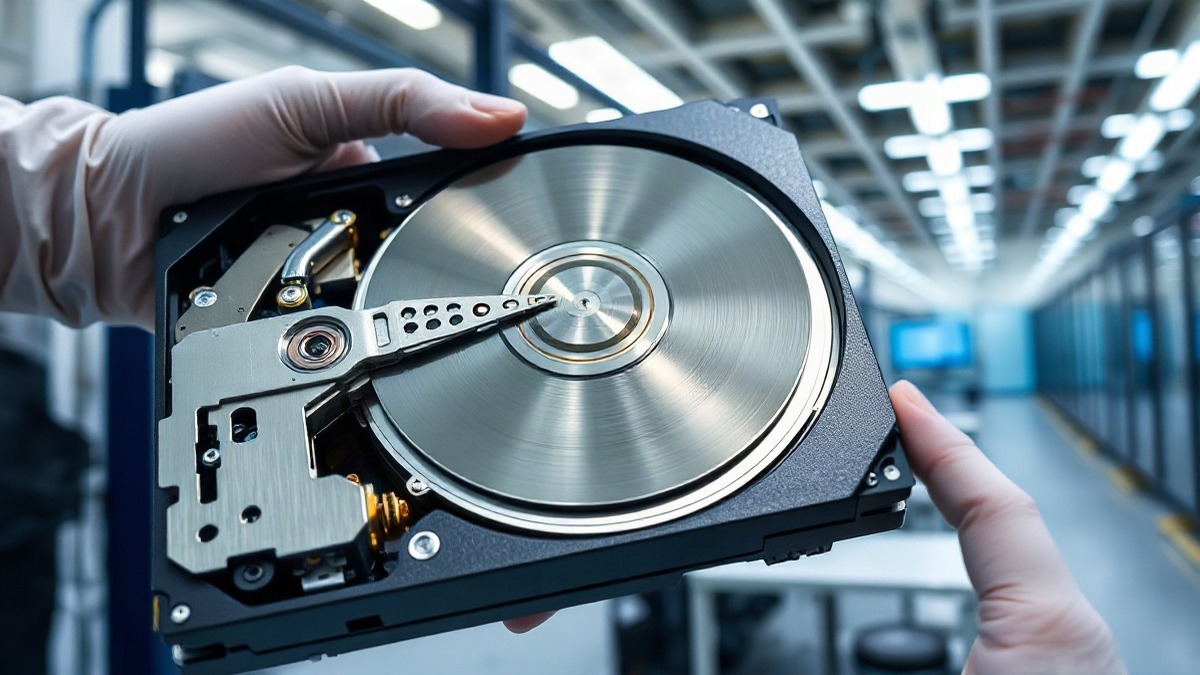
Western Digital builds the boxes that hold it: sealed metal cases full of spinning platters. Hard drives store roughly 80% of the data being generated worldwide. Picture a parking garage, where you add floors or pack cars tighter. WD sells the garage and charges more per space.
In the fiscal fourth quarter that ended July 3, WD grew revenue 44% to $3,747 million. The exabytes it shipped rose 22%, to 231. That gap is the investment case in one line. The drive business isn't selling space anymore, it's selling price.
| Price LIVE | $441.36 |
| Market Cap | $159.1B |
| Forward P/E | 13.90 |
| Total Revenue (TTM) | $12.919B |
| 52-Week Low | $105.32 |
| 52-Week High | $799.87 |
| Analyst Consensus | Buy |
| Analyst Target Mean | $664.92 |
The pricing is real. Two quarters ago, blended price per terabyte was up 9% year over year. Last quarter it ran 18% to 19% higher. Cost per terabyte fell only about 8%, against a 10% long-term target.
That lands on the margin line. Non-GAAP gross margin hit 54.4%, up 1,310 basis points in a year, and operating margin reached 44.2%. Each point of gross margin is worth about $37 million a quarter at this revenue base.
The customer changed first. Cloud buyers now supply 89% of revenue, or $3.3 billion, up 43% year over year. Client PCs are 6% of sales and consumer gear is 5%. WD stopped being a PC cyclical in a data-center costume.
Capacity also runs on a 52-week clock. Customers place orders roughly a year out under long-term agreements that set both price and volume. Those contracts now cover most of 2027, part of 2028 and a slice of 2029. Hyperscalers want to sign for 2030 and 2031, and WD hasn't.
Management is blunt about the constraint: revenue isn't gated by demand, it's gated by supply. In a shortage you don't sell storage, you sell permission to have some.
That's why the roadmap, not the quarterly print, is the re-rate driver. Capacity comes only from areal density, the bits you press into the same spinning metal. Every step up raises what each platter is worth.
The 32-terabyte generation shipped cleanly, and 40-terabyte ePMR and UltraSMR drives are now in volume production with two customers. UltraSMR heads toward 60% of nearline shipments as fiscal 2027 ends. A 44-terabyte HAMR drive is in qualification with four hyperscale customers and ships in the first half of calendar 2027. Fifty-terabyte-plus products follow later that year.
Throughput is the other bottleneck. Capacity drives have never been fast, so inference loads leak to flash at a 6-10x cost premium. Its High Bandwidth Drive, sampling with five customers, doubles that bandwidth, with 4x and 8x in development.
Next quarter WD guides revenue to roughly $4.1 billion and gross margin to 55% or 56%. That midpoint is about 110 basis points better than the quarter just reported, after steps of 440 and 390. The staircase is flattening, and that's where the bear case begins.
Read the long-term agreement like a short seller. WD commits to a base volume below what customers actually want, at a base price, and keeps upside volume for a different price. That turns scarcity into a schedule. Margins then step up on repricing dates instead of on shortage.
Seagate is a generation ahead at the top of the stack. Its Mozaic 4+ drives have shipped up to 44 terabytes to two leading hyperscale customers since March. Seagate grew total exabytes 34% year over year, to 218, against WD's 22%. It prices the leading edge while WD closes the gap with an extra platter.
An analyst on WD's own call noted that a rival's September margin target runs nearly 200 basis points above WD's guide, and management didn't dispute it. WD's reported 54.4% beat Seagate's 52.7% last quarter, so the shortfall is forward-looking. Add input costs. The DRAM and NAND inside every drive have gotten a lot more expensive.
The stock isn't cheap against its own history either. It trades roughly 45% below its 52-week high and more than four times above its 52-week low.
Two things settle the argument. Watch whether HAMR reaches volume with four hyperscalers in the first half of calendar 2027. And watch the September print: a 110-basis-point gross-margin gain confirms the schedule, a bigger one proves scarcity still sets the price.
Disclosure: The Signal holds no position in WDC. Positions may change. This is not financial advice.