As market volatility shakes out weak hands, institutional capital is rotating into structural compounders. We are ignoring the short-term distractions and focusing strictly on the core business drivers—the primary revenue engines that actually generate alpha.
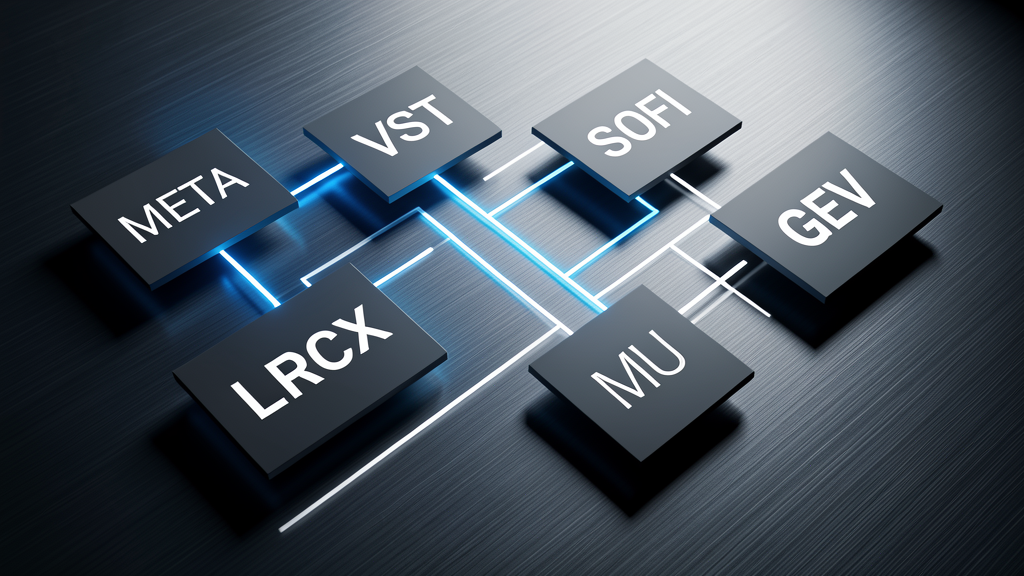
Here is our in-depth breakdown of The Signal's Top 6 Stocks to Accumulate in August:
1. Meta Platforms (META) — The Unrivaled Ad-Monetization Engine
The Core Engine (Why we're bullish): The market loves to debate Meta's capital expenditures on AI infrastructure, but they are missing the immediate, massive payoff. Meta is not building AI just for the sake of computing; they are actively integrating Llama into their core recommendation and ad-auction architecture. This integration is radically improving ad targeting, lowering customer acquisition costs for advertisers, and driving exceptional Return on Ad Spend (ROAS). When advertisers get better returns, Meta commands premium ad pricing.
The Alpha: Meta is the ultimate cash-flow machine. Their core family of apps (Instagram, Facebook, WhatsApp) continues to capture unparalleled global engagement. The sheer volume of high-margin free cash flow generated by this advertising monopoly allows them to aggressively buy back shares while self-funding the largest AI infrastructure build-out in corporate history.
Analyst Target: The street consensus is firmly bullish, with the average 12-month price target sitting between $768 and $827.
2. Vistra Corp (VST) — The Baseload Power & Capacity Market Anchor
The Core Engine (Why we're bullish): You cannot power a 24/7/365 AI data center with intermittent solar or wind. Vistra operates one of the largest competitive fleets of nuclear and natural gas plants in the country. Their primary business—selling reliable, high-density baseload electricity in the deregulated ERCOT and PJM markets—is suddenly the most critical bottleneck in the tech sector.
The Alpha: Vistra's true leverage lies in two areas: direct Power Purchase Agreements (PPAs) with hyperscalers and soaring regional capacity auctions. Recent grid constraints have caused capacity clearing prices to skyrocket, meaning Vistra is generating massive, predictable revenue simply for having plants ready to dispatch power. This provides utility-like downside protection paired with uncapped tech-driven upside.
Analyst Target: Backed by aggressive earnings beats and a lopsided bullish rating distribution, the consensus target sits at $225.00, with street-high estimates reaching $320.00.
3. SoFi Technologies (SOFI) — The Prime Banking Flywheel
The Core Engine (Why we're bullish): Forget the secondary software platforms; SoFi's true edge is its relentless consumer banking flywheel. SoFi is capturing a highly coveted demographic: high-income, prime-credit-score millennials and Gen Z professionals. By offering industry-leading yields, SoFi has built a massive, sticky deposit base that is completely rewiring their balance sheet.
The Alpha: Deposits are fundamentally cheaper than borrowing from warehouse credit facilities. By rapidly expanding its deposit base to over $45 billion, SoFi has drastically lowered its cost of capital. This drives massive net interest margin (NIM) expansion. They are acquiring high-quality members, holding their money for cheap, and cross-selling high-margin lending products (mortgages, personal loans) with minimal default risk.
Analyst Target: The street consensus sits around $21.00 to $22.00, with high estimates from firms like Mizuho pushing toward $29.00 as the balance sheet fundamentals compound.
4. Lam Research (LRCX) — The Essential Wafer Fab Tollbooth
The Core Engine (Why we're bullish): Semiconductor fabrication has hit a physical wall. You cannot manufacture next-generation chips without Lam Research. They hold a near-monopoly on the specialized deposition and conductor etch tools required to build 3D NAND memory and Gate-All-Around (GAA) logic transistors. If a foundry wants to build a modern chip, they have to pay Lam's toll.
The Alpha: Lam's dominance extends directly into advanced packaging—specifically, the electroplating of Through-Silicon Vias (TSVs) required to stack silicon vertically. As global Wafer Fab Equipment (WFE) spending accelerates to support sovereign chip manufacturing and data center build-outs, Lam captures high-margin hardware sales followed by an incredibly lucrative, recurring revenue stream from their spares and services division.
Analyst Target: Following their record fiscal performance and stock splits, the median target is $375.00, with street-high estimates at $500.00.
5. GE Vernova (GEV) — The Heavy Grid Infrastructure Giant
The Core Engine (Why we're bullish): The AI revolution requires the complete modernization of the electrical grid, and GE Vernova makes the heavy machinery that actually keeps the lights on. We are ignoring the noise around their wind segment turnaround; the real story is their dominant position in manufacturing heavy-duty gas turbines, grid switching infrastructure, and massive transformers.
The Alpha: The sheer volume of demand from data centers and utility companies has created an explosive book-to-bill ratio. GEV is sitting on a staggering $163B to $176B contracted backlog. They have absolute pricing power on their gas turbines (with prices rising 300% over the last three years), allowing them to aggressively expand EBITDA margins and generate massive free cash flow while providing the physical backbone for global electrification.
Analyst Target: Driven by backlog strength and data center electrification demand, analysts have pushed consensus targets into the $1,124 to $1,211 range, with bullish outliers reaching up to $1,864.
6. Micron Technology (MU) — The High-Bandwidth Memory (HBM) Monopoly
The Core Engine (Why we're bullish): Memory is no longer a cheap, cyclical commodity; it is the most critical strategic component of the AI boom. High-performance AI accelerators (like Nvidia's Blackwell and Vera Rubin architectures) are entirely bottlenecked by memory bandwidth. They require massive amounts of High-Bandwidth Memory (HBM3E and HBM4) to function, and Micron has established distinct technological and yield leadership in this exact space.
The Alpha: Because HBM requires highly complex vertical stacking, it consumes standard DRAM wafer capacity at a massive 3-to-1 ratio, creating a supply shock across the entire memory market. More importantly, Micron's HBM capacity is 100% sold out through 2026 and 2027 via multi-year, non-cancelable contracts. This guarantees unprecedented margin visibility and effectively insulates their primary revenue driver from standard spot-market price fluctuations.
Analyst Target: Reflecting their structural margin expansion and complete capacity sell-out, the average street target sits at $1,522.00, with top-tier bulls pushing a high estimate of $2,200.00.
The Bottom Line
August is a month for disciplined execution. By accumulating companies with unmatched ad-pricing power (META), prime-credit banking flywheels (SOFI), indispensable heavy grid infrastructure (GEV, VST), and unassailable technological choke points (LRCX, MU), we are positioning directly into the most durable revenue engines in the market.
Disclosure: The Signal holds no position in META, VST, SOFI, LRCX, GEV, or MU. Positions may change. This is not financial advice.
— The Signal