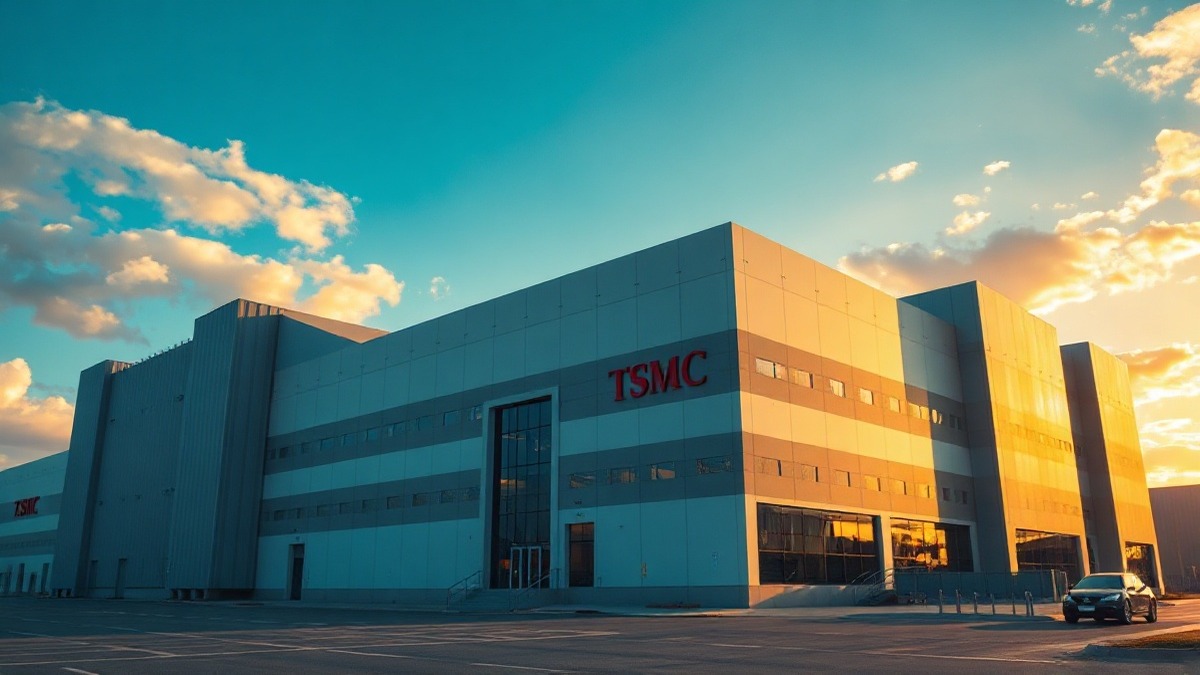
Let's be real for a second. When you look at a stock pushing a $2 trillion market cap, your first instinct isn't usually "yeah, that thing's still cheap." But Taiwan Semiconductor — TSM — is that rare beast where the numbers are so absurd that the conversation almost starts to feel disrespectful to the company.
We're talking about the sole manufacturer of NVIDIA's H200 and B200 chips. The only place AMD's MI300X gets made. The lonely foundry on planet earth that's actually pumping out 3nm silicon at scale. And the numbers? They're not just good. They're borderline obscene.
Revenue hit $138.8 billion over the trailing twelve months, up 36% year over year. Earnings grew 77% — more than double the revenue growth rate. That's operating leverage doing what it does best. Operating margins have climbed like a staircase: 50.6%, then 54.0%, then 58.1%, now 60.3%. That's not a typo. Sixty percent operating margins. Net profit margin sits at 49.9%. For a company that spends over $35 billion a year on capital expenditures. Let that sink in.
And here's the kicker: TSM's forward P/E is 18.8x. For a business growing earnings at 77% with margins this fat, that's not expensive — that's a discount. The analyst consensus is a Strong Buy at 1.42, with a median price target of $520.37. That's 30.6% upside from here. Return on equity is 40%. Free cash flow over the trailing twelve months sits at $35.5 billion. The balance sheet is a fortress — $98 billion in cash against just $31 billion in debt, a net cash position of $67.2 billion and a debt-to-equity ratio of 15.2%. TSM basically has no leverage.
So what's driving this thing? Three big catalysts.
First, the AI chip monopoly is real. TSM is the only game in town for the chips powering the entire AI boom — NVIDIA's H200 and B200, AMD's MI300X. Every hyperscaler building out AI infrastructure has to go through Taiwan Semi. And because earnings are growing twice as fast as revenue, you're seeing operating leverage kick in hard as those fabs fill up. The quarterly revenue trajectory in TWD tells the story: 989.9 billion, then 1,046.1 billion, then 1,134.1 billion, then 1,270.4 billion. Each quarter bigger than the last.
Second catalyst: the $100 billion Arizona expansion announced July 16. That brings TSM's total US investment to over $165 billion. This is a massive de-risking move. The bull case for TSM has always had a giant "but Taiwan Strait" asterisk next to it — roughly 90% of the world's most advanced chips are made on one island. Every billion TSM spends on US soil shrinks that geopolitical concentration risk. Markets rewarded the announcement, and for good reason.
Third, the process node moat is widening. TSM is the only foundry on earth mass-producing 3nm chips at any meaningful volume. Samsung's been chasing. Intel's been trying. Nobody's caught up. And N2 — the next-generation node — is on track for the second half of 2026. That means TSM's technological lead extends years into the future. Every AI company, every smartphone maker, every data center builder needs what only TSM can deliver at scale.
Let's talk about the risks, because there are two worth watching.
The obvious one is geopolitics. Taiwan Strait tensions are not going away. About 90% of advanced logic chips are fabricated on the island. If the unthinkable happens, the global tech supply chain grinds to a halt. TSM's Arizona expansion helps, but it's a multi-year build-out. The concentration risk is real and it's baked into the valuation — which is exactly why that 18.8x P/E exists.
The second risk is capex cycle fatigue. TSM is spending over $35 billion a year on new fabs and equipment. That's an enormous bet that demand keeps growing. Semi stocks sold off roughly 18% in July on concerns about return on invested capital — investors asking whether all this spending will actually pay off. So far the revenue and margin trajectory says yes, but it's a question worth watching each quarter.
Here's the bottom line: TSM with 60% operating margins, 77% earnings growth, a fortress balance sheet, and a monopoly on the most critical technology of the decade? That's not a complicated thesis. It's the pick-and-shovel play of the AI era, trading at a forward P/E that doesn't reflect the moat. The analysts see 30% upside. The catalysts are real. The risks are manageable and well-known. At this price, TSM looks like the kind of compounder you hold through the noise.
Disclosure: The Signal holds no position in TSM. Positions may change. This is not financial advice.