For decades, the legacy narrative was simple: automation comes for the factory floor first. We pictured assembly lines and delivery routes wiped out by robotics, while the laptop class sat comfortably in air-conditioned high-rises, safe behind their degrees.
| totalJobsAnalyzed | 143000000 |
| totalWageExposure | 3700000000000 |
| occupationsScored | 342 |
| metaLayoffs2026 | 7000 |
| metaAiEngineerSalaryMin | 700000 |
| metaAiEngineerSalaryMax | 3800000 |
| metaTopTalentStockBonusMax | 100000000 |
| usAccountingRoles | 3200000 |
We had the timeline entirely backward.
Artificial Intelligence isn't coming for the callouses — it's coming for the cubicles. It's aiming straight at the corner offices, the bloated middle-management layers, and the high-level cognitive tasks that took a decade of schooling to master. The knowledge worker is officially on notice.
But here's the flip side no one's talking about: within this massive disruption lies a generational opportunity for the modern operator who knows how to read the tape. The same algorithm that's eating white-collar salaries is about to make human skills — the physical, the empathetic, the real — more valuable than they've been in a century.
Here's the unfiltered signal on the current AI job landscape, who's bleeding, and how to position yourself for the ultimate human comeback.
The Karpathy Matrix: $3.7 Trillion in Exposure
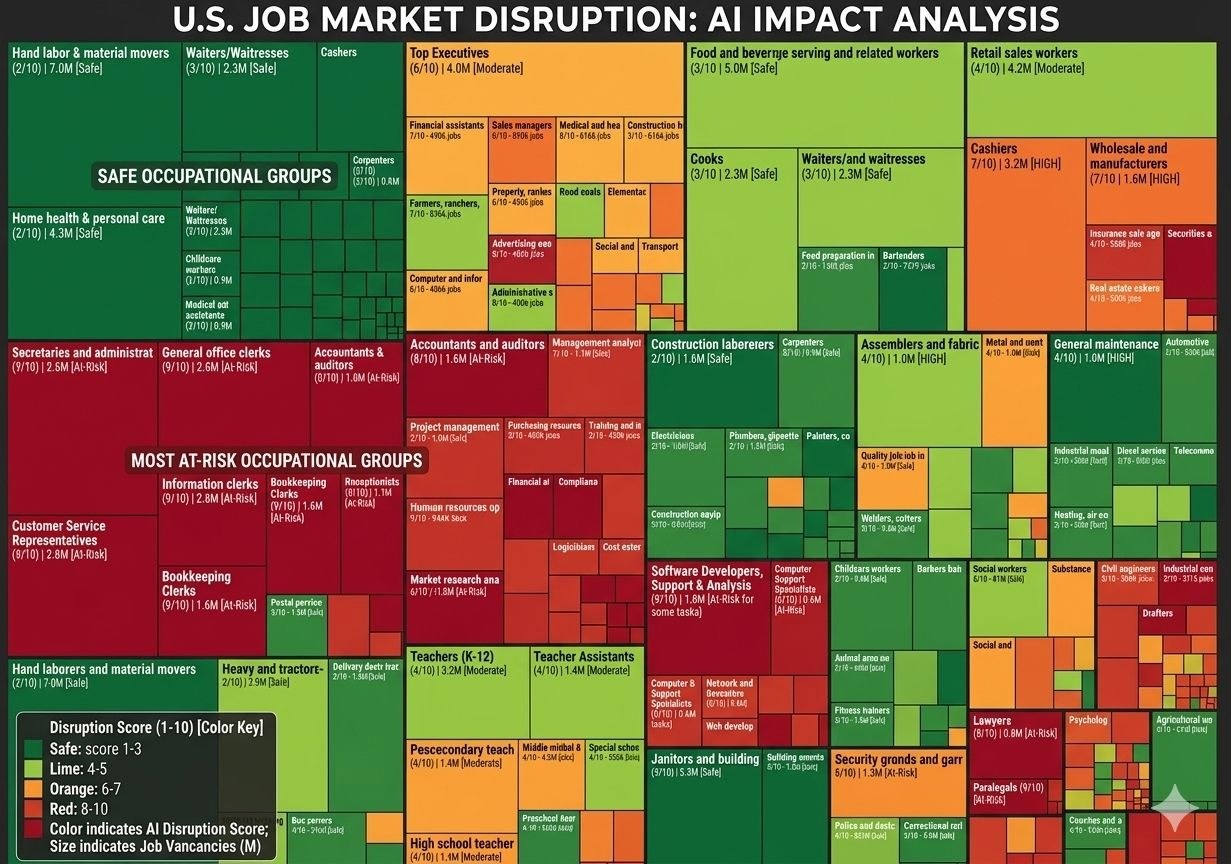
Earlier this year, former OpenAI and Tesla AI heavyweight Andrej Karpathy dropped an open-source dataset that sent shockwaves through the professional class. He scored 342 US occupations — representing 143 million jobs — by their AI exposure level. The total wage exposure? A staggering $3.7 trillion.
The resulting Job Risk Map flips the traditional college-to-corporate pipeline completely on its head. It's not a chart — it's a heat map of an entire economic class getting put on notice.
"The dataset isn't predicting displacement — it's measuring exposure. But when $3.7 trillion in wages is sitting in the high-exposure zone, displacement is the logical endpoint."
— Aniket Panjwani, AI Jobs Map Analysis
🔴 The Red Zone: Cognitive Sweatshops
The highest casualties aren't in manufacturing. They're mounting in areas previously considered the safest bets for an upper-middle-class life.
🧑💻 The Coders
Rote software development is dead. If you're just writing standard boilerplate code — CRUD APIs, basic frontend components, standard database queries — AI can do it faster, cheaper, and without needing a ping-pong table in the breakroom. Claude Code and Codex agents are already handling entire feature implementations. The mid-level engineer is getting squeezed out while staff-level architects command $3.8M+ packages.
📋 The Paper Pushers
Bookkeeping, accounting, HR, and mid-level administration are being evaporated by autonomous agents. These roles were always about pattern recognition and rule-following — exactly what LLMs excel at. The BLS data shows over 3.2 million accounting and bookkeeping roles in the US alone. AI exposure score: critical.
🧠 The Thinkers
Junior lawyers, market researchers, and project managers are finding out that AI eats high-level logic and language processing at a terrifying speed. Document review, contract analysis, market research synthesis — these aren't just assisted by AI anymore. They're being fully executed by it.
🟢 The Green Zone: Safe Havens
So what does AI actually struggle with? The physical world and genuine human empathy. Until robotics hardware catches up to AI software — which is still at least a decade out — these roles are completely untouchable.
🔧 The Physical Layer
Electricians, plumbers, construction trades, and aviation mechanics. These jobs require embodied intelligence — manipulating irregular objects in unpredictable environments. No matter how good GPT-7 gets at writing code, it can't rewire a 1970s breaker panel or snake a drain through a cast-iron pipe. Skilled manual labor is completely untouchable.
❤️ The Empathy Layer
Nurses, childcare professionals, barbers, massage therapists, and high-touch, in-person sales. These roles depend on trust, physical presence, and emotional intelligence. People don't want a machine holding their hand in the hospital room. They don't want an algorithm cutting their hair. The human premium is real.
The Barbell Strategy: Meta's Playbook
The apex predators of tech already figured this out. Meta recently executed another brutal round of layoffs — roughly 7,000 jobs cut. But the quiet part out loud? The mid-level engineers who stuck around are actively being used to train the very AI models that will eventually replace the bottom 80% of the coding workforce.
Meanwhile, Meta is handing out historic compensation packages to elite talent. Staff-level AI engineers are pulling down anywhere from $700,000 to over $3.8 million annually, with the true "1-of-1" talent securing vesting stock bonuses approaching $100 million.
This is the new playbook: run a hyper-lean ship, let AI handle the daily execution, and pay astronomical bounties to the master architects who build the models. Gut the middle, crown the architects.
The Operator's Edge: Surviving the Synthesis
There is a quiet panic echoing through the white-collar class right now. They don't know how to navigate a market where their singular, specialized skill has been commoditized by a server rack.
The investors and professionals who win this decade won't be the ones fighting the algorithm — they'll be the ones orchestrating it. The solution is to become the ultimate multi-faceted operator.
🎯 Be Adaptable, Not Specialized
The market no longer cares if you spent ten years mastering a specific software language that just became obsolete overnight. It cares if you know how to build businesses, manage leverage, and pivot across industries. The specialist era is over. The operator era has begun.
🎯 Move from 'Doer' to 'Director'
AI is doing the heavy lifting now. Your job is no longer to do the grunt work — your job is to direct the autonomous agents, synthesize their outputs, and orchestrate the broader strategy. The highest-leverage humans in 2026 are the ones who can manage a swarm of AI agents like a conductor manages an orchestra.
🎯 Bet on 'Team Human'
As digital noise scales to infinity, the premium on actual, physical human connection will skyrocket. The digital world is going to become so automated and sterile that authentic, hand-shake relationships and trust-based networks will become the ultimate currency. Real-world network > digital footprint.
The Bottom Line
Karpathy's job risk map isn't a doomsday prophecy — it's a roadmap. The red zones tell you where not to park your career. The green zones tell you where the moats are. And the middle ground — the operator who can bridge human skills with AI orchestration — is where generational wealth gets built.
The algorithm is here, but the human element is about to command a massive premium. Build your cross-disciplinary skills, keep your flexibility high, and let the AI do the heavy lifting.
Your move.