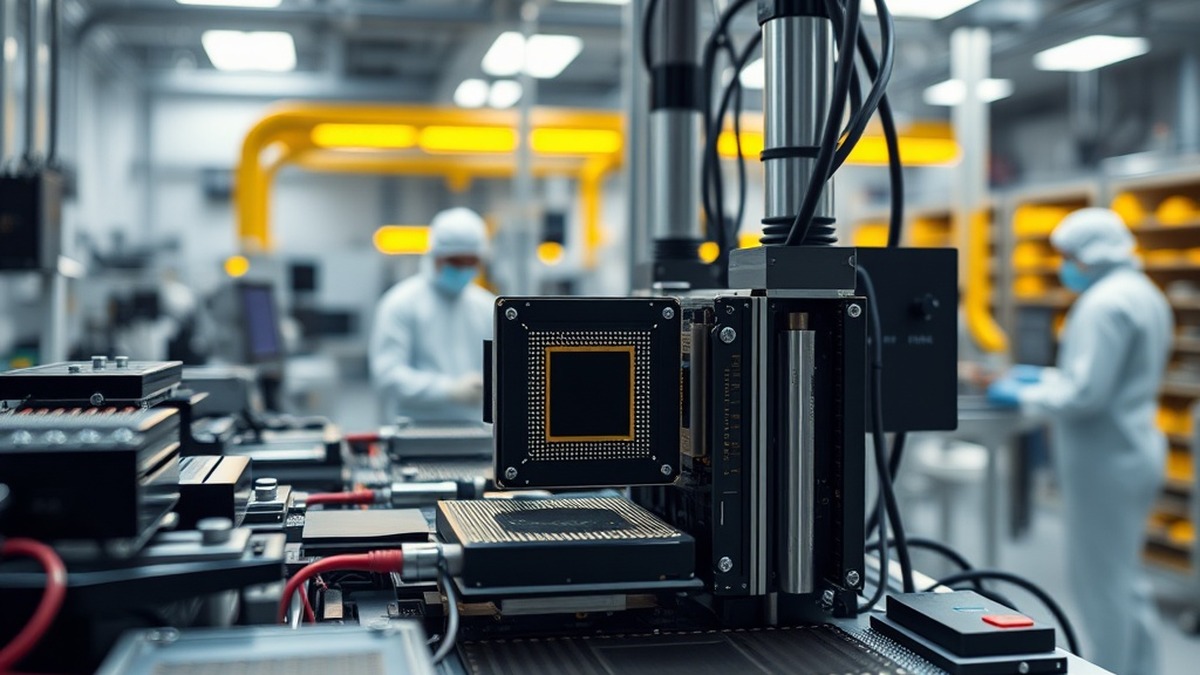
Applied Materials hit $739.67 on June 30 — an all-time high that felt like a victory lap for the company that quietly builds the machines that build every AI chip on the planet. Two weeks later, it's sitting at $595.70, down 19.5%, and the narrative has flipped from "picks and shovels royalty" to "what did the market see that I didn't?"
The answer might be nothing. Because sometimes a 20% haircut on a business printing $29 billion in annual revenue with a 31.9% operating margin isn't a signal — it's a sale.
Let's start with what actually happened. Michael Burry disclosed a short in AMAT at $729.40 on June 30, right at the peak. Then SK Hynix missed earnings, triggering a rout in semi equipment stocks. Add renewed China export restriction chatter potentially costing AMAT $600 to $710 million, and you've got a perfect storm of optics that looks terrifying on the surface.
But peel back one layer and the picture changes fast.
Applied Materials just delivered the best quarter in its history. Q2 FY2026 revenue hit $7.91 billion, up 11% YoY, with GAAP EPS of $3.51 crushing the $3.21 consensus. Gross margins touched 49.9% — a 25-year high. Operating margins came in at 31.9%. Free cash flow sits at $5.3 billion on $7.99 billion in operating cash flow. The balance sheet carries roughly net cash neutral, and the company boasts over 52,000 installed systems worldwide with a 90%+ service renewal rate. That's not a cyclical peak — that's a moat.
And the forward look is even better. AMAT guided Q3 revenue to $8.95 billion, plus or minus $500 million, representing 23% year-over-year growth — a clear acceleration from Q2's 11% clip. Q3 EPS guidance of $3.36 implies 36% growth. CEO Gary Dickerson has guided the broader semiconductor equipment market to grow 30% or more in calendar 2026. Applied Materials, as the market leader in deposition, etch, and ion implantation, is the single biggest beneficiary of that wave.
Now let's talk about the bear case, because it's real but not fatal. China export restrictions are a genuine headwind — the $600 to $710 million revenue hit represents roughly 2% to 2.5% of TTM revenue. But AMAT has been navigating this terrain for years, and surging demand from Taiwan, Korea, and the US is filling the gap. The SK Hynix rout raises questions about memory capex, but AMAT's revenue is diversified across logic, foundry, memory, and advanced packaging. Morgan Stanley downgraded to Equal-Weight in May with a $647 target — but that call was made at $580, and the stock still hasn't recovered.
The bigger story is what AMAT is building for the next decade. The EPIC Center — a $4 billion R&D partnership with TSMC, Broadcom, SK Hynix, Micron, Samsung, Stanford, and ASU — doesn't show up on a single quarter's P&L but defines competitive positioning for a generation. These aren't customer relationships; they're joint-development partnerships locking AMAT into every major chip roadmap from 3nm through 1nm and beyond. When TSMC figures out its next node, AMAT engineers are in the room.
Analysts get it. The consensus is still a Strong Buy, with mean price targets between $609 and $612. The high-end targets are ambitious: Cantor Fitzgerald at $850, Susquehanna at $900, TD Cowen at $700. Even Morgan Stanley's $647 target offers 8% upside from here.
There's another catalyst that doesn't get enough attention: Meta's in-house chip push. When hyperscalers design their own silicon — whether it's Meta's MTIA chips or Amazon's Trainium — they still need wafer fab equipment to produce them. Every custom chip project is another demand vector for AMAT's deposition and etch tools, and that wave is only gaining momentum.
Short interest sits at just 2.52% of the float, so this isn't a heavily shorted stock betting against the company's survival. Beta is 1.57, meaning AMAT moves roughly 50% more than the broader market in both directions — which explains the violent pullback but also means the snapback could be equally sharp when sentiment turns.
So here's the real question, and it's the only one that matters: is the structural thesis intact or is it damaged?
Applied Materials is the bottleneck through which every leading-edge AI chip must pass. That hasn't changed. The company has $29 billion in TTM revenue, record margins, accelerating guidance, and a CEO who's calling for 30% industry growth next year. The headwinds — China restrictions, a single bearish bet from a famous investor, and one customer's earnings miss — are real but transitory. The installed base, the service revenue, the EPIC Center partnerships, and the structural demand for advanced nodes are not transitory. They compound.
A 19.5% drawdown in a company with these fundamentals isn't a crisis. It's a clearance rack. You decide how you want to play it.
Disclosure: The Signal holds no position in AMAT. Positions may change. This is not financial advice.