Mark Sept. 24 on the calendar. That's when Iridium shareholders vote on Rocket Lab's $8 billion deal to buy the satellite operator outright. Win, and Rocket Lab owns the full stack — launch, spacecraft manufacturing, and a working constellation.
| Price | $63.07 |
| Market Cap | ~$40.3B |
| Forward P/E | N/A |
| Total Revenue (TTM) | $769.1M |
| 52-Week Low | $37.57 |
| 52-Week High | $151.00 |
| Analyst Consensus | Buy |
| Analyst Target Mean | $111.00 |
Here's the tension underneath. Rocket Lab just posted its best quarter ever and announced its largest acquisition ever. The stock has still been cut by more than half since its May peak. The market is betting Neutron slips again, and that bet is about to be tested.
First, the primer. Rocket Lab builds rockets and satellites — an end-to-end space company that touches everything from solar cells to flight-proven launchers. Electron is the most-launched small rocket in the world, with 94 missions flown and 15 launches so far this year. Buying Iridium adds 66 operational satellites and 2.5 million subscribers to that stack.
That integration is the moat, and it runs deeper than rockets. Space Systems, the satellite and components side of the house, grew 94% last quarter and now delivers most of the revenue.
Rocket Lab makes the parts — solar cells included — assembles whole spacecraft, and flies them on its own vehicles. It just introduced a high-efficiency solar cell built to lean less on supply-constrained critical minerals.
Why does that matter right now? Launch capacity is the choke point of the decade. AI data centers, defense constellations, and commercial networks all need rides to orbit, and only two vertically integrated launch companies operate at scale. SpaceX has been public since June and is worth well over a trillion dollars; Rocket Lab is the counterweight public investors can actually measure.
The trust argument does heavy lifting too. Since January, major U.S. defense awards total roughly $943 million — hypersonic test flights, missile-defense missions from a new Alaska pad, and more. The headline is the $397 million contract to build and launch missile-tracking satellites on Neutron, its largest defense award this year.
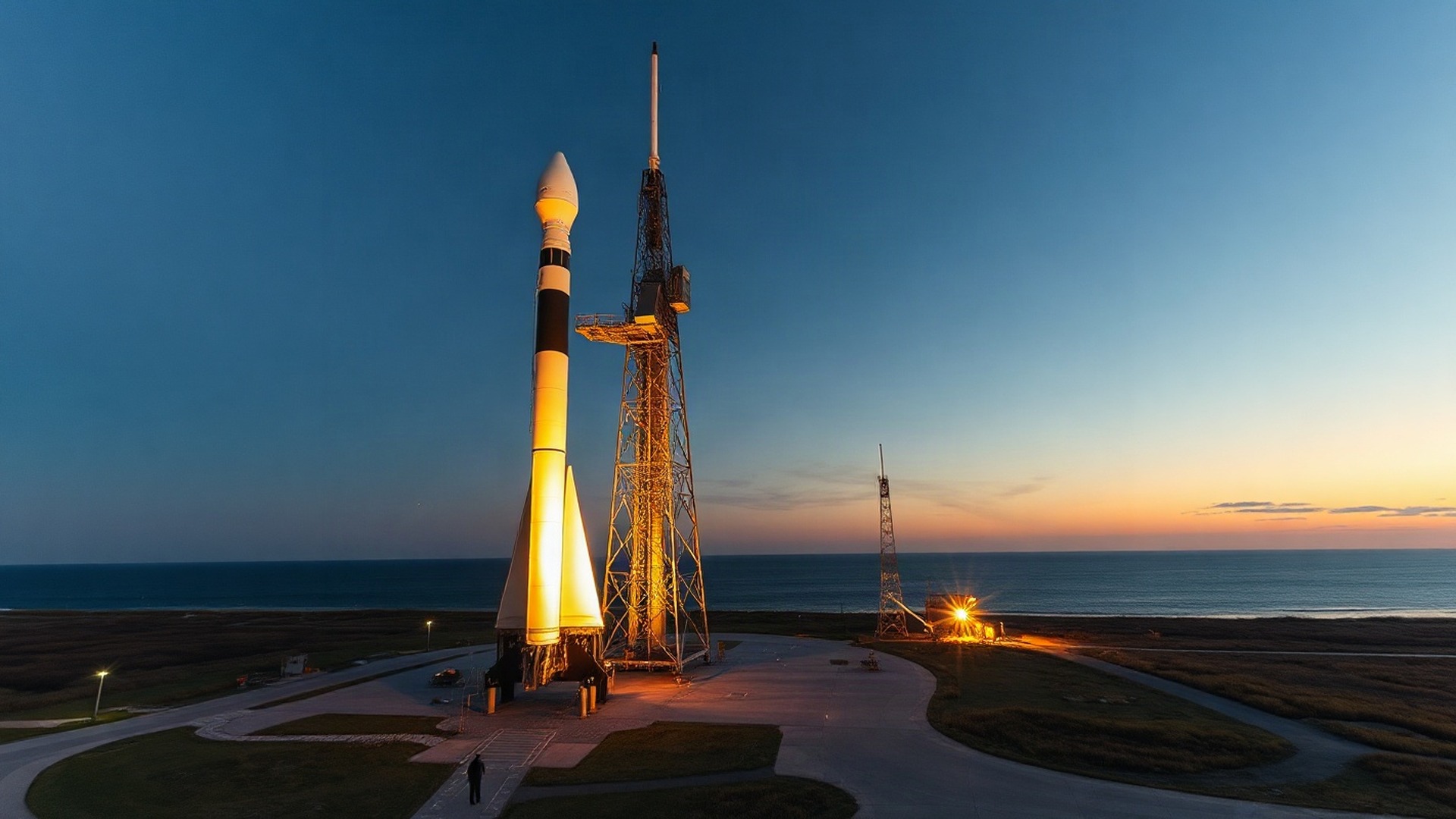
Management now guides to “delivery of Neutron to the launch pad in Q4”. The latest 10-Q admits the window for an end-of-year launch “is narrowing”.
Two things soften that risk. The manifest already holds more than 70 Electron and Neutron missions, including the largest launch order in company history from a confidential customer in May.
Kepler has the first dedicated Neutron flight booked for 2028 at the earliest, with on-orbit compute payloads in mind. And Synspective, fresh off the 94th Electron mission in early September, has 16 more launches booked through 2030.
The financials give the story legs. Q2 revenue hit a record $234.1 million, up 62%, with Space Systems growing 94% and the net loss narrowing to $49.3 million. Management guides the current quarter to $250-265 million.
The backlog says demand is durable. It sits at a record $2.36 billion, up 137%, with 90-plus launches booked and roughly 45% converting to revenue within a year. Cash and securities stood near $2.3 billion at the end of June. That is a balance sheet built to absorb a rocket delay and to fund an acquisition.
Which brings us back to Iridium, the capstone. Holders get cash plus Rocket Lab stock through an exchange-ratio collar, with $3.6 billion in bridge commitments from Deutsche Bank and Wells Fargo behind the deal. Management calls the purchase a shortcut to owning spectrum and a constellation — assets that took rivals a decade to build. The close is expected in mid-2027.
Wall Street is watching, not walking. The consensus rating is Buy. Bank of America trimmed its price target in late August but kept its rating, while Berenberg opened coverage at Buy in early September. ARK bought roughly $45 million of shares around the same time.
Here's the bottom line. This is an execution story with two dates attached: the Sept. 24 vote and Neutron's Q4 pad delivery. Clear both, and the full-stack thesis has its capstone and its rocket.
Slip on either, and the market's caution starts looking fair. Rocket Lab is either building the second full-stack space empire or reaching for more — the vote and the pad will tell us which.
Disclosure: The Signal holds no position in RKLB. Positions may change. This is not financial advice.