
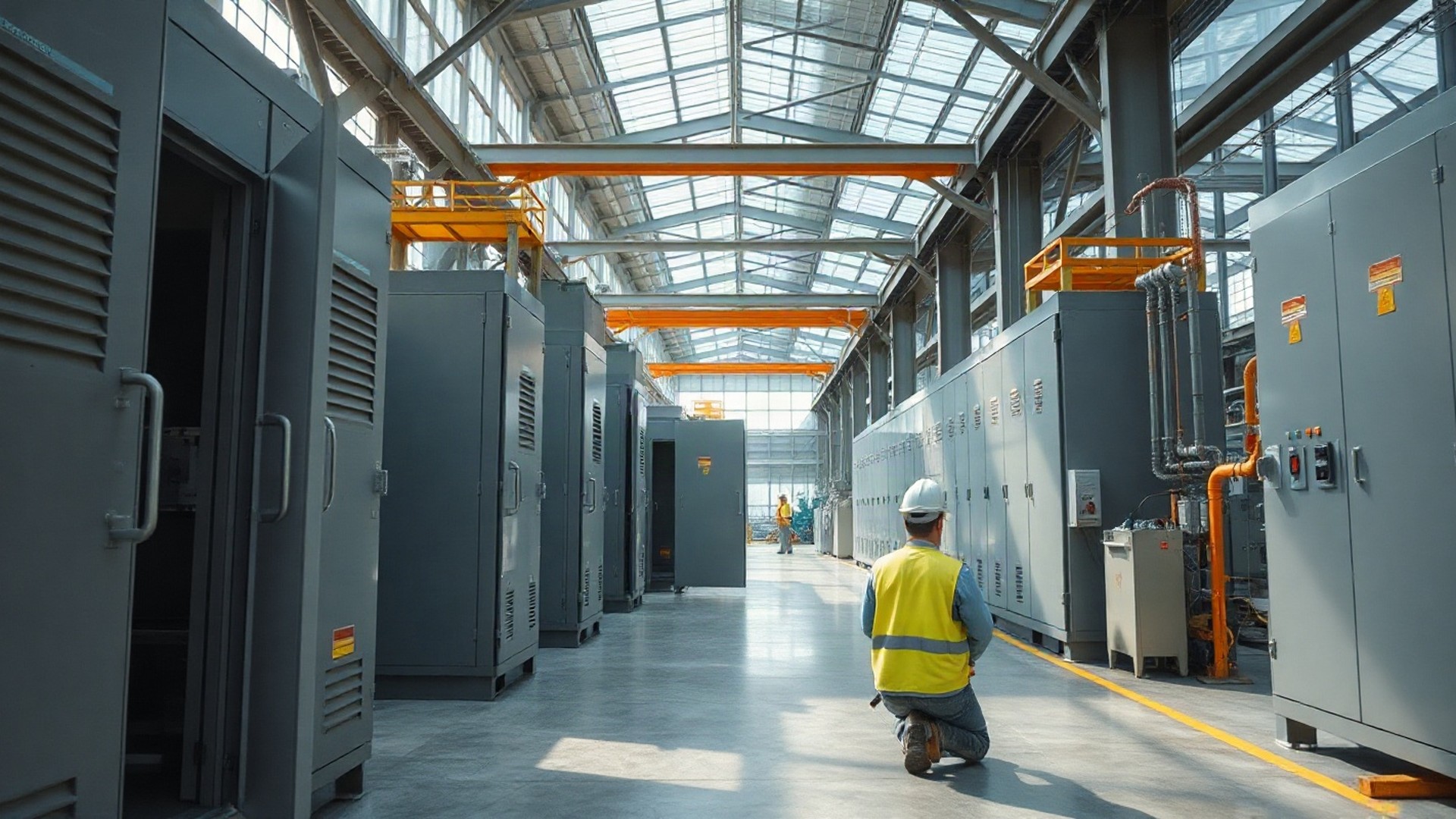
Every developer training a frontier model eventually collides with cold physics. You can buy all the server racks in Silicon Valley. But you cannot buy a switch that safely steps down five hundred thousand volts on short notice without waiting months. Powell Industries builds the heavy steel enclosures that make raw high-voltage electricity usable.
Powell manufactures custom medium-voltage switchgear, modular substations, and integrated power control rooms. The grid's bouncers. When power surges from a turbine, Powell's gear intercepts it, meters it, and isolates dangerous circuit faults in milliseconds before sensitive electronics incinerate. Rivals sell standardized catalog parts, but Powell delivers bespoke, skid-mounted electrical control rooms that arrive pre-wired on flatbed trucks. That custom packaging saves contractors nearly a full year of on-site electrical assembly.
Speed is everything. The standard American utility interconnection queue is frozen solid. Wait times stretch past five years across major data corridors. Hyperscalers have responded by skipping local utilities entirely to build behind-the-meter power islands fueled by on-site gas turbines. It is an end run around grid bureaucracy.
Those power islands require massive distribution switchgear to balance local generation against fluctuating server loads. This architectural shift multiplies equipment content per campus, turning modest hardware orders into complex, multi-year electrical contracts. Content expands.
| Price LIVE | $197.74 |
| Market Cap | $7.20B |
| Forward P/E | 28.3 |
| Total Revenue (TTM) | $1,157.5M |
| 52-Week Low | $92.59 |
| 52-Week High | $328.00 |
| Analyst Consensus | Buy (4 analysts) |
| Analyst Target Mean | $280.00 |
The financial impact showed up clearly in Powell's fiscal third quarter. New orders surged to a record $934 million, jumping 158% from the prior year. Total backlog hit an all-time peak of $2.4 billion, backed by an anchor award exceeding $400 million for Phase 1 of an off-grid power island.
Why this matters to the stock comes down to multiple expansion. Powell historically traded like an obscure Houston industrial cyclical tied to Gulf Coast refineries. At roughly twenty-eight times forward earnings, the market has begun recognizing the transformation. However, it still discounts Powell relative to pure-play data center power peers who command far richer multiples. For the equity to re-rate, gross margins must hold above thirty percent.
The short-seller argument against Powell is straightforward. This looks like a cyclical peak masquerading as a structural tech narrative. Three concentrated project awards accounted for roughly 57% of the entire record order quarter. If a hyperscaler pauses capital spending, hundreds of millions of dollars in backlog could slide out of the fiscal year. High concentration is a risk.
Meanwhile, legacy petrochemical revenue fell 49% in the latest quarter. Oil, gas, and chemical work still accounts for nearly thirty percent of the order book. If industrial spending freezes before data center buildouts reach scale, revenue growth will abruptly stall.
Powell's defense sits on its balance sheet. The company carries more than $630 million in net cash and holds essentially zero debt. Rather than levering up to chase demand, Powell is internally funding a twenty percent expansion of its physical manufacturing footprint, including a new 335,000-square-foot facility at Jacintoport. Real steel.
What we are watching is execution on that $1.3 billion short-term conversion pipeline. With visibility extending into fiscal 2028 and cash equal to nearly ten percent of its valuation, Powell controls its destiny. In an artificial intelligence buildout starved for electricity, the companies that control the electrons dictate the timeline.
Disclosure: The Signal holds no position in POWL. Positions may change. This is not financial advice.