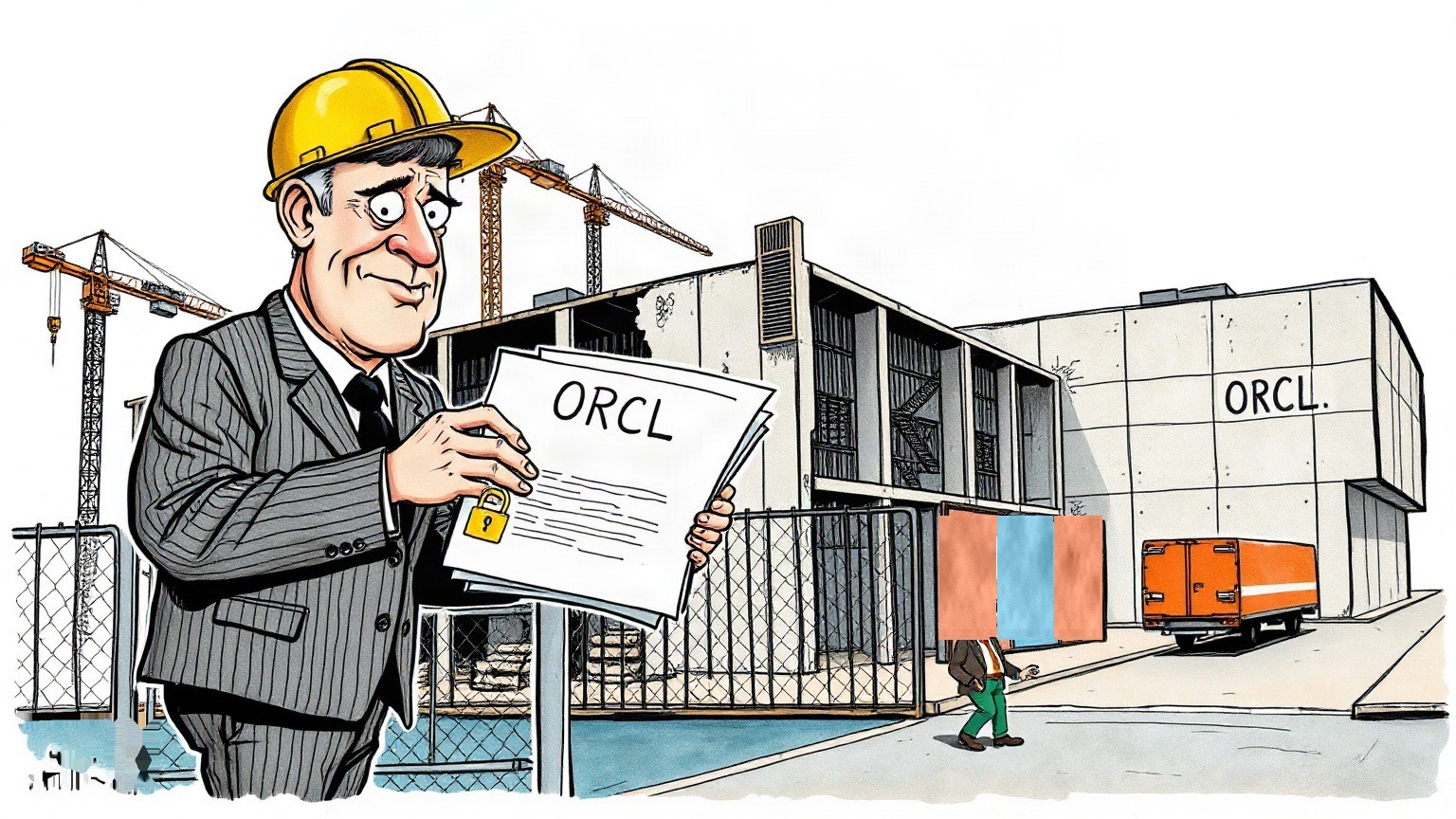
Oracle added $209 billion of new contracts to its backlog over the past twelve months, yet had to scramble back to capital markets twice this year for fresh cash. The bottleneck in the artificial intelligence buildout is no longer customer appetite. It is the raw capital required to pour concrete and buy chips before those customers pay.
| Price LIVE | $119.09 |
| Market Cap | ~$371B |
| Forward P/E | 10.8 |
| Total Revenue (TTM) | $71.8B |
| 52-Week Low | $109.21 |
| 52-Week High | $250.25 |
| Analyst Consensus | Strong Buy (40 analysts) |
| Analyst Target Mean | $236.18 |
At its core, Oracle sells the load-bearing database software that keeps airlines flying, banks balancing ledgers, and hospitals running payroll. These are sticky enterprise systems companies spend decades paying for because ripping them out is organizational surgery. Over the past three years, it grafted a massive computing landlord business onto that legacy engine, buying Nvidia graphics chips in bulk and renting them out through Oracle Cloud Infrastructure. If AI startups are writing the software of the future, Oracle is the real estate developer buying up the land, securing the power substations, and leasing out the server racks.
That landlord model works when capital is cheap and plentiful. The mechanics turn punishing when funding pipes seize up at once. On November 2, Oracle tapped the market for $10 billion in stock and $10 billion in high-cost notes yielding up to 8.65%, breaking its June guidance that it did not expect to issue more debt in calendar 2026. Its credit default swaps have more than doubled over the past year to near 295 basis points, leaving its Baa2 and BBB- rated paper hovering one to two notches above junk. With approximately $120 billion of Oracle debt sitting inside investment-grade indices, any rating slip would force benchmarked bond funds into mandatory selling.
The second funding pipe was offshore customer prepayments, which vanished when a reported five-year, $7 billion lease with Tencent collapsed under Washington pressure. Then the Commerce Department closed the door entirely. An interim final rule issued on November 16 requires an export licence for any data centre anywhere in the world delivering more than 12 million aggregate total processing performance to firms headquartered in China or other embargoed nations. The rule treats linked facilities as single sites, pierces corporate subsidiaries to look at ultimate parentage, offers no exemption for American-owned data centres abroad, and gives existing arrangements a 90-day clock to comply.
Distress is already showing up in private credit. That same week, HSBC offloaded about $300 million of the $18 billion construction loan package behind Oracle's New Mexico campus at prices in the mid-80s cents on the dollar. Meanwhile, Oracle's fiscal first-quarter filings showed $28.5 billion in quarterly capital expenditures chewing through $23.1 billion in operating cash flow, producing negative $5.4 billion in free cash flow. That followed a fiscal 2026 in which the company burned negative $23.7 billion of free cash flow to build out capacity.
Making matters trickier, nearly half of Oracle's $664 billion backlog rests on a single counterparty, and that counterparty's own funding is the least proven part of the story. OpenAI accounts for more than $300 billion of the contracted total through its Stargate partnership, yet both parties already dropped expansion plans for a flagship site in Abilene, Texas, where Microsoft snapped up the adjacent building. Oracle also issued a force majeure notice in September over power delays on its $165 billion Project Jupiter campus in New Mexico, hedging its legal exposure while maintaining the buildout is fully on schedule.
For equity investors, this capital squeeze explains why shares have fallen roughly two-thirds from their September 2025 peak and sit near their lowest level in over a year. The stock now trades at roughly ten times forward earnings, a discount that assumes the funding gap gets worse rather than better, against a Wall Street consensus target that sits near double the current price. For the equity to re-rate, management has to prove its October investor day promise: that capital spending peaks between fiscal 2027 and 2028, that free cash flow turns positive in the second half of fiscal 2028, and that capital raises stay capped at $20 billion through fiscal 2030.
A dedicated short-seller looks at those targets and sees wishful thinking colliding with a bond maturity schedule. Capital expenditure is running at an annualised clip above $110 billion against roughly $23 billion in quarterly operating cash flow, so positive cash generation is at least two fiscal years away and depends on management voluntarily tapping the brakes while backlog demand surges. If a rating agency issues a single-notch downgrade, roughly $120 billion in bonds falls out of investment-grade benchmarks, instantly driving up refinancing costs across the balance sheet. With the Tencent lease gone, remote-access compute laws clamping down globally, and campus debt trading at 85 cents on the dollar, the downside trigger is clear: another quarter where capital spending stays above the $28.5 billion run-rate while backlog additions slow, or an outright credit downgrade.
Oracle bet its balance sheet on becoming the primary utility provider for generative intelligence, locking in enormous backlogs before securing the cash to build the plants. What we are watching is the fiscal second-quarter report expected in mid-December, specifically whether capital expenditure per dollar of new backlog additions begins to decline. That ratio will reveal whether Oracle is constructing an enduring cash engine or an overbuilt monument to someone else's algorithms.
Disclosure: The Signal holds no position in ORCL. Positions may change. This is not financial advice.