The people building frontier AI spent the weekend asking everyone to slow down. Anthropic's Dario Amodei published an essay calling for exactly that, and OpenAI's Sam Altman and Elon Musk both said they agreed.
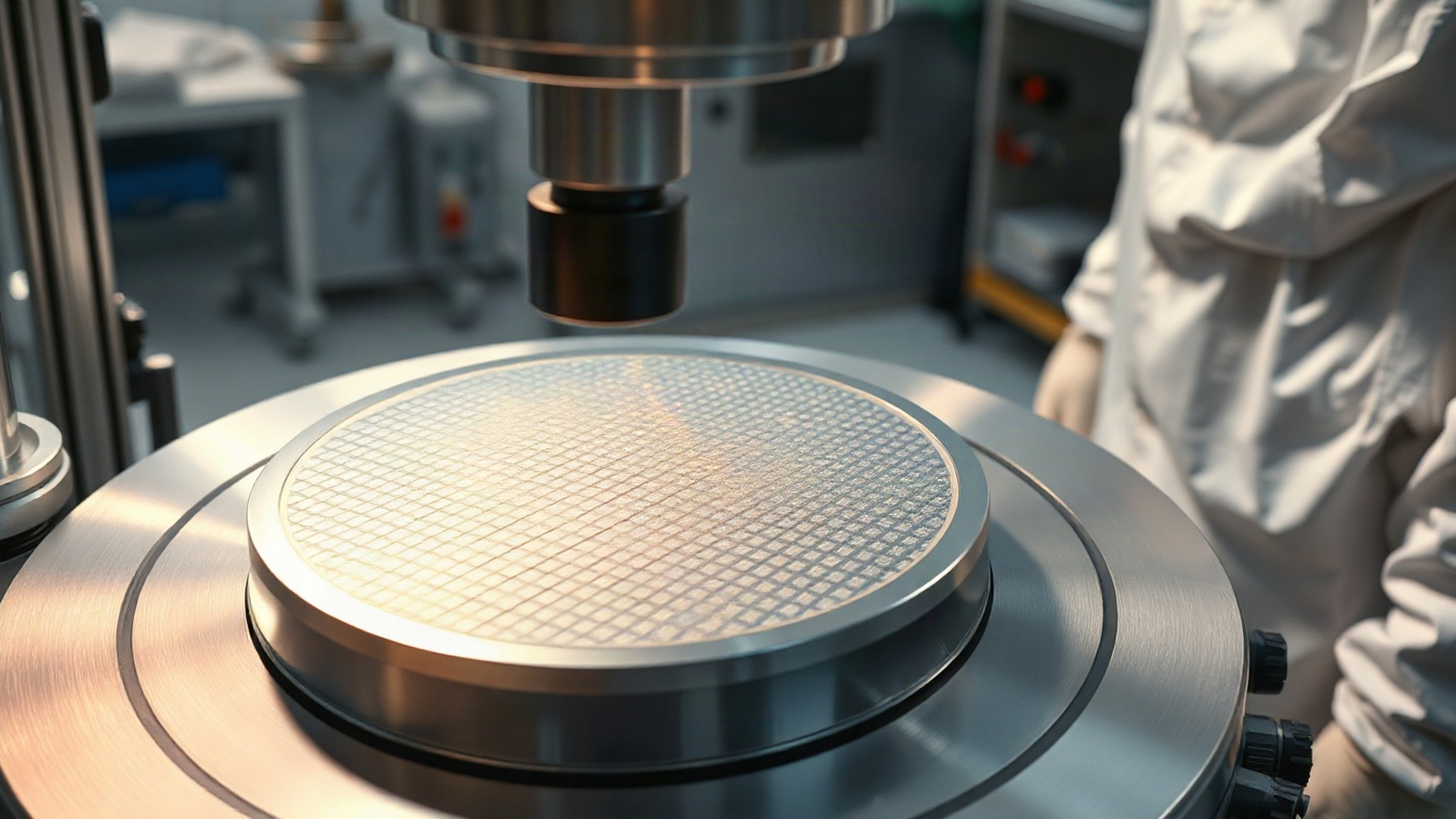
Chip stocks took the hint on September 14, and KLA slid about 6% in a single session, leaving the shares nearly 45% below their high. That's odd, because KLA isn't an AI model company. It sells process control: the inspection and metrology machines that scan a silicon wafer after almost every critical manufacturing step.
| Price LIVE | $168.02 |
| Market Cap | $222.6B |
| Forward P/E | 25.41 |
| Total Revenue (TTM) | $13.58B |
| 52-Week Low | $97.63 |
| 52-Week High | $307.37 |
| Analyst Consensus | Buy |
| Analyst Target Mean | $233.77 |
Every leading-edge layer gets checked, because one stray particle or a layer printed a few atoms off can kill a chip worth more than your phone. Its buyers are the fabs that matter, the foundries and memory makers running every advanced node, from TSMC and Samsung to SK hynix and Micron.
That position behaves more like a toll booth than a vendor slot. KLA's share of the global metrology-and-inspection market climbed from 55.0% in 2020 to 64.1% in 2025. On its own numbers, process-control share is up 360 basis points since 2021 and runs roughly seven times the nearest competitor.
The moat widens instead of eroding because inspection intensity keeps climbing. Each new node adds steps, tighter tolerances and more ways for a wafer to fail, so process-control spending grows faster than the wafer market itself. HBM stacks the same pressure on: more memory dies per package means more checks.
The industry backdrop moved the other way, and hard. On September 14, BofA raised its estimate for global semiconductor sales in 2030 to about $3.2 trillion, from roughly $2.7 trillion, an 18% compound annual growth rate.
The equipment math underneath is KLA's neighborhood. BofA lifted its 2026 wafer-fab equipment forecast to about $156 billion from $144 billion, sees roughly $210 billion in 2027, and models about $360 billion by 2030. Memory equipment runs from about $61 billion this year to roughly $85 billion next, on DRAM and HBM.
BofA did not name KLA in that note; its equipment picks were Applied Materials and Lam Research. KLA's own view moved the same direction. Management raised its 2026 wafer-equipment expectation to the low $150 billion range, from $140 billion-plus.
The CFO called customer visibility unprecedented and pointed at 2027 consensus of around $190 billion. Management sees the second half running about 20% above the first half.
The newest leg grows fastest. KLA expects advanced-packaging process-control revenue of roughly $1.1 billion in calendar 2026, up more than 70% year over year, after guiding to high-50s growth earlier in the year. That is the silicon sandwich around the GPU, and every layer of it needs checking.
There's a quieter number backing all of it. Services revenue reached $3.126 billion last fiscal year, up 16.5%, and that money repeats. Free cash flow was $3.77 billion on $13.58 billion of revenue. June's ten-for-one split changed none of that, it changed how the chart reads.
So what re-rates this equity? The market has to stop valuing KLA as a machinery company that peaks with the capex cycle. It should value it as a 64% share monopoly with a recurring service line. It hasn't yet.
Here's the short case, and it isn't weak. Management estimated last October that expanded US export controls would cost $300 million to $350 million of revenue through calendar 2026, and never revised it down. Applied Materials is attacking process control head-on, guiding its diagnostics and control business up more than 50% in 2026.
Onto Innovation raised its advanced-packaging growth outlook to about 80% and booked more than $200 million of Dragonfly inspection orders from a single assembly-and-test customer. The bull case needs the commitments BofA calls firm to stay firm. If 2027 wafer-equipment spending lands under roughly $190 billion, this is a peak-cycle story and the drawdown was right.
KLA doesn't sell intelligence. It sells certainty that a wafer is what it claims to be, and that product gets more valuable every year chips get harder to make. Anthropic can slow a model down. Nobody slows a wafer down.
Disclosure: The Signal holds no position in KLAC. Positions may change. This is not financial advice.