
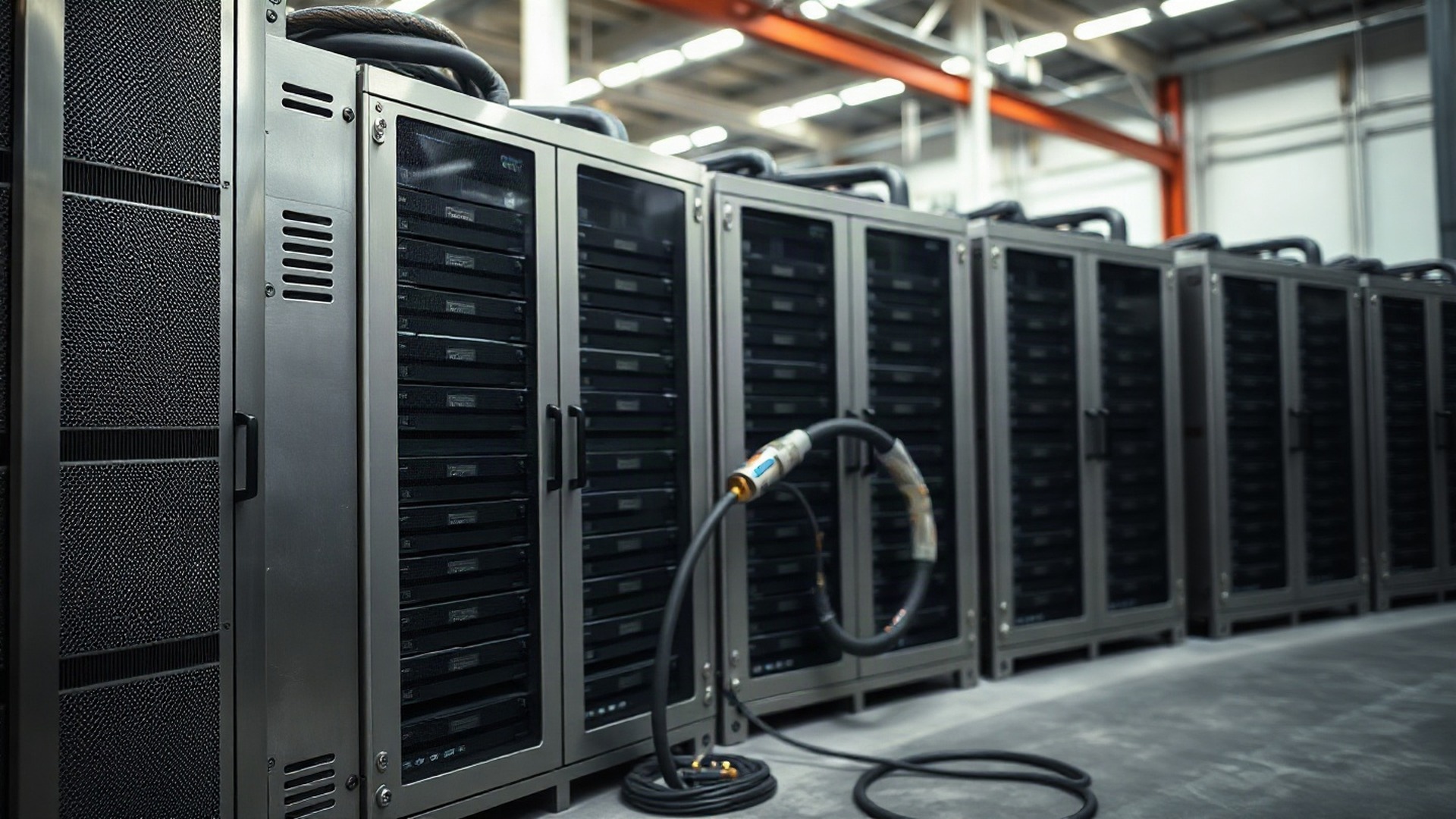
Think of Nebius as a commercial landlord signing an anchor tenant before securing the construction mortgage. The company buys Nvidia graphics chips, builds massive data halls, and rents computing power by the hour to labs and tech giants. Spun out of search provider Yandex’s international assets, it does not sell workplace apps or consumer gadgets. It sells high-voltage power and dedicated processor time under multi-year agreements.
Strip away the marketing, and Nebius is a financing business wearing a cloud company's clothes. The model relies on a clean chain of credit: sign a massive contract with a blue-chip counterparty, then borrow against that promised revenue to buy more hardware.
Nebius laid this bare when it announced its five-year, $17.4 billion deal with Microsoft. Capex for that contract, the company said, would be funded by cash flow and by "debt secured against the contract" itself. Then the Financial Times reported that OpenAI told investors its annualized revenue was approaching $50 billion, not the whispered $68 billion. Not a single signed contract on Nebius’s balance sheet changed. What shifted overnight was the price of belief in that collateral.
| Price LIVE | $221.07 |
| Market Cap | $56.1B |
| Forward P/E | -62.1 |
| Total Revenue (TTM) | $1.36B |
| 52-Week Low | $73.52 |
| 52-Week High | $299.86 |
| Analyst Consensus | Buy (19 analysts) |
| Analyst Target Mean | $282.53 |
Shares of Nebius tumbled roughly 7.4% in a single session after the report, while peers like CoreWeave and Oracle dropped hard alongside it. The sensitivity is obvious when you look at the sheer scale of the balance sheet. Nebius expects to pour between $20 billion and $25 billion into capital expenditure this year while guiding for $3.0 billion to $3.4 billion in revenue. To feed that pipeline, total borrowings doubled to $8.55 billion by the end of June. Meanwhile, Nvidia holds roughly 9.3% of Nebius’s Class A shares following a $2 billion strategic investment. That creates a tight loop where the chip vendor backs the buyer who borrows to purchase its silicon.
Borrowing billions worked smoothly when capital was practically free, but the tollbooth is getting expensive. The US 10-year Treasury yield recently closed near a two-decade peak at 5.29%, lifting borrowing costs everywhere from your credit card bill to corporate debt syndicates. SoftBank had to offer a 9.75% yield on a dollar bond tranche in late September, showing that institutional lenders want serious premiums to bankroll compute farms. Even the Bank of England’s Financial Policy Committee stepped in, warning that opaque, circular leverage across an estimated $700 billion private credit buildout could amplify losses if revenue growth ever stumbles.
Operationally, the reported speed looks formidable. Second-quarter revenue jumped 454% year over year to $582.3 million, with its dedicated AI cloud segment printing a 49.7% adjusted EBITDA margin. Customers like Reflection, Cohere, and Microsoft have pushed deferred revenue to nearly $6 billion, representing cash or commitments locked in ahead of service delivery. But physical hardware eats cash far faster than traditional software. In the first half of 2026, Nebius generated $4.50 billion in operating cash flow while burning $8.13 billion on capex, leaving a cash outflow of about $3.6 billion.
The bear case goes straight for that liquidity neck. Nebius is not an enterprise software platform trading on recurring customer retainers; it is a leveraged infrastructure developer running a binary race against credit markets. Burning $3.6 billion in cash over six months while doubling debt creates an unforgiving setup. To hit its full-year target, second-half revenue must deliver more than $2 billion after generating only $981.3 million across the first two quarters. The critical test is observable and immediate: if the next debt raise prices materially wider than July’s SOFR plus 2.50% facility, the thesis that contract-backed debt is self-funding falls apart. If signed contracts slip on execution or funding dries up, financial leverage will dictate the equity price rather than customer compute demand.
For the equity to re-rate higher, the business does not require a richer trading multiple from the market. Nebius trades roughly a quarter below its June high, wedged between a street-wide buy rating and a low target roughly 60% below current levels. A sustainable re-rate requires the operating leverage to show up in reported filings. Second-half revenue has to close the gap toward the $3.0 billion baseline. AI cloud margins have to stay near 50%, and the next secured debt raise has to price at or inside July’s terms. Deliver those three, and the company proves its balance sheet can stand on its own feet.
What we are watching is the third-quarter report slated for early November. The proof will be whether revenue conversion accelerated toward the full-year target and whether fresh borrowing costs remain contained. In a leveraged race, staying on track is the only metric that matters.
Disclosure: The Signal holds no position in NBIS. Positions may change. This is not financial advice.