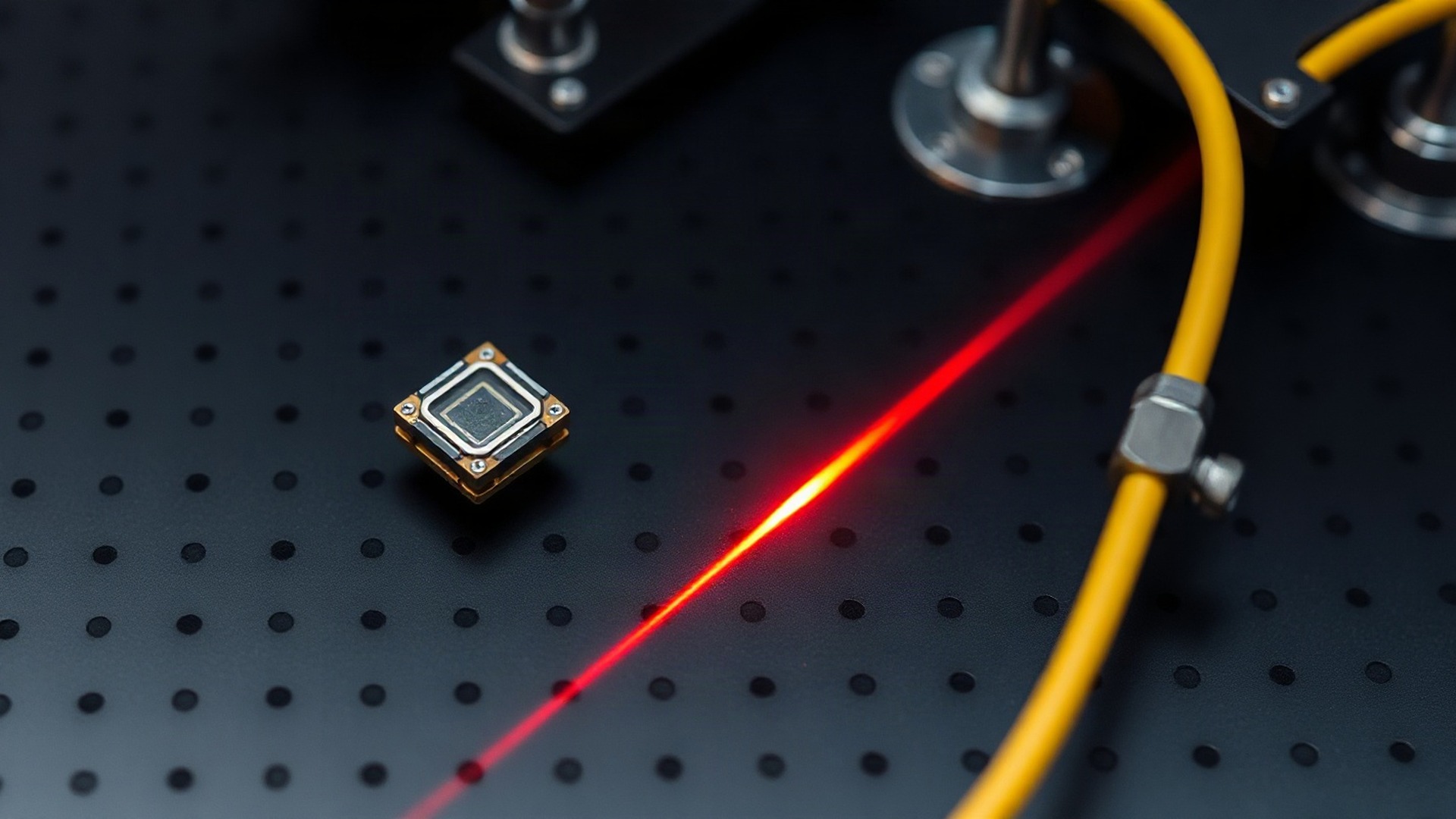
The US government just moved quantum computing from the science fair stage to a forensic audit. For two years, DARPA's Quantum Benchmarking Initiative graded more than twenty hardware builders against one cold question: can anyone construct a machine whose computational value exceeds its cost by 2033? On October 7, the agency advanced four more contenders to Stage C, its final verification phase. IonQ made the cut alongside IBM, Atom Computing, and Diraq.
IonQ designs quantum hardware out of trapped ions rather than the cryogenically chilled microchips favored by Google. The company suspends individual ytterbium and barium atoms inside electromagnetic traps, steering them with laser pulses. While these atomic gates take longer to switch, they are remarkably stable, notching a record 99.99% two-qubit gate fidelity in 2025. Customers do not buy the hardware so much as rent time on it through Amazon Web Services, Microsoft Azure, and Google Cloud.
Two structural pillars separate IonQ from every other pure-play quantum lab. First, it manufactures its own components. In July 2026, IonQ closed a roughly $1.8 billion acquisition of SkyWater Technology, securing a trusted domestic semiconductor foundry. By making its own photonic and quantum chips onshore, IonQ avoids waiting in line at overseas fabrication plants.
| Price LIVE | $39.89 |
| Market Cap | $16.16B |
| Forward P/E | -30.9 |
| Total Revenue (TTM) | $246.5M |
| 52-Week Low | $25.89 |
| 52-Week High | $84.64 |
| Analyst Consensus | Strong Buy (14 analysts) |
| Analyst Target Mean | $66.63 |
Second, the company is building networking hardware, not just isolated processors. Its memory-enhanced interconnect links quantum systems using light, stitching smaller modules into a unified computing cluster. In enterprise computing, Nvidia sells the heavy compute engines, but Ethernet made modern cloud data centers possible by linking individual racks. IonQ wants to be that quantum networking fabric.
Passing DARPA's audition gives that architectural vision significant institutional weight. Stage C is not an academic paper review. Government specialists physically inspect the hardware to verify that a commercial blueprint can be constructed as drawn and operated as intended. IonQ’s agreement carries a potential value of up to $300 million, though funding beyond the initial obligation depends on congressional appropriations.
The selection also trimmed a crowded field. DARPA evaluated eleven companies during Stage B, leaving seven behind in this round, including error-correction heavyweight Quantinuum. While DARPA insisted the program does not pick winners and losers, advancing to the final tier alongside Microsoft and PsiQuantum separates serious contenders from theoretical projects. The Pentagon simultaneously backed the initiative with roughly $200 million in fresh funding.
Two days after the defense announcement, IonQ revealed the engineering plumbing behind its scale-out ambitions. The company entangled a barium-138 ion qubit with a solid-state quantum memory inside a diamond nanophotonic cavity. The system achieved an average entanglement rate of 1,032 pairs per second with an 87.9% state fidelity, quadrupling the trapped-ion record held by IonQ co-founder Chris Monroe at Duke.
The physics here solves a brutal scaling bottleneck. Traditional quantum links require two individual photons to hit a sensor at the exact same instant, which makes success probabilities decay quadratically. IonQ's memory scheme reflects a single photon instead, letting network throughput scale roughly linearly with light collection. With a mean success window of 969 microseconds, the link directly matches the one-millisecond cycle time expected in future fault-tolerant processors.
As Mihir Bhaskar, IonQ SVP and GM of Quantum Technologies at SkyWater, noted, the result shows a photonic quantum interconnect does not have to be a bottleneck for distributed quantum computing. Commercial sales have already begun to trickle in, with interconnect platforms sold to the University of Maryland and South Korea's SDT. Niccolo de Masi, Chairman and CEO of IonQ, framed the breakthrough as the missing link needed to build the networked quantum data centers of the future.
Yet public markets gave the milestone a cold shoulder. IonQ shares dropped in subsequent sessions, closing out the week roughly 8% below their pre-announcement level and sitting at less than half their peak over the past year. Wall Street remains upbeat, with fourteen analysts holding a consensus Strong Buy and an average price target in the high-$60s. But equity investors are clearly pricing delivery timelines rather than benchtop science.
A dedicated short seller would point out that validation is not cash. The headline $300 million agreement is an authorization ceiling, not booked revenue, leaving IonQ dependent on future congressional defense appropriations. The financial burn also remains relentless. IonQ generated $246.5 million in trailing revenue while burning roughly $484 million in negative free cash flow.
Competition is equally aggressive. While $2.1 billion in cash buys runway, DARPA's staggered review means left-behind rivals like Quantinuum could secure promotion later. Meanwhile, PsiQuantum recently secured a conditional $150 million federal loan for its own chip plant. An 87.9% link fidelity works in a laboratory, but true fault tolerance demands far lower error rates before enterprise adoption arrives.
For this equity to sustainably re-rate, quantum computing has to shift from a speculative science grant to a standard procurement line item. In the upcoming quarterly reports, we are tracking whether Stage C milestones translate into funded contract revenue rather than lingering as paper backlog. We will also monitor whether IonQ can close commercial interconnect deals outside government and research institutions. Validation is a vital step, but cash in hand is the only thing that changes the story.
Disclosure: The Signal holds no position in IONQ. Positions may change. This is not financial advice.