Wall Street just delivered a cold reality check to the AI infrastructure trade: having signed customer orders is no longer enough. Consider the arithmetic around IREN. The company has locked in more than $20 billion in contracted revenue from tech's biggest spenders, yet its shares just hit a fresh 52-week low, down more than 80% from their early-summer peak.
In a market that spent the past year obsessing over scarce computing capacity, a business holding multi-year commitments from Microsoft and Nvidia is suddenly trading as if that revenue will never materialize.
To understand why, you have to look at what IREN actually does. The company started out as a Bitcoin miner, acquiring vast acreage in Texas plugged directly into high-voltage electrical substations. The early business was simple: run rows of mining rigs and sell whatever crypto tokens they produced each day.
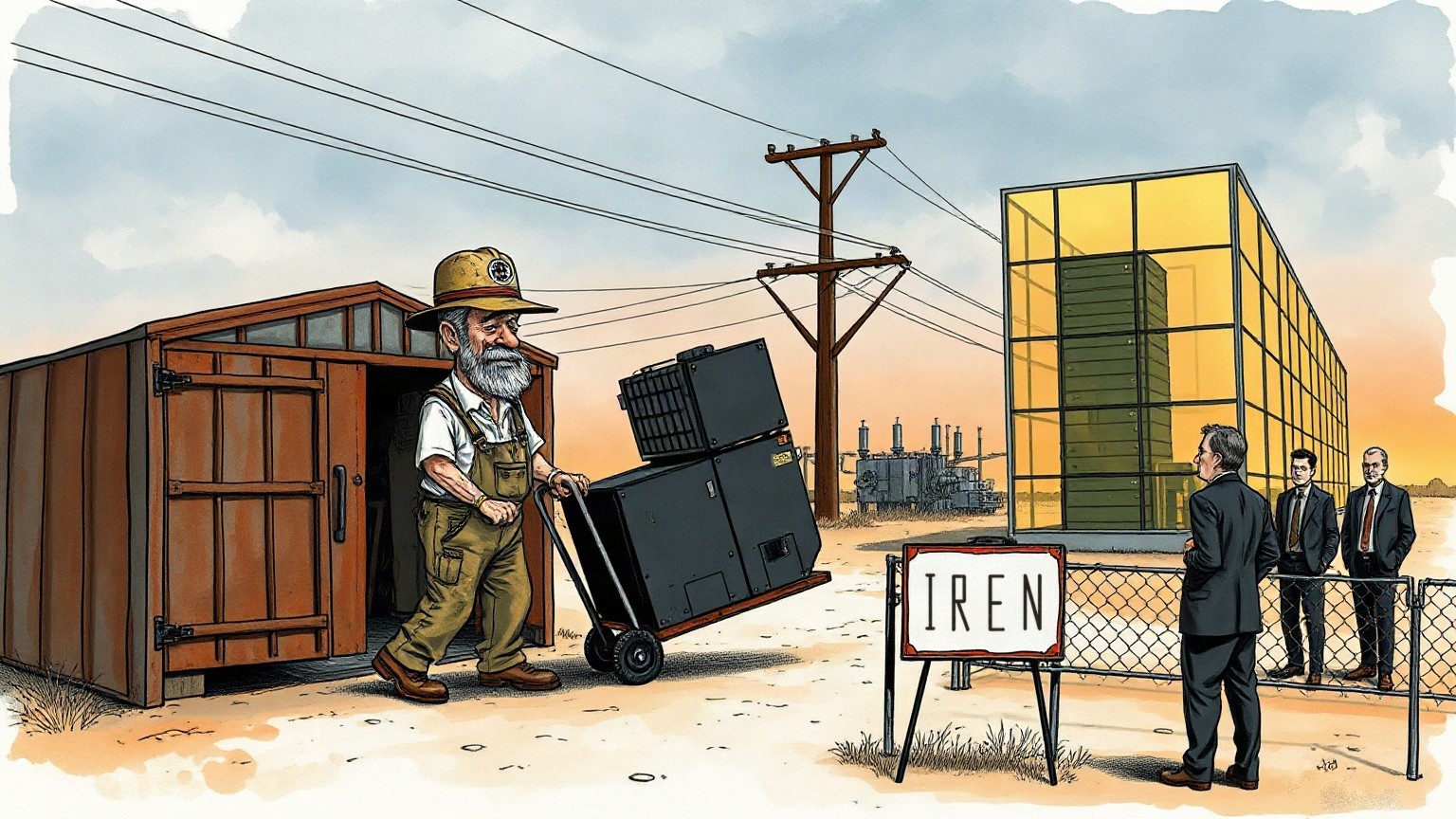
But in artificial intelligence, land with approved, immediate power access has become the scarcest commodity on earth. IREN is rewiring those sites, replacing crypto rigs with liquid-cooled clusters of graphics processors, and renting that compute to AI developers on multi-year terms. Think of IREN as a landlord who owns the only building in town with its own private power grid, evicting low-rent crypto miners to lease space to premier tech tenants.
On paper, the transformation looks spectacular. Last quarter, AI cloud revenue nearly tripled sequentially to $200 million, while legacy mining revenue shrank to just $28 million. Total revenue backlog expanded to $20.3 billion, with roughly two-thirds secured by investment-grade counterparties.
Microsoft committed nearly $10 billion to anchor IREN's Childress campus, while Nvidia signed a $3.4 billion service deal of its own. Inside the data halls, margins are enviable: the AI cloud segment logged an 86% gross margin before depreciation. The catch is that an 86% margin on paper means little when building the physical infrastructure burns cash faster than you can bill it.
That gap between signing a contract and powering up silicon is where the equity is stalling. Last quarter, IREN spent over $4.8 billion in capital expenditure, deploying roughly twenty-one dollars on hardware and construction for every dollar of revenue recognized on the ledger.
Free cash flow sank to negative $4.36 billion, and total debt principal crossed $10 billion against contractual commitments of nearly $19 billion. On its latest earnings call, management told analysts that finishing the buildout for the current fiscal year requires roughly $15 billion, against just $9 billion in available cash and committed facilities. That leaves an unfunded $6 billion gap that must be solved before those chips can be plugged into the wall.
This is why the equity is now being priced as a high-stakes credit trade rather than a growth story. For the stock to re-rate, IREN must close that $6 billion hole without crushing existing shareholders. If management fills the void by selling stock after an 80% drawdown, per-share value erodes regardless of top-line growth.
The bullish path depends on smarter capital: IREN already funds part of the build with non-recourse project debt priced near 7%, while its GPU equipment financing costs more than 10%. Customers, meanwhile, are now prepaying between 45% and 90% of their upfront hardware costs on new deals. If customer deposits and cheap project debt carry the buildout, the equity becomes a leveraged call option on high-margin cash flows.
The bear case, however, argues the company is running out of financial runway. IREN's quarterly interest expense spiked to $73 million, officially overtaking its adjusted EBITDA of $66 million. The business cannot cover its debt service from operating earnings, and its equipment financing carries punishing interest rates north of 10%.
At the same time, anchor tenants dictate the timetable: when Microsoft requested a network reconfiguration at Childress, IREN delayed its flagship $4 billion operating run-rate milestone into 2027. Backlog is an agreement to pay over several years, not cash in the bank, and heavy customer concentration creates severe execution risk. With mining revenue halved, no Bitcoin treasury to lean on, and Nvidia's equity warrant sitting hopelessly underwater, the safety net is gone.
The proving ground arrives within weeks. What we are watching is the rescheduled January-to-February delivery window, where IREN must deliver on its operating run-rate milestone while securing non-dilutive project financing for its Sweetwater hub. Until that $6 billion gap is closed with customer cash rather than freshly printed shares, the market will treat a $20 billion backlog not as an asset, but as an unpaid bill.
Disclosure: The Signal holds no position in IREN. Positions may change. This is not financial advice.