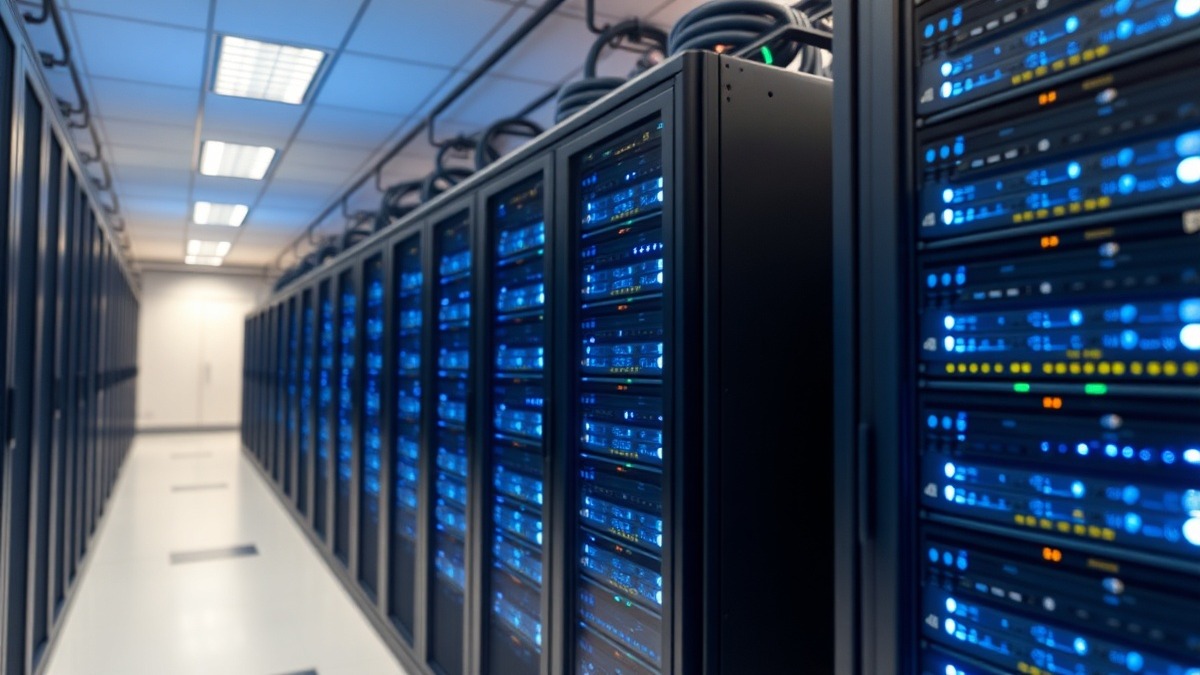
Picture buying a high-end gaming PC only to discover your home broadband still runs on copper wire from the nineties. That is the exact physical bottleneck currently haunting artificial intelligence. Training next-generation neural networks requires tens of thousands of processors to speak to one another without a millisecond of lag, and traditional copper cables simply run out of breath over those distances.
That is where Corning steps in. The 175-year-old glassmaker produces optical fiber—hair-thin strands of pure glass that transmit information as pulses of light. If graphic processing units are the high-powered engines of the AI race, Corning manufactures the private interstates connecting them. Without those glass lanes linking server to server and facility to facility, modern data centers choke on their own computational speed.
You would expect the scaled Western supplier of that essential infrastructure to trade at an untouchable premium. Instead, the equity just took a sledgehammer to the face. After a parabolic run to late June peaks, shares shed roughly 63% of their value, landing only modestly above where they started the year. The latest session was particularly ugly: shares tumbled roughly 11% on heavy volume as a broader tech washout dragged down peers like Marvell and Nvidia. To reclaim its summer high, the stock would need to roughly 2.7x from here.
The paradox is that Corning's factory floors have never been busier. In the third quarter, core sales jumped 19% year over year to $5.08 billion, delivering $0.91 in core earnings per share. Optical communications led the charge, with sales climbing 44% to $2.38 billion and segment net income soaring 80%. Products purpose-built for generative AI surged more than 100%. Along the way, core operating margins expanded by 310 basis points to 22.7%, proving that factory volume was translating directly into profit.
More importantly, hyperscalers are not just ordering glass through standard purchase forms; they are co-funding the balance sheet. In May, Nvidia handed Corning $500 million in upfront cash to tenfold its optical-connectivity manufacturing capacity and expand US fiber output by more than half across three new plants. In exchange, Nvidia received warrants on 18 million shares—most carrying an exercise price that is now deeply underwater. The most important buyer in computing is sitting on a paper loss just to guarantee physical supply.
Telecom carriers piled in alongside them. Verizon inked a multiyear deal for over 80 million miles of high-density fiber. AT&T signed an agreement worth over $3 billion, and Meta committed to deals reported at up to $6 billion.
So why did the multiple fall out of bed? Wall Street decided to price in a 2027 hyperscaler spending cliff well before anyone actually cancelled an order. For the equity to re-rate, Corning has to prove optical growth can hold above roughly 25% year over year. It also has to knock down its Springboard checkpoints, starting with a $20 billion annualized sales rate by the end of 2026. The market is treating structural infrastructure demand as if it were a temporary cyclical fad.
Skeptics see a company that flew too close to the AI sun and is now paying the price. Even after shedding two-thirds of its value, Corning trades at roughly 20.7 times forward earnings. That is a punchy multiple for a glass fabricator. It implies roughly $4.55 in forward EPS against about $3.38 this year, assuming another 35% earnings leap.
Top-line execution has not cracked: core sales beat consensus in each of the last three quarters, and optical revenue has compounded at a pace management keeps raising. The stress shows up on the forward read instead, with the stock down roughly 9% the day of the first-quarter print and 12% on the second-quarter report as guidance landed light.
The revenue base is dangerously top-heavy: optical generates 47% of revenue and 60% of segment profit, while the solar and life sciences divisions both lose money. Meanwhile, Glass Innovations sales dropped 3% as spiking memory prices squeezed consumer electronics like notebooks and TVs. Building out massive new manufacturing capacity into that narrow foundation is a recipe for idle overhead if Big Tech moderates its spending. Tellingly, management held off buying back a single share this year despite $3.0 billion in authorization, while setting up a $2.0 billion equity program to sell into the market.
The bull rebuttal comes down to price and operating reality. The stock already suffered a 63% reset, flushing out tourist capital while core margins widened against rising capital spending. Furthermore, Corning does not build factories on spec; these expansions are secured by long-term customer contracts that directly share cost and risk.
What we are watching now is the fourth-quarter report, where management guided core sales between $5.2 billion and $5.3 billion. Landing inside that range would clear the $20 billion annualized sales milestone and signal whether enterprise fiber demand is holding its trajectory.
Wall Street priced the stock as if the optical pipeline had gone dark. The customers writing multibillion-dollar checks told an entirely different story.
Disclosure: The Signal holds no position in GLW. Positions may change. This is not financial advice.