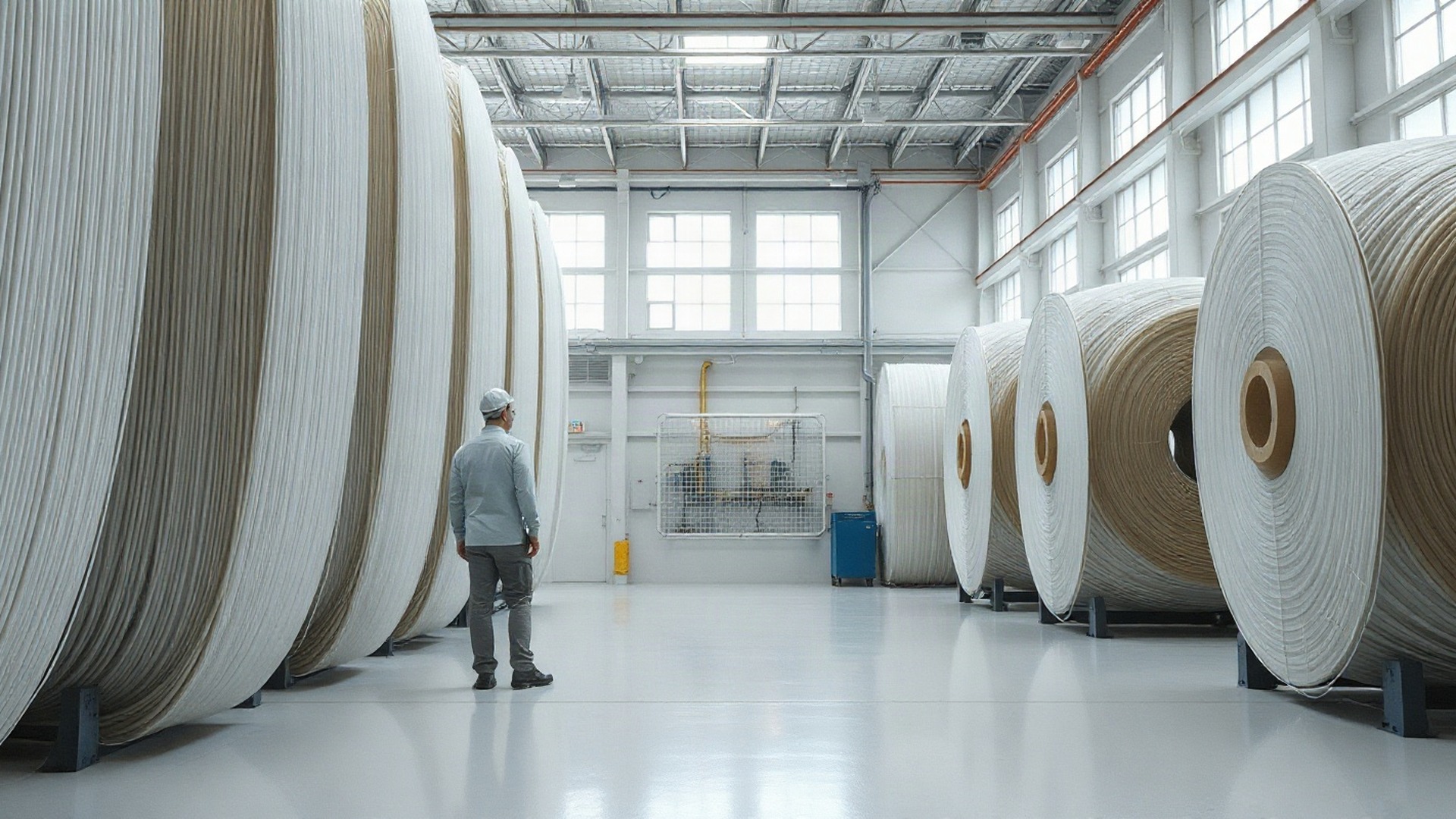
Corning and Verizon made it official September 8, and the AI wiring trade just added a new kind of buyer. The hyperscalers came for fiber first; now the carriers are in. Verizon signed a multi-year, multi-billion-dollar supply agreement for more than 80 million miles of Corning's high-density optical fiber, stretching from 2027 through 2032 — enough glass to circle the Earth about 3,200 times. Consumer broadband is part of it. The real prize is the "AI corridor."
| GLW Price | $165.96 |
| Market Cap | $142.7B |
| Forward P/E | 38.7 |
| Total Revenue (TTM) | $16.96B |
| 52-Week Low | $72.72 |
| 52-Week High | $271.78 |
| Analyst Consensus | Strong Buy |
| Analyst Target Mean | $194.31 |
Here's what Corning does, in one sentence: it makes the glass that data travels over. Corning is a 175-year-old materials-science company. It invented modern optical fiber and is still its largest manufacturer. That fiber, cable, and connectivity hardware is what data centers and carriers buy to move information at AI scale.
It also makes the Gorilla Glass in your phone. But the AI story lives in Optical Communications, its biggest and fastest-growing segment. Think plumbing, but for data: the pipes nobody sees, and nothing flows without them.
What did Verizon actually buy? Corning will supply fiber and connectivity solutions for consumer broadband expansion and for the national long-haul backbone hyperscalers depend on — the AI corridors that are fast becoming genuine national infrastructure. The marquee product is Contour Flow Cable, a flexible ribbon design that packs far more fiber into existing conduit, so carriers can add AI-era capacity without digging up the ground. The agreement deepens a partnership spanning roughly 30 years. Verizon Business CEO Kyle Malady calls the deal "securing the physical foundation of America's AI economy." Investors bought the framing: shares climbed about 7 percent on the news.
Zoom out, and this is the fourth fiber mega-deal of 2026. Meta started the year in January with an agreement worth up to $6 billion through 2030. Nvidia followed in May with a long-term partnership that includes up to a $3.2 billion investment and three new U.S. optical plants in North Carolina and Texas — part of a 10x expansion of optical-connectivity manufacturing capacity and a 50 percent boost in domestic fiber production. Amazon came next in June with a multi-year, multi-billion-dollar pact of its own.
Now Verizon. Four of the most important buyers in modern computing, all ordering the same thing: glass.
So why does a 175-year-old glassmaker belong in every AI conversation? Because GPUs compute, but data travels. Between chips, between racks, between data centers, information moves over glass, and every AI cluster on earth is a fiber consumer.
As clusters scale, copper keeps hitting its limits and glass keeps replacing it, with co-packaged optics and multicore fiber already waiting in the wings. The compute layer belongs to Nvidia and friends. The physical layer increasingly belongs to Corning — the pick-and-shovel supplier of the AI rush. It's a structural shift, not a cycle.
This isn't a hope story; the numbers are already moving. Optical Communications posted Q2 sales of $2.07 billion, up 32 percent year over year, with segment net income of $438 million, up 77 percent, good for a roughly 21 percent net margin. Enterprise Networks grew 65 percent, gen-AI product sales nearly doubled, and the segment has now grown for nine consecutive quarters.
The company is building for more of the same. Its upgraded Springboard Plan targets $20 billion in annualized sales by the end of 2026, $30 billion by 2028, and $40 billion by 2030. That's a roughly 19 percent compound growth path. CEO Wendell Weeks is even blunter: "the amount of fiber per data center is going to explode." The Verizon order is that thesis in action.
The toll road is the right metaphor. Anyone can rent GPUs by the hour, but no one can rent the glass Corning spent decades learning to make. It owns the draw towers, the factories, and the technology road map, and it now carries simultaneous multi-year backlogs from Meta, Nvidia, Amazon, and Verizon. This contract alone runs through 2032, stacking six years of visible revenue runway on top of the rest. That kind of visibility is what separates infrastructure owners from one-deal vendors.
For investors, the signal is clear: the carriers just joined the hyperscalers in the fiber queue. The stock is up roughly 90 percent this year as the market reprices Corning from glassmaker to AI backbone. GPUs power the boom, but glass carries it. Corning has reinvented itself before — from light bulbs to LCD screens to the fiber that wired the internet — and this chapter may be its biggest yet. Sometimes the purest AI play in the room is the company that invented the wire, 175 years ago.
Disclosure: The Signal holds no position in GLW. Positions may change. This is not financial advice.