
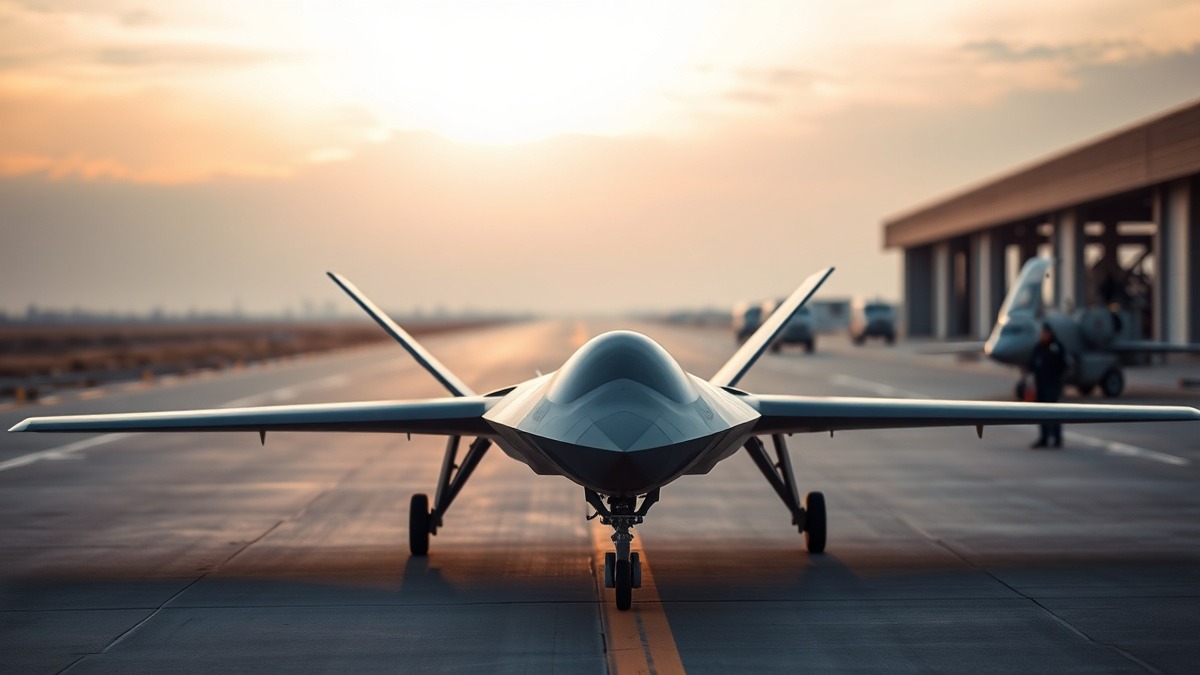
Let's get one thing out of the way: Kratos Defense & Security Solutions is not a defense contractor in the traditional sense. It doesn't build F-35s. It doesn't manage billion-dollar integration programs. It doesn't clip coupons on decades-old sustainment contracts. What Kratos does is build the actual hardware — jet-powered drones, solid rocket motors, hypersonic flyers, turbine engines — and it does so at a price point that the primes can't touch.
| q1Revenue | $371M |
| q1RevenueGrowth | +22.6% YoY |
| backlog | $2.01B (record) |
| bookToBill | 1.6x |
| pipeline | $14.3B |
| fy26RevenueGuide | $1.70-1.76B |
| hypersonicRevenue2026 | ~$400M |
| hypersonicRevenue2027Target | ~$700M |
| valkyrieCCAProgram | $231.5M (MUX TACAIR) |
| dowHypersonicFunding | ~$400M (July 2026) |
| defenseBudgetFY27 | $1.5T proposed |
The distinction matters because the Pentagon is in the middle of its most significant procurement shift since the Cold War. The era of the "exquisite" platform — the $150 million fighter jet that you baby through 8,000 flight hours — is giving way to something radically different: attritable mass. Cheap, capable, unmanned systems designed to be expended in contested airspace. Quantity as a quality all its own.
Kratos is the factory floor for that future.
Why the Marine Corps just bet $231.5 million on Valkyrie. The XQ-58 Valkyrie has been flying since 2019 — a fact that matters more than any spec sheet. While Lockheed and Boeing have concepts on PowerPoint slides, Kratos has hardware in the air, flying in formation with F-22s and F-35s. In January 2026, that real-world capability paid off: Northrop Grumman and Kratos won the Marine Corps' MUX TACAIR Collaborative Combat Aircraft contract, a $231.5 million award to turn Valkyrie into the service's first operational drone wingman.
This is not a science project. The 24-month OTA leads to production. Kratos is already expanding its Oklahoma City factory by 100,000+ square feet to ramp Valkyrie output, targeting roughly 40 units annually by end of 2027. International demand is following — Airbus purchased two Valkyrie airframes in April for the German Air Force, with a first European flight expected later this year.
The hypersonics flywheel. If Valkyrie is the narrative anchor, hypersonics is the financial accelerant. Kratos guided hypersonic franchise revenue to roughly $400 million in 2026, doubling over the prior year, with a path to $700 million in 2027. That confidence got a massive validation in July when the Department of War dropped approximately $400 million in new hypersonic funding on Kratos — cash arriving in June and accelerating into July, underpinning the back-half-weighted revenue profile.
Kratos is the only company delivering both propulsion and flyer systems for hypersonics — the Dark Fury and Erinyes flyers, plus Zeus and Oriole solid rocket motors. The MACH-TB test bed contract ($1.45 billion, five years) positions the company as the primary test infrastructure provider for the entire U.S. hypersonic enterprise. When the government needs to test a Mach 5+ system, Kratos is who they call.
The financial reality: investment phase, not maturity. Here's where the story gets honest: Kratos is in an investment phase, and the financial statements reflect it. Margins are thin — operating margin around 1.8%, EBITDA margin roughly 5.7%. Free cash flow is negative as the company builds factories, stocks long-lead materials, and invests in internal R&D. The stock has fallen more than 40% year-to-date, giving back most of the post-MUX TACAIR euphoria that pushed it toward highs not seen since January.
But the underlying metrics tell a different story. Record backlog of $2 billion. Book-to-bill of 1.6x in Q1. A bid and proposal pipeline of $14.3 billion. Full-year 2026 revenue guidance raised to $1.70-$1.76 billion after a Q1 beat. The company is guiding for 100 basis points of EBITDA margin expansion this year and another 100 bps in 2027 — operating leverage that should compound as Valkyrie and hypersonics transition from development to production.
The structural bet. The FY27 national security budget is proposed at $1.5 trillion — a $411 billion increase over FY26. And for the first time, the Pentagon has a specific line item: $13.4 billion allocated to autonomy. This is not cyclical defense spending. This is a generational recapitalization of the U.S. military's approach to air power, driven by the lesson of Ukraine: cheap drones beat expensive tanks, and swarms beat single points of failure.
The risk is real. Competition is coming — Lockheed is pivoting to expendables, Anduril is well-funded, and the Air Force's CCA Increment 1 went to General Atomics. Execution at scale is unproven. The stock trades at a premium that leaves no room for stumbles.
But the structural thesis is intact. The Pentagon is building a drone army. Kratos is building the drones. Everything else is noise.
Disclosure: The Signal holds no position in KTOS. Positions may change. This is not financial advice.