Imagine landing signed contracts with Google, Microsoft, Amazon, and Meta in roughly five weeks, only for the market to shrug and send your shares down roughly a third from their peak. That is where Constellation Energy sits today. The stock rallied about 12% the day the Google deal crossed the tape, but every bit of that gain has vanished. The market is treating the largest corporate nuclear power deals in American history like background noise.
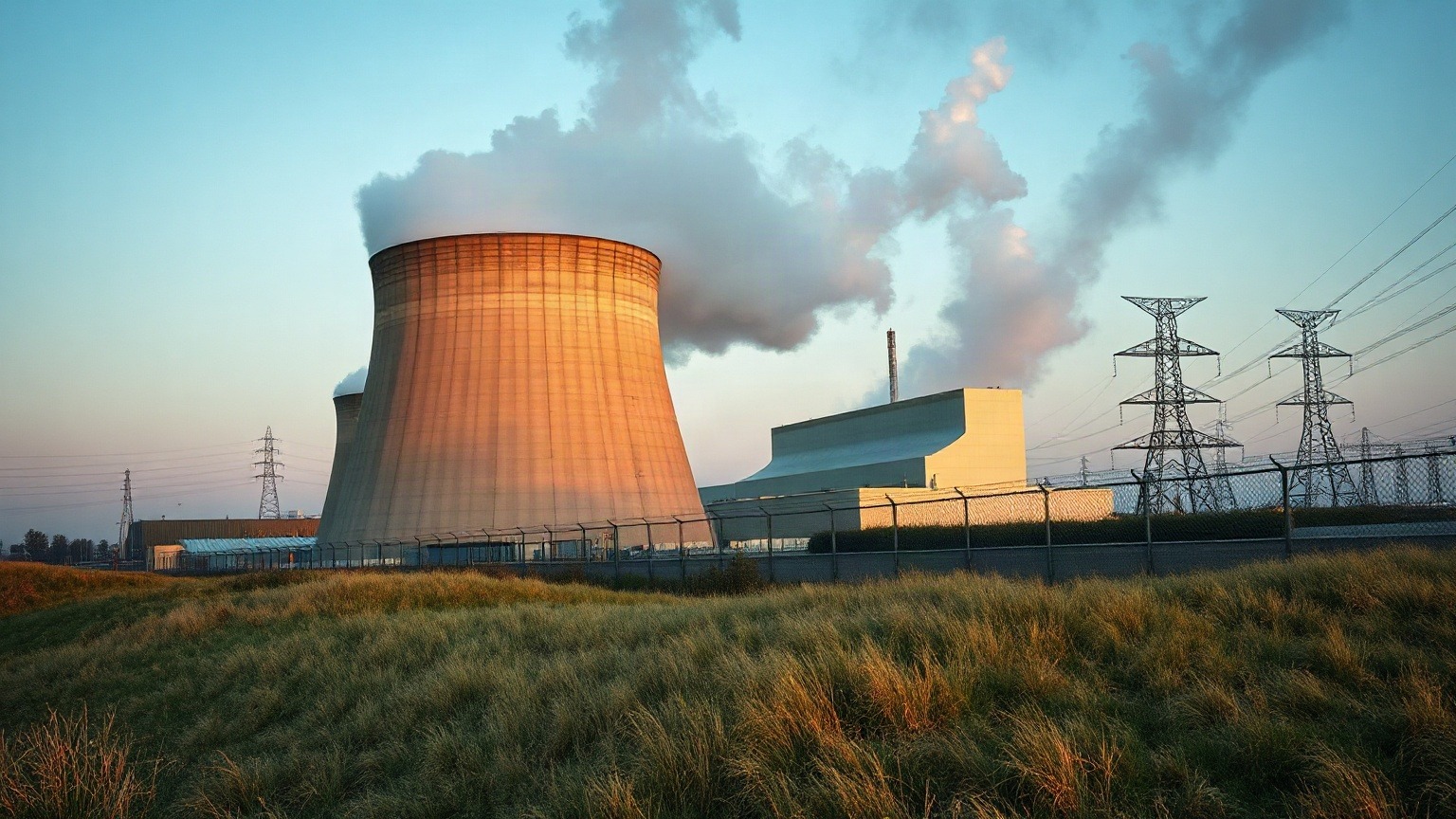
To understand why, you have to look at what Constellation actually sells. Think of the company as the landlord holding the keys to the only building on the block with reliable electricity. Constellation operates the biggest collection of nuclear reactors in the United States, running 21 reactors across 14 plants. Across nuclear, gas, hydro, and renewables, it manages roughly 55 gigawatts of generating capacity. It produces about 10% of America’s clean power, keeps the lights on for the equivalent of 27 million homes, and services 2.5 million retail customer accounts.
For decades, running a nuclear fleet meant accepting whatever wholesale price the power grid paid that hour. Artificial intelligence changed that equation overnight. Training models and running inference clusters requires an uninterrupted torrent of clean electricity that solar panels and wind turbines simply cannot guarantee when weather turns. Technology giants desperately need firm baseload power, and Constellation owns the only carbon-free fleet large enough to feed them.
| Price | $257.25 LIVE |
| Market Cap | $91.2B |
| Forward P/E | 19.2x |
| Total Revenue (TTM) | $31.3B |
| 52-Week Low | $228.63 |
| 52-Week High | $384.98 |
| Analyst Consensus | Buy (23 analysts) |
| Analyst Target Mean | $339.25 |
The problem for the stock is not the story. It is the arithmetic. Constellation announced more than $7 billion of commitments across its hyperscaler deals, but management has not disclosed the price per megawatt-hour on a single one. Even worse, the revenue from those contracts does not begin flowing until between 2027 and 2032. Analysts cannot model a premium the company refuses to quantify, especially when the cash arrives half a decade away.
The physical scale tells the same cautionary tale. Google’s agreement involves 890 megawatts of uprates across 11 units, demanding more than $4.3 billion of capital. Constellation’s own sensitivity figures show that a gigawatt of nuclear power contracted at a healthy premium yields $125 million to $325 million of annual free cash flow before growth. At full ramp, Google’s entire program will generate between $111 million and $289 million a year. That is roughly 1% to 2% of the $11.5 billion to $13.0 billion in cash flow the company targets for 2028 and 2029. It feels like buying an expensive annual gym membership for a workout class scheduled three years from now.
Meanwhile, roughly 70% of Constellation’s expected 2029 output still sells directly into the open merchant grid, where regulators set the ceiling. In the regional PJM market, electricity capacity prices cleared at the administrative cap of $325 per megawatt-day. For the upcoming 2029 and 2030 period, regulators set the cap at $337.83 and the floor at $181.91. Every $100 swing on Constellation’s cleared capacity moves after-tax earnings by about $1.44 a share. To complicate matters, grid operators recently proposed paying brand-new power sources up to $555 per megawatt-day to solve local supply shortfalls. The cap on Constellation’s existing reactors sits 39% below that number.
The bear case writes itself from these cash flows. Trailing twelve-month free cash flow has dropped from $1.288 billion in 2025 to roughly $309 million as spending accelerates. Net debt has swelled from $5.4 billion to about $24 billion following the Calpine acquisition. If the retired Crane reactor restart slips past 2027, or if Google’s first uprate misses its 2028 deadline, capital stays trapped without generating returns. Furthermore, hyperscalers are not exclusive partners; Google already turned to Georgia Power for another nuclear uprate deal. If December’s grid auction clears near the regulatory floor or if free cash flow stays suppressed, the scarcity thesis falls apart.
For Constellation to re-rate from its current utility-like valuation of roughly 19 times forward earnings, press releases will not cut it. The company needs to break its silence and publish the actual dollar terms on its hyperscaler contracts. Failing that, it needs to prove that grid scarcity is severe enough to keep merchant capacity pinned to the maximum regulatory cap.
What we are watching is the December 2026 PJM capacity auction, where Constellation has 18,875 megawatts on the line and the clearing price will reveal whether open-market power can match Big Tech’s promises.
Until those tech contracts deliver verifiable cash to the bottom line, investors will continue valuing atomic reactors like ordinary wholesale utilities.
Disclosure: The Signal holds no position in Constellation Energy Corporation (CEG). Positions may change. This is not financial advice.