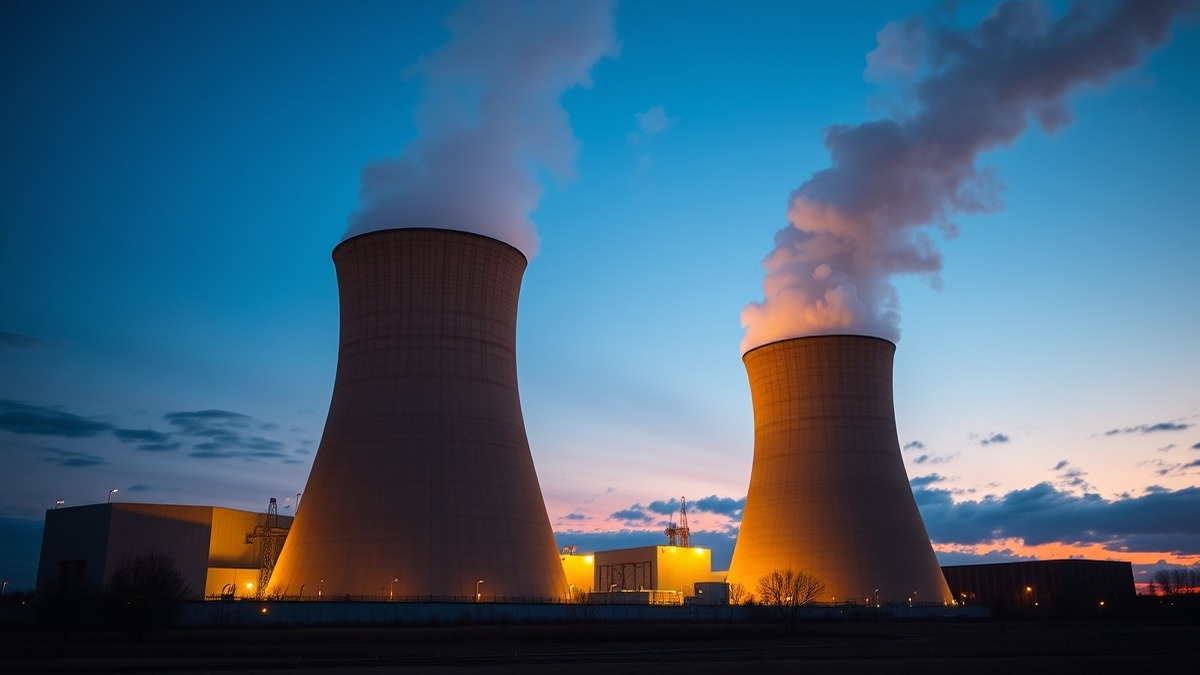
Here's a question that should keep every hyperscaler CEO up at night: where's the power coming from?
Everyone's been obsessing over GPU shipments, model training costs, and inference margins. But none of it works without electrons. And right now, America's grid is running on fumes. Coal plants are retiring. Gas faces permitting headaches. Renewables can't sustain 24/7 uptime. The one thing that can — that actually does — is nuclear.
Enter Constellation Energy. Ticker CEG. America's largest nuclear operator, controlling about 25% of domestic nuclear capacity with a 32-gigawatt fleet. That's not just a market share stat. That's a structural moat. Because nobody's building new nuclear plants at scale — but Constellation already owns a fleet of them, fully permitted, fully operational, pumping out carbon-free power around the clock.
And here's where it gets interesting. Three Mile Island Unit 1 — the reactor that survived the 1979 incident, stayed online until 2019, and was shut down for economic reasons — is coming back. Constellation signed a power purchase agreement with Microsoft to restart the plant, rebranded as the Crane Clean Energy Center, targeting operations in 2027. The FERC waiver was approved. The restart decision is imminent — as in weeks, not months. If this goes through, it's the first reactor restart in US history. And it's a proof point that nuclear can come back online fast enough to matter for AI.
That alone would be a story. But there's more.
Eight days ago, Constellation announced a strategic investment in Blue Energy — a company building a novel shipyard-based manufacturing model for new nuclear generation. Think modular construction, assembly-line efficiency, factory-built reactors delivered by barge. It's the kind of outside-the-box thinking that suggests CEG isn't just restarting old plants — they're figuring out how to build new ones cheaper and faster than anyone thought possible.
Then there's the Walmart PPA. The largest retailer in the world signed a deal with Constellation to power its Illinois operations with nuclear energy. That's commercial validation from a company that doesn't mess around with its supply chain. If Walmart trusts nuclear to keep its lights on, that's a signal to every other corporate buyer out there.
The Calpine acquisition, which closed late last year, doubled Constellation's revenue overnight to nearly $30 billion. It added natural gas and renewables to the mix, making CEG a diversified power giant instead of a pure nuclear play — but the nuclear fleet remains the crown jewel. In Q1 2026, earnings beat expectations, and management affirmed a 20%+ annual EPS growth outlook through 2029. That's not aspirational. That's a compounder hiding in plain sight.
The PJM capacity market — which covers a huge chunk of the Eastern US grid — is a massive tailwind. Data center demand is surging. Coal and gas plants are retiring. PJM capacity prices are reflecting real scarcity. Constellation's nuclear fleet, with its baseload reliability and zero-carbon profile, is perfectly positioned to capture those rising prices. Every megawatt-hour they sell gets more valuable as the grid tightens.
Now here's the part that makes this interesting: the stock is about a third off its 52-week high. It's been recovering over the last few days, but the market still seems to be pricing CEG as a slow-moving regulated utility rather than what it really is — the only pure-play nuclear IPP at scale, with restart optionality, hyperscaler PPA proof points, and a manufacturing innovation pipeline. There's a real disconnect between the narrative and the numbers. And in markets, that disconnect is usually where the money gets made.
The biggest risk? Execution. Restarting a nuclear reactor that's been dormant for years is hard. The Blue Energy investment is early stage. And if the AI trade cools off, enthusiasm for the power thesis cools with it. But if you believe — as I do — that the AI infrastructure buildout is a multi-trillion-dollar, decade-long trend, then Constellation Energy is one of the few names that actually owns the thing the market needs most: baseload power, at scale, with a clear path to grow.
Everyone's been asking which GPU maker wins the AI race. Maybe the right question is: which power company keeps the lights on while they figure it out?
Disclosure: The Signal holds no position in CEG. Positions may change. This is not financial advice.