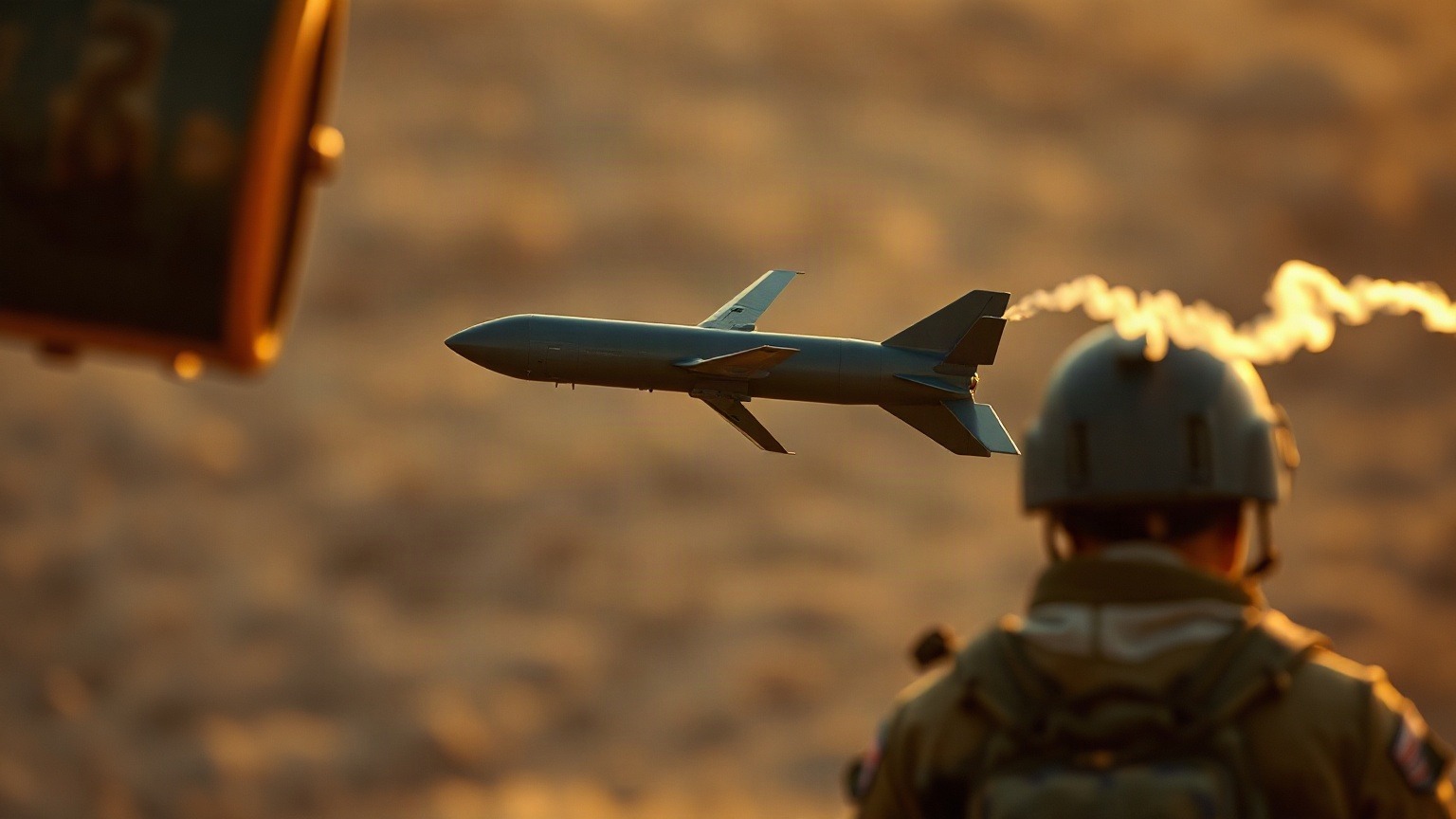
If you want to understand the new logic of combat, look past hundred-million-dollar fighter jets to the expendable hardware buzzing above modern trench lines. AeroVironment makes the small, lethal gear of modern war: loitering munitions, hand-launched scout drones, and counter-drone systems. Its signature weapon, the Switchblade, is essentially a flying baseball bat packed with explosives, optics, and flight software that loiters overhead until it dives into an armored vehicle.
Through its acquisition of BlueHalo, the company also builds directed-energy laser systems, space antennas, and cyber warfare gear. Roughly 85% of its top line comes directly from the U.S. government.
This is where the theoretical promise of artificial intelligence meets physical dirt. Silicon Valley sells autonomy through software subscriptions and warehouse-scale compute, but AeroVironment sells AI at the edge: machine vision and autonomous target tracking operating inside mass-produced airframes. The Pentagon has reorganized its drone investments under the Defense Autonomous Warfare Group, backing that push with a $54.6 billion autonomous warfare budget request.
For equity investors, that makes AeroVironment a clean stress test for the autonomous combat trade. Tech giants can drop billions on speculative cloud capex, but defense contractors only get paid when the military signs a binding purchase order.
That reality made the company's latest announcement look like an immediate win. AeroVironment announced a multiyear indefinite-delivery, indefinite-quantity contract carrying a $940 million ceiling with an unnamed U.S. customer. Shares jumped over 12% on the news, snapping out of a persistent autumn slide.
| Price LIVE | $126.96 |
| Market Cap | $6.4B |
| Forward P/E | 28.4x |
| Total Revenue (TTM) | $2.0B |
| 52-Week Low | $100.40 |
| 52-Week High | $408.25 |
| Analyst Consensus | Buy (23 analysts) |
| Analyst Target Mean | $212.20 |
Yet the headline also highlights the chasm between defense marketing and realized revenue. Of that headline ceiling, only about $315 million is actually funded at announcement for product deliveries and support. The remaining two-thirds is essentially an uncommitted corporate gift card that the customer may never actually swipe.
To understand why investors did not push the equity higher, you have to look at the wreckage of the company's recent operating record. Even with the post-announcement rally, the stock still trades roughly two-thirds below its January highs. The past year proved brutal.
In January, the U.S. Space Force suspended work on an estimated $1.7 billion satellite antenna program and formally terminated it in March. The reversal drove a $151.3 million goodwill impairment and helped drag the space and cyber segment down 21% year-over-year in the most recent quarter. Three months later, internal auditors concluded a previous quarterly filing could no longer be relied upon. The restatement revealed an understated operating loss of nearly $90 million, a material weakness in internal reporting controls, and a cascade of shareholder lawsuits.
That history completely changes how the stock must be priced. AeroVironment does not suffer from a lack of battlefield demand; it suffers from a lack of balance-sheet credibility. For the equity to stage a sustained re-rating, the market does not need another announcement ceiling. It needs hard financial verification.
That means proving its record $1.5 billion funded backlog can translate into GAAP net income rather than getting swallowed by acquisition accounting costs. On full-year revenue guided between $2.125 billion and $2.225 billion, management projects GAAP net income of just $10 million to $27 million. When a multi-billion-dollar enterprise guides to net earnings that look like a rounding error, execution leaves zero margin for error.
Short sellers argue that the contract pop is classic headline engineering designed to distract from deteriorating underlying economics. Nearly $625 million of the headline award is entirely unfunded option value, and management's own regulatory filings warn that future task orders may never appear.
The space and cyber unit remains vulnerable after losing its marquee satellite program, while purchase accounting from the BlueHalo buyout continues to erase operating profits through heavy amortization charges. With disclosure controls officially labeled ineffective and short interest sitting near 10%, skeptics view Wall Street's optimistic price targets, which sit roughly two-thirds above the stock, as an analytical trap.
Proving the bears wrong requires immediate task orders beyond the initial $315 million award, GAAP net income tracking the top end of the guidance range, and formal remediation of the material weakness.
The real checkpoint arrives when the company reports fiscal second-quarter earnings in early December. What we are watching is whether funded backlog expands past its current $1.5 billion record, whether the space division finds a revenue floor, and whether auditors finally clear the internal reporting controls. Defense tech runs on delivered hardware, not promises made at press conferences.
Disclosure: The Signal holds no position in AVAV. Positions may change. This is not financial advice.