The global technology economy runs on thousands of brilliant recipes that almost nobody knows how to cook.
Every tech company in your life designs chips. Apple sketches the processor running the phone in your pocket. Nvidia draws the architecture powering every generative model you try out online. AMD, Qualcomm, and Broadcom draft blueprints for high-speed modems and data-center accelerators.
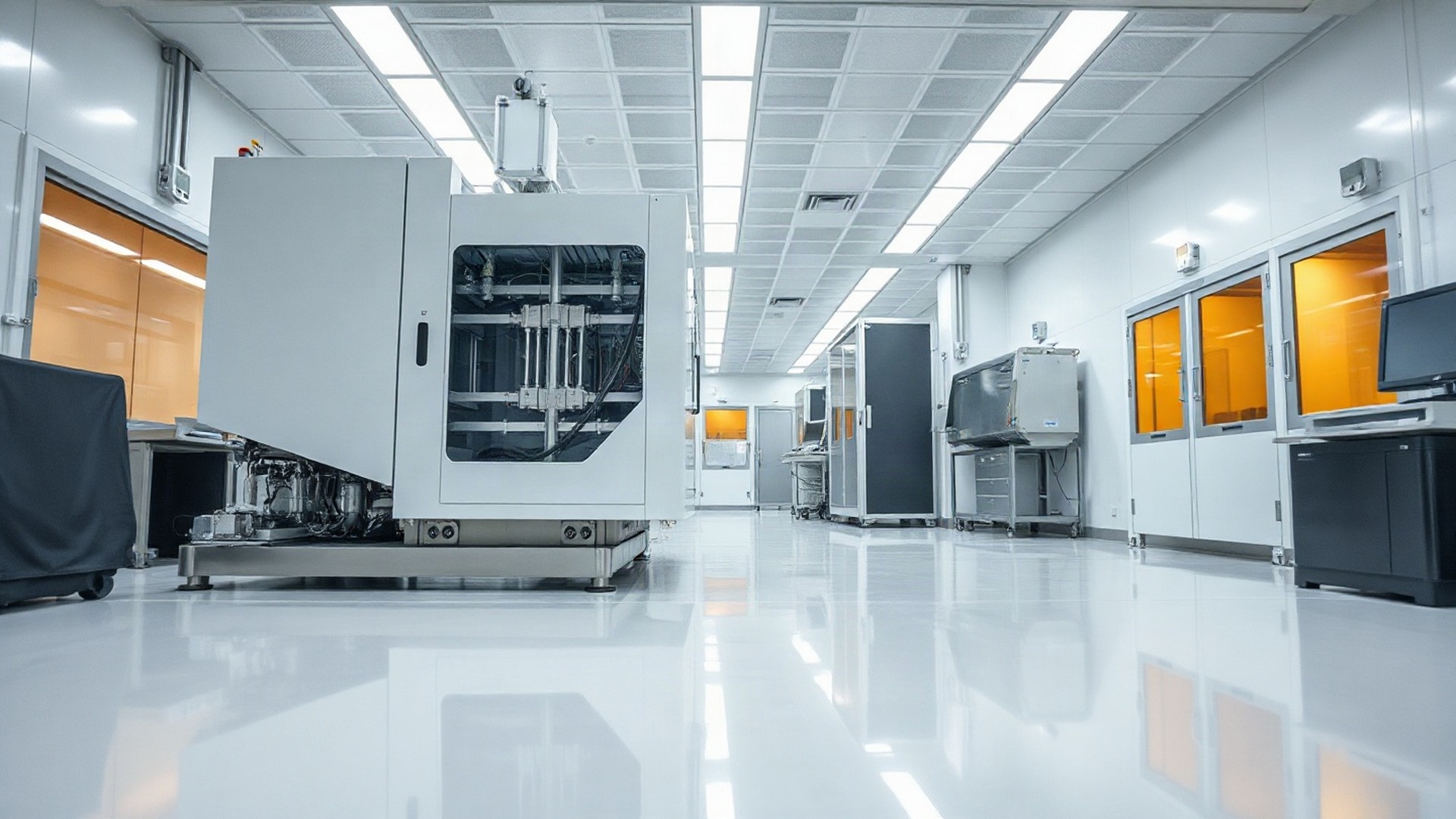
But none of those companies actually manufactures silicon at scale. They hand their digital blueprints across the Pacific to Taiwan Semiconductor Manufacturing Company. TSMC owns the only industrial kitchens on Earth capable of cooking those dishes at leading-edge volume.
| Price LIVE | $472.20 |
| Market Cap | $2.45T |
| Forward P/E | 21.5x |
| Total Revenue (TTM) | $139.6B |
| Gross Margin | 64.2% |
| 52-Week Low | $266.82 |
| 52-Week High | $487.47 |
| Analyst Consensus | Strong Buy (20 analysts) |
| Analyst Target Mean | $555.01 |
Think of TSMC not as an innovative restaurant, but as a mandatory toll booth on a one-way highway. The foundry does not care which software application captures your monthly subscription fee. It does not care whether Nvidia or an internal hyperscaler processor wins the next generation of cloud infrastructure. Its business model requires only one condition: whenever someone wants to build advanced computing hardware, they must pay TSMC to print the silicon.
That structural reality produced an eye-popping print for the third quarter of 2026. Because Taiwan exchange rules mandate monthly disclosures, the tally came straight from routine filings. Adding up July, August, and September, TSMC generated NT$1.49 trillion in quarterly revenue, or roughly US$46.7 billion. That is a 50% surge compared to the prior-year period. It sailed past the NT$1.46 trillion consensus SmartEstimate compiled by LSEG from nineteen analysts. It also cleared the top end of TSMC’s own guidance ceiling, which pegged revenue between US$44.6 billion and US$45.8 billion.
The top line broke the previous all-time quarterly record of NT$1.27 trillion, set just three months earlier. But the story here is not that revenue went up. The story is why the world's most critical bottleneck still trades at a modest valuation multiple while its biggest customers trade at stratospheric premiums.
The Mechanics of the Toll Booth
To understand why TSMC controls this market, you have to understand what a foundry actually does. Silicon manufacturing is not assembly-line work. You take a blank, circular disc of hyper-pure silicon—a wafer—and you project microscopic circuitry onto it using ultraviolet light.
The industry measures these processes in nanometers, or nodes. A smaller node packs more transistors onto the same square millimeter of silicon. More transistors mean faster calculations and lower power draw. That efficiency is the lifeblood of modern computing. If your data center runs hot, your power bills spike. If your smartphone processor drains battery, customers switch brands.
Designing these microscopic layouts is hard. Printing them without defects is exponentially harder. When a foundry ramps up a new node, early manufacturing batches often have high defect rates. If half the chips on a wafer fail inspection, the foundry burns money. As manufacturing yields improve, more chips survive, unit costs drop, and gross margins surge.
TSMC masters that learning curve faster than anyone else. Today, its advanced nodes account for roughly 74% of its entire wafer revenue. That concentration is why competitors cannot simply copy the business model. Samsung and Intel have spent billions trying to catch up, but TSMC's manufacturing yields keep it years ahead.
The current frontier is N2, TSMC's 2-nanometer production process. High-volume manufacturing for N2 has been running since the fourth quarter of 2025. The company is now tracking toward producing roughly 120,000 N2 wafers per month by the end of 2026, stepping up from roughly 100,000 wafers a month in August.
More importantly, customer demand for N2 is vastly outstripping its predecessor. Early tape-outs—the final design submissions sent to the factory to create production masks—are running at roughly four times the rate seen during the comparable ramp of the 3-nanometer node. Every serious designer in the world is lining up at the exact same counter.
Pricing Power Meets Physical Scarcity
When you control the only factory capable of building a mandatory product, traditional pricing rules change. For years, semiconductor foundries faced deflationary price pressure from aggressive hardware customers. That dynamic has flipped entirely on the leading edge.
Reports across the semiconductor industry indicate that TSMC is raising prices on its advanced manufacturing nodes by 5% to 10%. Separately, industry reporting suggests plans for additional price increases of up to 10% in 2027, with an extra premium attached to high-performance computing silicon. TSMC does not comment publicly on customer pricing negotiations. Yet the commercial reality is obvious: if TSMC raises prices, where else is a customer going to go?
Consider the alternatives. Building an alternative leading-edge fab requires years of lead time, specialized extreme ultraviolet lithography equipment, and tens of billions of dollars in upfront capital. Even if a rival spends the money, mastering the yields takes years of trial and error. TSMC's scale gives it an insurmountable operational moat.
The financial results reflect that leverage. Over the trailing twelve months, TSMC generated NT$4.44 trillion in revenue, or roughly US$139.6 billion. Its gross margin over that span sat at a remarkable 64.2%.
Generating cash is one thing; keeping it while building out global infrastructure is another. TSMC produced NT$1.12 trillion—about US$35 billion—in free cash flow over the trailing twelve months, even after accounting for massive capital expenditures. As of mid-2026, the company held NT$3.13 trillion in cash against total debt of NT$1.06 trillion.
The balance sheet looks like a sovereign wealth fund attached to a manufacturing plant. It generates enough internal cash to fund its next-generation fabs without leaning on volatile credit markets.
The Multiple the Market Refuses to Pay
Despite these numbers, TSMC's equity sits in an unusual spot. Even after posting a 50% revenue jump, the American Depositary Receipt trades a few percent below its all-time high. More telling is the valuation multiple. The stock trades around 21 times forward earnings.
Compare that to the companies buying its wafers. Nvidia and Broadcom trade at substantially richer forward earnings multiples, even though their products cannot exist without TSMC's fabs. The market is happy to pay a premium for software design and chip architecture, but it consistently discounts the company that prints the physical silicon.
Why does that discount persist? It comes down to two persistent investor fears: cyclicality and geography.
First, Wall Street treats manufacturing as a cyclical, capital-intensive grind. In traditional hardware cycles, foundries build too much capacity, demand slumps, and depreciation costs crush earnings. Even in an AI boom, some investors treat TSMC as a cyclical vendor rather than an essential platform.
Second, there is the unhedgeable reality of geography. The overwhelming majority of TSMC’s leading-edge manufacturing capacity sits on the island of Taiwan. No matter how much cash the company generates, investors apply a persistent geopolitical haircut to the equity.
For the stock to meaningfully re-rate higher, that discount has to narrow. That will not happen simply because revenue grows. It will happen only when the market accepts that TSMC possesses genuine structural pricing power that protects margins through any node transition. If reported price hikes turn into realized revenue while gross margins hold steady near 60%, the cyclical argument falls apart. Until then, the market treats TSMC as a brilliant utility rather than an AI monopoly.
The Short Seller's Argument
The bear case against TSMC does not require believing that artificial intelligence is a fad. It requires looking at customer math, node economics, and macro liquidity.
Start with the nature of the quarterly print itself. That NT$1.49 trillion revenue figure was calculated by financial reporters summing monthly disclosures. It confirms that wafers shipped, but it tells you nothing about profitability. New node ramps are notoriously dilutive to gross margins during their early stages. Tool depreciation and defect yields drag on profitability before efficiencies kick in. If the N2 ramp proves more expensive than modeled, margins could easily compress.
Then look at customer concentration. TSMC relies heavily on a tiny club of elite tech titans: Apple, Nvidia, AMD, Broadcom, and Qualcomm. If any one of these customers trims orders or delays a product launch, TSMC's leading-edge capacity utilization drops instantly.
Price hikes also create dangerous friction. Customers are already dealing with a brutal cost crunch in memory. Memory pricing has surged, illustrated clearly by Samsung guiding quarterly operating profit up more than 700% on the back of soaring DRAM and NAND flash prices. If chip designers face soaring memory bills alongside 10% price hikes from TSMC, their own margins take a beating. Squeezed customers eventually seek alternatives, redesign silicon, or delay rollouts. Intel and Samsung are both pouring billions into their foundry businesses, waiting for any opening to capture alienated clients.
The broader macroeconomic tape adds another layer of vulnerability. Financial markets have grown nervous as climbing oil prices and rising bond yields fuel fresh inflation concerns. Over at Bank of America, strategist Savita Subramanian has warned that AI-related stocks could hit an "air pocket" in 2026 as cloud hyperscalers increasingly rely on debt to fund massive infrastructure buildouts.
Every dollar of TSMC revenue represents capital expenditure by someone else. If higher borrowing costs force cloud giants to slow down data-center expansion, the foundry's order book will feel the chill immediately. And looming over all of it is geography. A single geopolitical flashpoint could freeze the supply chain overnight. In the eyes of a short seller, paying even 21 times forward earnings for a company exposed to these binary risks is simply too generous.
What to Watch on October 15
The true health of the business will become clear when TSMC delivers its audited third-quarter earnings report and updated guidance on October 15.
Consensus expectations are elevated. Analysts are projecting net profit to surge roughly 64% year over year to approximately NT$740.8 billion. But the headline profit figure is secondary.
The real signal lies in management's commentary on gross margins, the profitability trajectory of the N2 ramp, and any confirmation of the reported 2027 pricing adjustments. Those three factors will reveal whether TSMC is merely passing along inflationary costs or actively extracting monopolistic rents from the AI ecosystem.
TSMC remains the single indispensable node in modern computing. It prints the future of technology on twelve-inch discs of silicon, leaving everyone else to fight over the applications. The business owns the toll booth, but the market still questions the safety of the bridge.
Disclosure: The Signal holds no position in TSM. Positions may change. This is not financial advice.