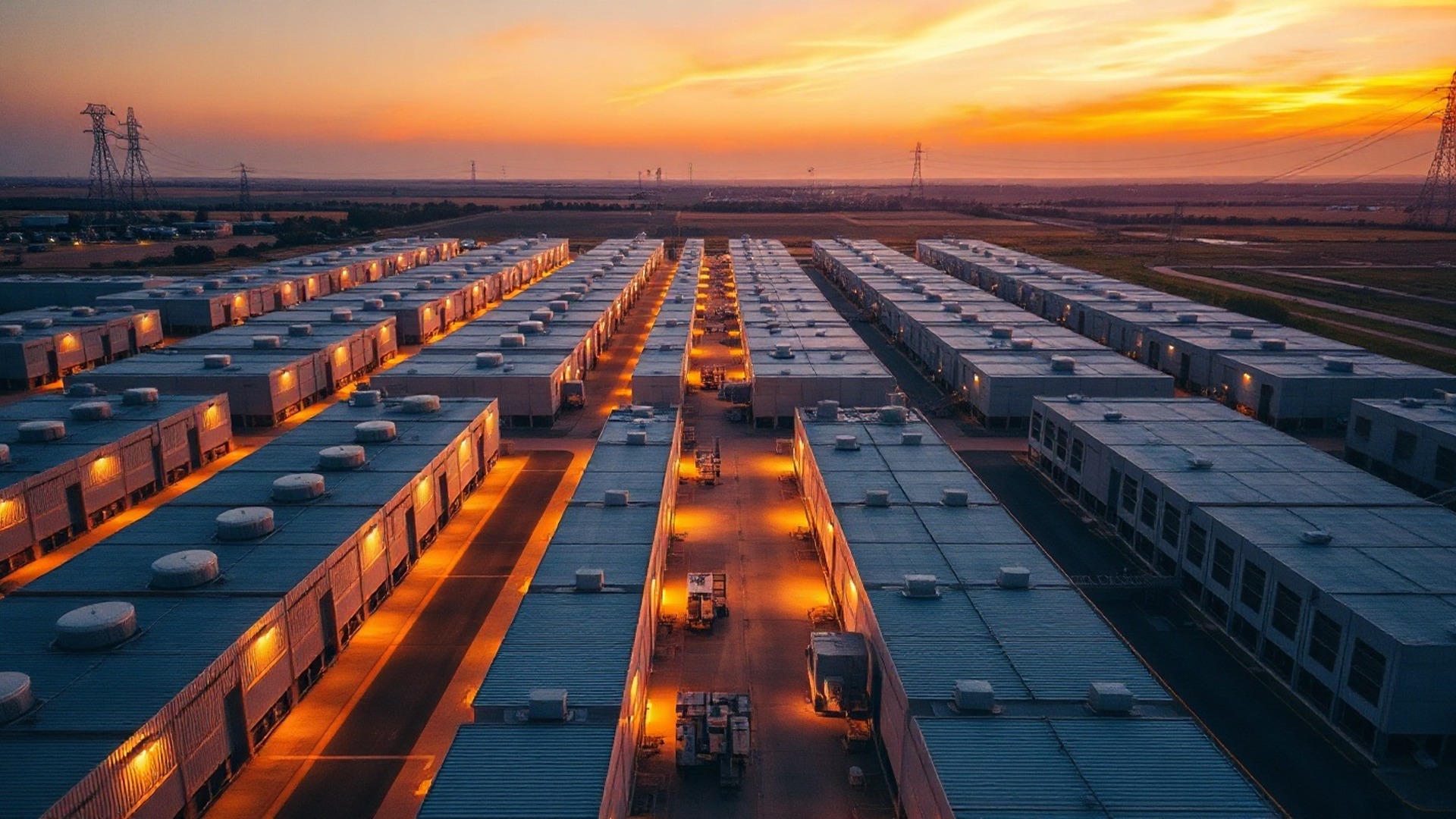
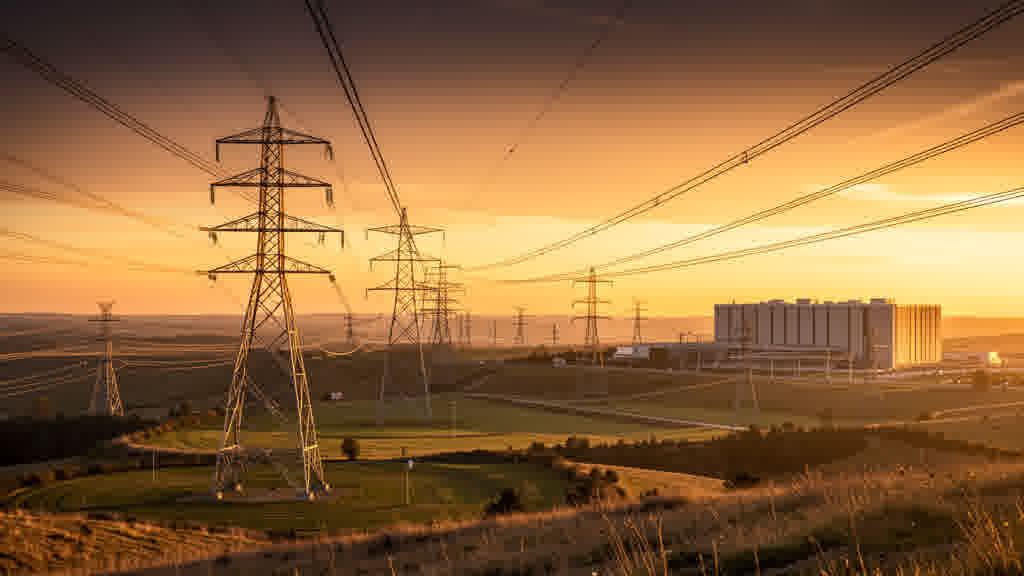
There are two ways to play the AI infrastructure buildout. You can chase the chip stocks — the Nvidias and Broadcoms of the world — where every earnings report is a knife fight and every product cycle resets the competitive landscape. Or you can buy the companies that get paid before a single GPU ever ships: the ones that generate the electricity, build the turbines, and wire the data centers.
That second group has a name right now, and it's the most crowded energy trade on Wall Street for a reason. Four companies — GE Vernova, Constellation Energy, Vistra, and Eaton — represent $595 billion in market cap, cover every link in the AI power chain, and share one thing in common: they're all sold out, way ahead of schedule.
Let's break down how each one wins — and why the sum is more interesting than any single name.
GE Vernova is the infrastructure backbone. With a $293 billion market cap and $38 billion in trailing revenue, it's the dominant supplier of the gas turbines that hyperscalers are buying as fast as GE can build them. Q1 2026 told the story: $18.3 billion in orders, up 71% organically, with the electrification segment alone capturing $2.4 billion in data center equipment orders — more than all of 2025 combined. The backlog hit a record $163 billion, and every gas turbine slot is sold through 2030. At $1,092 per share and 45x forward earnings, it's not cheap. But when your customer is the entire hyperscaler industry and you're the only supplier who can deliver at scale, pricing power tends to take care of itself.
Constellation Energy is the nuclear story, and it's the cleanest AI power thesis on the board. At $90 billion market cap with $25.5 billion in revenue, CEG is the largest nuclear operator in the United States and, after its Calpine acquisition in January, the largest private power producer in the world at roughly 55 gigawatts of generating capacity. The catalyst that every investor knows by now: Microsoft signed a 20-year deal to restart Three Mile Island's Unit 1, with Constellation supplying the carbon-free baseload power that AI training clusters need. Meta followed with a 1.1 gigawatt nuclear contract in Illinois. Analysts expect revenue growth of 29% and earnings growth of 30% this year. At 18.5x forward earnings with $3.6 billion in cash, it's the cheapest multiple in this group — the market is still pricing nuclear as a utility story when it's really a technology enabler.
Vistra is the dark horse with the widest moat. At $54 billion market cap and $17.7 billion in revenue, it's smaller than its nuclear rival Constellation but operates with more strategic flexibility. Vistra's integrated model — retail electricity, natural gas generation, nuclear, battery storage, and merchant power exposure — means it can monetize AI demand across every pricing mechanism in the market. The headline deal: Meta signed a 2.6 gigawatt nuclear-powered data center agreement with Vistra, one of the largest single corporate renewable/nuclear procurement agreements in history. At 14.7x forward earnings and just $785 million in cash against $20 billion in debt, the balance sheet is the risk factor here. But the cash flow math works: $4.1 billion in operating cash flow and $1.3 billion in free cash flow service that debt comfortably, and every new AI contract drops almost entirely to the bottom line.
Eaton is the electrical backbone that nobody talks about enough. At $158 billion market cap and $27.5 billion in revenue, Eaton isn't a power generator — it's a power manager, and that distinction matters. The company's Electrical Americas segment posted record Q1 revenue of $3.6 billion, up 20% YoY, with total backlog surging 48%. The thesis here is broader than AI: Eaton supplies switchgear, transformers, power distribution units, and the grid-to-chip infrastructure that every data center needs regardless of who's supplying the turbines or the electrons. Its pending $9.5 billion acquisition of Boyd Thermal adds liquid cooling capability — the next bottleneck in data center power density. At 25.8x forward earnings with $4.5 billion in operating cash flow, Eaton trades at a premium to the utilities but a discount to the industrial peers it should be compared to.
The unifying theme across all four names is that the demand is real, it's contracted, and it's multi-decade. The hyperscalers — Microsoft, Meta, Amazon, Alphabet — are guiding to a combined $710 billion in 2026 capital expenditure. That money doesn't buy GPUs alone. It buys gas turbines from GE Vernova, nuclear power from Constellation and Vistra, and switchgear from Eaton. The electricity has to exist before the training cluster can draw it.
The obvious risk is that this trade is getting crowded. Valuations across the group range from 14x to 45x forward earnings, and the AI energy narrative has become a consensus call on Wall Street. Any slowdown in hyperscaler CapEx — or a shift toward more efficient chip architectures that reduce power demand — would hit this group hard. Constellation and Vistra are particularly exposed to interest rates, given their debt loads and the long-duration nature of their power purchase agreements.
But here's the thing about consensus calls that are also structural realities: they're right until the underlying trend breaks. And the underlying trend — that AI needs exponentially more electricity, that the grid isn't ready for it, and that the companies building the infrastructure are sold out years in advance — hasn't started to bend yet.
The four stocks in this trade cover the full energy stack: generation (Vistra, Constellation), equipment (GE Vernova), and distribution (Eaton). Owning all four is a hedge against any single technology or regulatory shock. The nuclear operators win if carbon mandates tighten. The gas turbine builder wins if permitting delays push out nuclear timelines. The electrical equipment supplier wins regardless of which power source wins, because every data center needs transformers.
That's the real argument for this group right now. It's not about picking the single best AI energy stock. It's about owning the infrastructure layer that gets paid first, lasts the longest, and doesn't care whether the chip on the other end of the wire is an NVIDIA H200 or a Broadcom TPU.
Disclosure: The Signal holds no position in GEV, CEG, VST, or ETN. Positions may change. This is not financial advice.