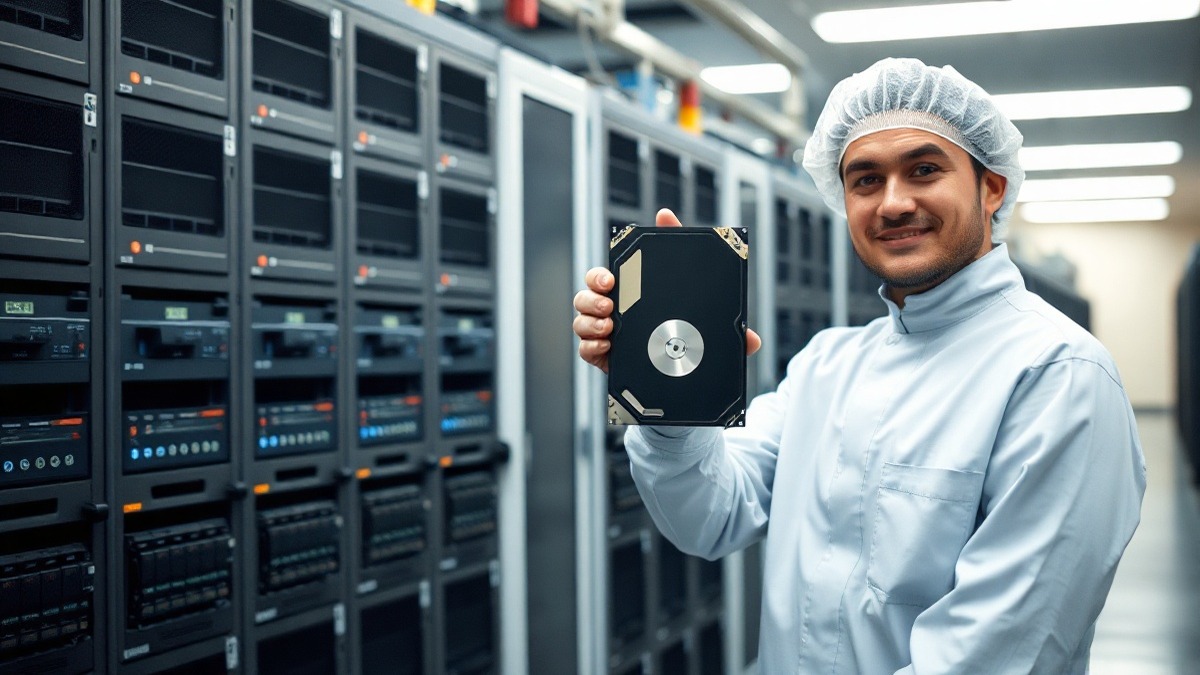
For a decade, the smartest take on hard drives was that they were a sunset business — a slow, dignified decline into irrelevance as flash memory swallowed every workload in sight. Seagate just put that thesis through the shredder. The company that was supposed to be managing a managed decline reported a fiscal fourth quarter so strong the stock kept climbing for days afterward, and then management casually revealed something no hardware maker should ever be able to say: nearline capacity is nearly fully committed through calendar 2027, with hyperscalers locked into both configuration and pricing. The hard drive isn't dying. It's the scarcest thing in AI right now.
| Price LIVE | $973.44 |
| Market Cap | $221B |
| Forward P/E | 17.6 |
| Total Revenue (TTM) | $12.2B |
| 52-Week Low | $152.50 |
| 52-Week High | $1,145.00 |
| Analyst Consensus | Strong Buy |
| Analyst Target Mean | $1,115.87 |
The backdrop matters, because this is not the storage rally of 2020. On August 14, the Wall Street Journal grouped Seagate with Sandisk and Micron as the data-storage and memory names that "have flown higher" — and for good reason. AI's training runs get the headlines, but the data they chew on has to live somewhere, and the cheapest place to park exabytes of warm data is still a spinning disk. Every hyperscaler buildout this cycle carries a hard-drive line item, and Seagate is the last pure-play scale supplier of nearline drives left standing. Shares have more than tripled year to date and are up roughly six-fold over the past twelve months — which sounds like a peak-cycle tell until you actually look at the order book.
The reason this cycle is different is HAMR — heat-assisted magnetic recording — the technology Seagate spent more than a decade and billions of dollars bringing to production under the Mozaic brand while rivals dithered. HAMR already accounts for roughly 40% of nearline exabyte shipments and is on track to reach about 70% by July 2027. The Mozaic 4+ platform, with drives up to 44TB, is in production at two of the largest hyperscalers on the planet, and the Mozaic 5 generation — 50TB-class drives packing more than five terabytes per platter — starts qualification shipments in late calendar 2027. That is a genuine technological moat in an industry that had convinced itself there was nothing left to invent.
Here's the part that should make you sit up. Seagate's nearline capacity is nearly fully committed through calendar 2027 through build-to-order contracts that lock in both configuration and pricing with hyperscalers, and some industry reports say most drives are sold out through 2028. For a hardware maker, that kind of multi-year visibility is almost unheard of. Revenue is booked, margins are contracted, and the surprise risk sits mostly on the upside. This is what an AI-driven storage supercycle actually looks like from the factory floor: not hype, but a backlog.
The numbers back up the narrative. Fiscal Q4 revenue came in at $3.629 billion, up 48.5% year over year, with non-GAAP EPS of $5.71 beating the $5.10 consensus by 12% and more than doubling year over year. Gross margin hit 52.7%, up from 37.9% a year earlier — a fifteen-point swing that proves HAMR pricing power is real — and quarterly free cash flow was $1.1 billion, up 163%. For the full fiscal year, revenue reached $12.2 billion, up 34%, GAAP net income was $3.18 billion, up 117%, and free cash flow hit a record $3.1 billion, up 279%. Management retired $1.4 billion of debt, returned $810 million to shareholders, and posted non-GAAP EPS of $15.58. Then came the guide: fiscal Q1 revenue of $4.1 billion plus or minus $100 million versus roughly $3.78 billion expected, non-GAAP EPS of $7.30 against a $5.85 consensus, sequential growth and margin expansion through fiscal 2027, and an annual revenue growth target raised to a minimum of 20%.
Wall Street has responded in kind. The consensus sits at strong buy, and the post-earnings wave of target hikes reads like a bidding war: BNP Paribas lifted its target from $1,050 to $1,275, Barclays from $1,000 to $1,250, Morgan Stanley from $1,035 to $1,187, Citi from $1,240 to $1,300, and Rosenblatt from $1,300 to $1,400. When analysts are racing each other upward in lockstep, the tape is telling you the fundamental story is intact — not that any price is cheap. The rerating has already happened; the question is whether the execution keeps up.
Now the bear case, because there is always one. Hard drives were written off as a dying technology for years, and the memory and storage complex is still brutally cyclical — this is the same industry that destroyed itself with oversupply just a few years ago. The biggest risk is a hyperscaler capex air pocket: if even one or two of the big cloud buyers pause their buildouts, a sold-out order book can empty faster than it filled. Seagate's valuation has also repriced dramatically, so the market is no longer paying sunset-business multiples — which means the bar for continued execution is high and the margin of error is thin.
For now, the setup is about as good as it gets in hardware: a genuine technology lead, contracted revenue stretching through 2027, record cash generation, and a balance sheet that gets healthier every quarter. The hard drive's obituary was written years too early, and Seagate is collecting on it. Buy the dips, respect the cycle, and remember that in storage, the winners are the ones who own the capacity when the tide comes in.
Disclosure: The Signal holds no position in STX. Positions may change. This is not financial advice.