$20.7 billion is a number built to move a stock on the day it lands. Read the fine print and the Pentagon had actually committed about $240 million.
| Price | $185.01 |
| Market Cap | $249.6B |
| Forward P/E | 23.57 |
| Total Revenue (TTM) | $93.5B |
| 52-Week Low | $155.64 |
| 52-Week High | $226.88 |
| Analyst Consensus | Buy (22 analysts) |
| Analyst Target Mean | $234.14 |
RTX is the parent most people know as Raytheon. It builds missiles and the radars that guide them, jet engines through Pratt & Whitney, and cockpit systems through Collins. The customer here is the U.S. Air Force, the Navy, and an allied row of air forces that buy American interceptors.
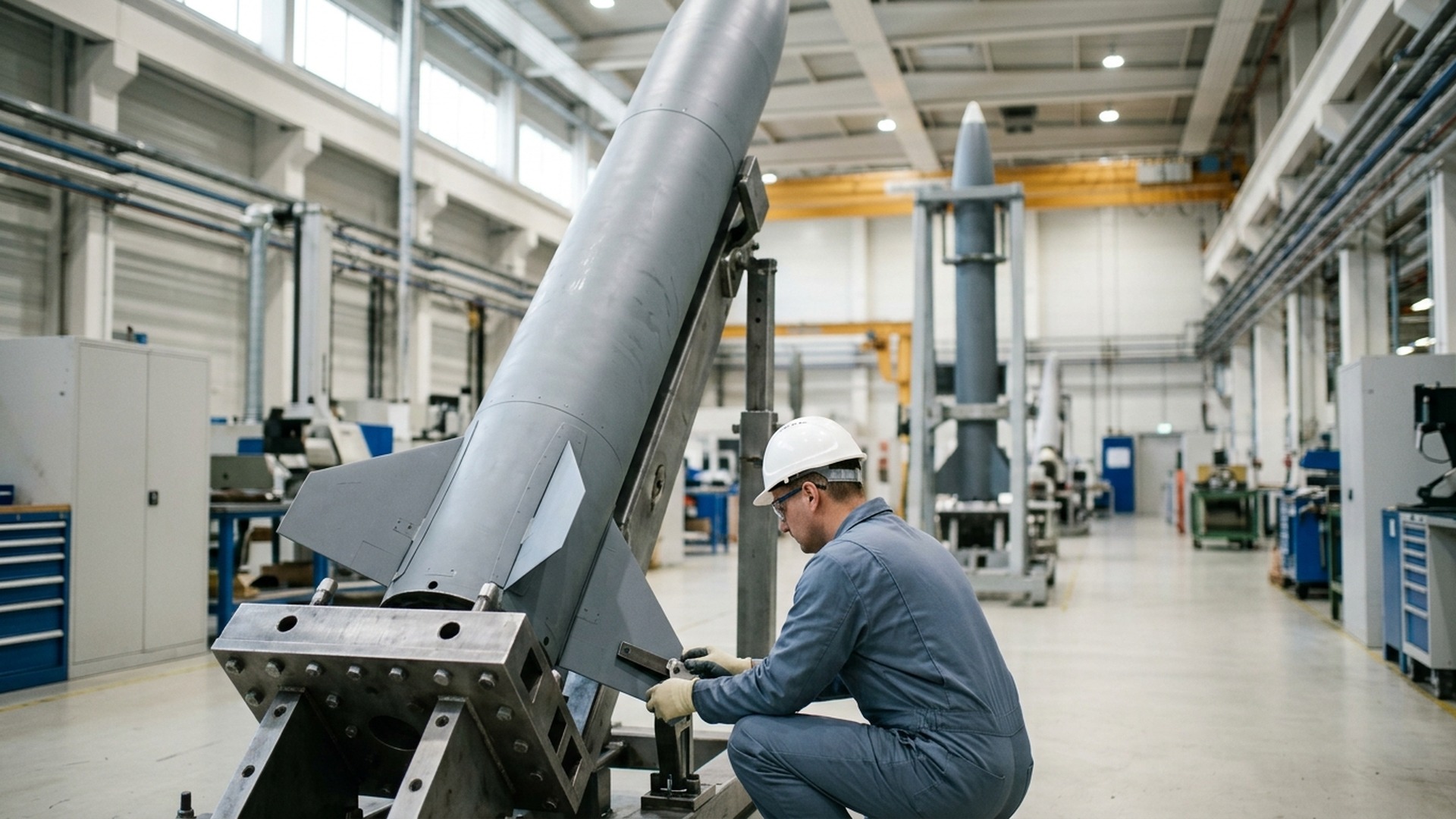
AMRAAM is the air-to-air missile fighters fire beyond visual range. It is in its fifth generation, flies on 14 platforms, and is fielded by 44 countries.
The award is a five-year multiyear contract with two option years, valued at up to $20.7 billion. It was awarded on Sept. 25 and announced three days later. Reuters calls it provisional for a reason: Congress has not appropriated the full multiyear funding, so contractors may struggle to invest at scale until lawmakers act.
It is one piece of a pattern. RTX also holds a $22.9 billion, seven-year Tomahawk contract that lifts output toward more than 1,000 missiles a year, from roughly 60 today. On Oct. 1, the Navy added a $24.4 billion SM-6 interceptor deal with the same five-year-plus-two-option structure as AMRAAM.
Why does a missile maker belong in the AI conversation? Because the modern interceptor is a sensor-and-software problem wrapped in metal. AMRAAM carries processors that let crews push software updates to outpace new threats. RTX is also working with Shield AI on autonomy for its loitering munitions and targeting sensors.
Think of a restaurant kitchen that can plate only so many covers an hour. You can take reservations for the entire year; the dining room still fills at the speed the line cooks move. The Pentagon just booked the whole year.
That is why the real story is capacity, not demand. A solid rocket motor is not a phone; there is no over-the-air update for propellant. Northrop Grumman plans to lift annual output from more than 13,000 units to 25,000, but not until 2029. L3Harris is spending $1.3 billion in Virginia and building or expanding more than 30 sites to catch up.
Seekers, energetics, machine tools and machinists are just as tight, and none scale in a quarter. Raytheon's management has effectively admitted it. On the second-quarter call, executives described "at least over two years of quarter-over-quarter material receipts going up." RTX is now juggling hundreds of small and mid-sized suppliers and exploring international co-production.
The order book and the income statement tell different stories. RTX carried a record $289 billion of backlog last quarter, split between $170 billion commercial and $119 billion defense. Raytheon booked $19.9 billion against $8.3 billion of sales, yet still ran the thinnest operating margin of RTX's three segments, at 12.6%.
So what has to happen for this equity to re-rate? Raytheon has to convert backlog into shipped hardware at a richer margin, and the market has to believe the funding is real. RTX trades near 23.5 times forward earnings; Lockheed Martin, Northrop and General Dynamics sit near 15 to 18. That is a third-to-a-half premium for a mix that has not earned it.
The bear case is not hard to build, and a short-seller would open with the ceiling. The $20.7 billion is not cash: only about $240 million was obligated at award, and if appropriators slow-walk it, Raytheon cannot fund new factories against a promise. Capacity spending runs ahead of revenue, so any slip in the ramp dents free cash flow before it lifts margin.
The mix makes it worse. Raytheon's 12.6% margin is the weakest of RTX's three segments. Undefinitized fixed-price terms have a habit of becoming charges when costs land above the ceiling. Pratt & Whitney's powder-metal remediation, pegged at $6 billion to $7 billion in gross cost with 600 to 700 engine removals, compounds it. The bear case has real weight.
What would prove the bears right is specific. If the multiyear appropriation stalls while defense margin sits near 12.6% and backlog keeps ballooning, the award was a headline, not a business. Watch both in the same print.
There is also a cheaper threat coming. The Army wants a counter-drone missile under $150,000 a round. The Pentagon's low-cost cruise missile program signed Anduril, CoAspire, Leidos and Zone 5 to buy more than 10,000 rounds starting in 2027. Raytheon's Coyote interceptor is its answer, with 600 combat intercepts claimed in one campaign.
That makes the next earnings report the checkpoint. RTX is expected to report third-quarter results in late October, and the numbers that matter are Raytheon's operating margin and whether the multiyear money clears Congress. Those two lines decide whether the capacity build pays off.
A $20.7 billion award that obligates $240 million is optionality, not revenue. The missiles are already sold. Whether the factories, the motors and the funding arrive before that window closes is the whole bet.
Disclosure: The Signal holds no position in RTX. Positions may change. This is not financial advice.