Most rocket companies sell a single ride. Rocket Lab just signed one customer up for twenty of them, spread across four years.
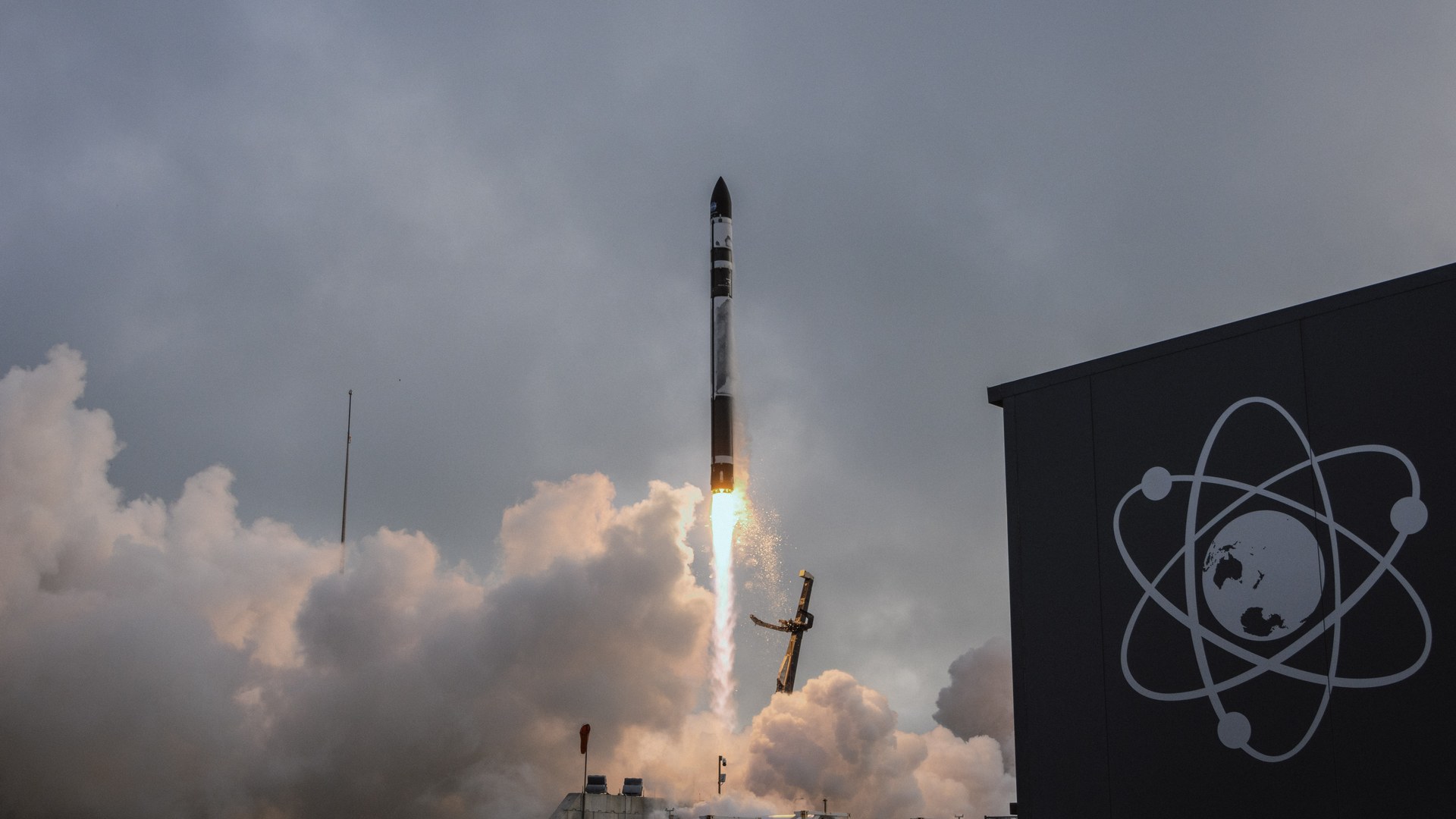
Here's what Rocket Lab actually does. It builds small orbital rockets, called Electron, that carry satellites to orbit. It also builds the satellite hardware that rides inside them, sold to commercial constellation operators and government and defense agencies.
So don't picture a one-off transaction. Picture a phone plan. A customer who needs a fleet of satellites comes back launch after launch, and every returning customer thickens the order book.
| Price LIVE | $73.92 |
| Market Cap | $47.3B |
| Forward P/E | N/A |
| Total Revenue (TTM) | $769.1M |
| 52-Week Low | $37.57 |
| 52-Week High | $151.00 |
| Analyst Consensus | Buy (20 analysts) |
| Analyst Target Mean | $109.15 |
On Sept. 30, Rocket Lab announced a multi-year launch agreement with Synspective, a Tokyo-based Earth-observation company, for 20 new Electron missions. It is the largest commercial launch contract for Electron in company history.
Those flights are scheduled annually from 2028 through 2031, each carrying a StriX synthetic-aperture-radar satellite to sun-synchronous orbit from Rocket Lab's Launch Complex 1. Other terms stayed undisclosed.
For Synspective, this is now the deepest relationship in Rocket Lab's book. The new missions lift its total Electron count to 47, the most of any customer.
And the orders stack. Several multi-launch contracts awarded this year pushed Rocket Lab's launch backlog above 100 missions. Total backlog, counting launch and space systems, sits at $2.36 billion.
There's fresh proof in the pipeline, too. On Sept. 25, the company's 97th Electron mission, its 18th of 2026, deployed a Synspective satellite — the customer's 13th StriX in orbit.
That cadence is the whole trick: a deal running to 2031 hands Rocket Lab four years of scheduled launches, the closest thing a rocket company gets to predictable revenue.
Why would an AI investor care about any of this? Because the AI buildout is reaching orbit. Google's first orbital TPU test flew on a SpaceX Falcon 9 on Oct. 1, 2026. That is the signal.
Rocket Lab is one of the few non-SpaceX suppliers of both launch and satellite platforms. It is not involved in Google's orbital test. The point is structural: AI compute, data relays, and defense networks all need hardware in the sky.
Now the part that moves the stock. Rocket Lab has said adjusted EBITDA turns positive once Neutron starts flying. That makes the medium-lift rocket the switch between a money-losing story and a self-funding one.
Neutron is a 13-ton-to-LEO, partially reusable medium-lift rocket, 43 times the payload of Electron. Investors care about it far more than the small rocket, because it is the bigger prize.
Electron is the dependable commuter car. Neutron is the freight truck. One keeps the lights on, the other decides what the whole garage is worth.
Is the market pricing that right? At roughly 60 times trailing revenue on a business still losing money, it is already paying for Neutron's success. The question is timing, not direction.
The finances set the stage. Trailing-twelve-month revenue is $769.1 million. Last quarter revenue rose 62% to $234.1 million, but the net loss was $49.3 million.
The balance sheet is the cushion. Cash and short-term investments stood at $2.30 billion on June 30. In September, Rocket Lab raised $1.94 billion in stock to fund the pending $8 billion Iridium acquisition.
That deal adds a global L-band network, licensed spectrum, and roughly 2.6 million subscribers. Iridium shareholders approved it on Sept. 24, with the close expected around mid-2027. Funding it meant issuing roughly 29 million new shares.
The government side is compounding, too. This year Rocket Lab was onboarded to the $981 million NITE-STAR program and picked for the Space Data Network Consortium with $12 million in contracts. That is real defense money.
Wall Street is leaning in, as well. Twenty analysts cover the stock with a consensus Buy rating and a mean target above where shares trade now.
Bears tell it like this. Neutron has blown through every deadline: mid-2025, late 2025, Q1 2026, now late 2026. In January its Stage 1 propellant tank ruptured in a pressure test, and the current target is pad delivery, not a launch date. If first flight slips past 2027, a business valued near 60 times trailing revenue has nowhere to hide.
So here's your dashboard. The event is Neutron's first flight, now sliding toward 2027. The number to watch is the launch backlog, which needs to hold above 100 missions on the Q4 2026 update. Hit on the rocket and hold the backlog, and the bulls can wait.
Disclosure: The Signal holds no position in RKLB. Positions may change. This is not financial advice.