Everpure, the storage company formerly known as Pure Storage, sells the heavy-duty flash memory that keeps modern digital infrastructure alive. When your phone pulls up a photo album from the cloud or an enterprise queries a financial database, that data lives on flash arrays rather than spinning hard drives. Everpure builds the proprietary storage modules and operating software that sit beneath corporate databases, virtual machines, and massive artificial intelligence training clusters.
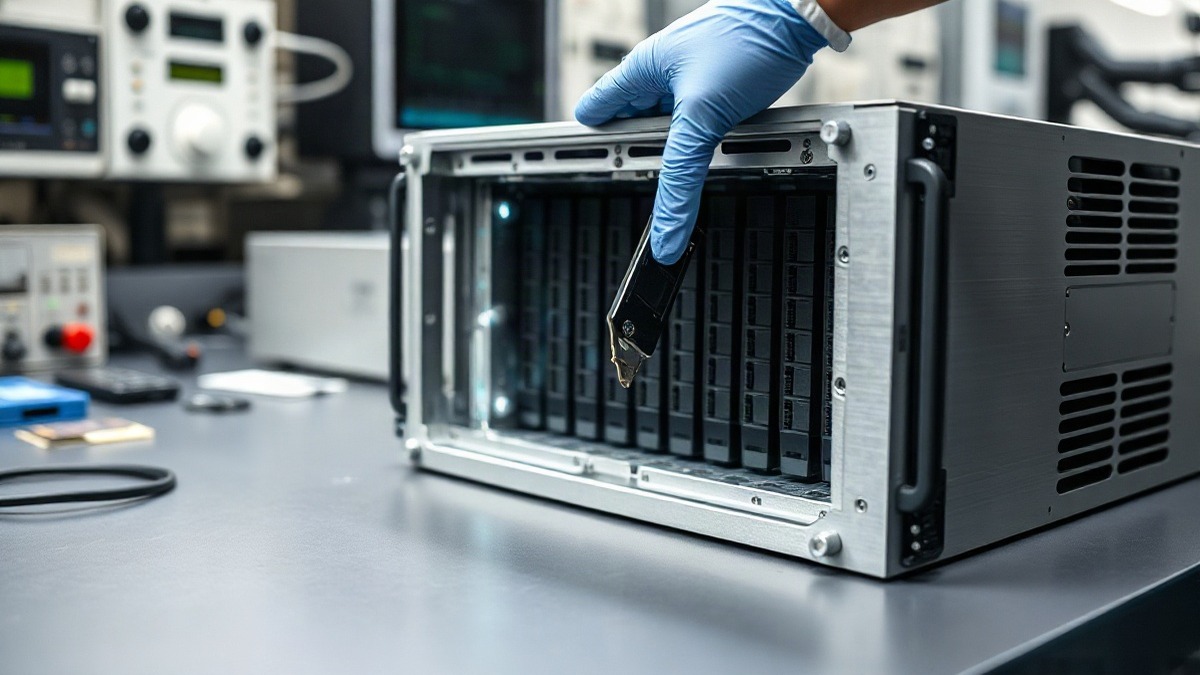
Most enterprise storage makers buy standard solid-state drives off the shelf, but Everpure strips that commodity hardware down to the bone. Standard drives carry their own individual memory controllers and on-board DRAM chips, essentially duplicating tiny computers inside every single slot. Everpure’s DirectFlash modules remove those parts entirely, letting its central Purity operating software manage raw silicon across the entire cabinet. That architecture cuts power draw, eliminates wasted overprovisioned memory, and turns dumb storage into an optimized system.
| Price | $94.69 |
| Market Cap | $31.6B |
| Forward P/E | 22.1x |
| Total Revenue (TTM) | $4.76B |
| 52-Week Low | $56.78 |
| 52-Week High | $157.57 |
| Analyst Consensus | Buy (19 analysts) |
| Analyst Target Mean | $148.21 |
That architectural difference makes Everpure a critical bottleneck solver in the artificial intelligence buildout. While the market fixates on training mega-models, the everyday cost of running them comes down to inference speed. In benchmarking tests, Everpure's FlashBlade//EXA swept the top spots for checkpointing and key-value cache handling. The key-value cache acts like short-term working memory during an AI chat, holding the entire conversation context so the model does not have to recalculate every word. When thousands of users query an application simultaneously, standard storage chokes on those reads, leaving expensive graphics chips idling while they wait for data.
Think of traditional storage vendors as landlords renting fully furnished apartments, while Everpure is turning into the architect licensing building blueprints to the city's largest developers. In its latest fiscal quarter, revenue jumped 51% to nearly $1.46 billion, yet non-GAAP gross margin contracted to 69.2%. The knee-jerk reaction in the market was that Everpure was sacrificing profitability to chase volume in commoditized boxes. In reality, that single margin figure is blending two businesses operating with completely inverted economic models.
On one side sits the traditional enterprise hardware business, where Everpure sells fully built systems against Dell and NetApp. With semiconductor components at decade-high costs, those core product sales generate gross margins at the low end of a 65% to 70% range. On the other side sits a quiet hyperscale licensing business. Instead of sourcing expensive memory and assembling servers, Everpure licenses its Purity software and DirectFlash design to cloud giants who build the hardware themselves. Everpure collects pure royalties at gross margins between 75% and 85% with zero working capital tied up in metal or silicon. Because both streams sit inside reported product revenue, the surging licensing math remains invisible on the surface.
This reporting structure explains why the stock sits roughly 40% below its autumn highs despite raised full-year guidance and record quarterly operating cash flow of $443 million. Wall Street is valuing the company as a cyclical hardware seller exposed to volatile component prices because it cannot separate the software royalties from box shipments. That changes only when management separates the two, which it does once a year. For the stock to decisively re-rate, the licensing royalty stream has to prove it is a material earnings driver rather than a novelty project.
The bear case insists Everpure is buying its growth at an unsustainable price and walking into a cyclical trap. To hit 51% revenue growth, management cut prices across most models entering the current quarter even as component costs hovered near ten-year peaks. At the same time, the company stockpiled inventory up fivefold to $379.5 million and tripled prepayments to $967.1 million, making a massive bet on persistent chip scarcity. If industry forecasts prove accurate and memory contract prices start sliding early next year, Everpure will be stuck holding high-cost inventory while enterprise competitors slash prices. Worse, recurring subscription revenue rose only 19%, dropping services to 35% of total revenue. If hyperscalers treat the licensing design as a temporary lesson before designing their own internal workarounds, Everpure is left as a low-margin hardware assembler trading at a premium platform valuation.
The turning point arrives in late February with fiscal fourth-quarter results, where management will finally break out the full-year scale of its hyperscale and modern data software business. That report will settle whether Everpure is successfully converting cloud infrastructure into an asset-light intellectual property engine or simply selling metal in a tightening market.
Disclosure: The Signal holds no position in P. Positions may change. This is not financial advice.