For two years the story was simple. OpenAI and Anthropic set the price and everyone else paid it. That story just broke.
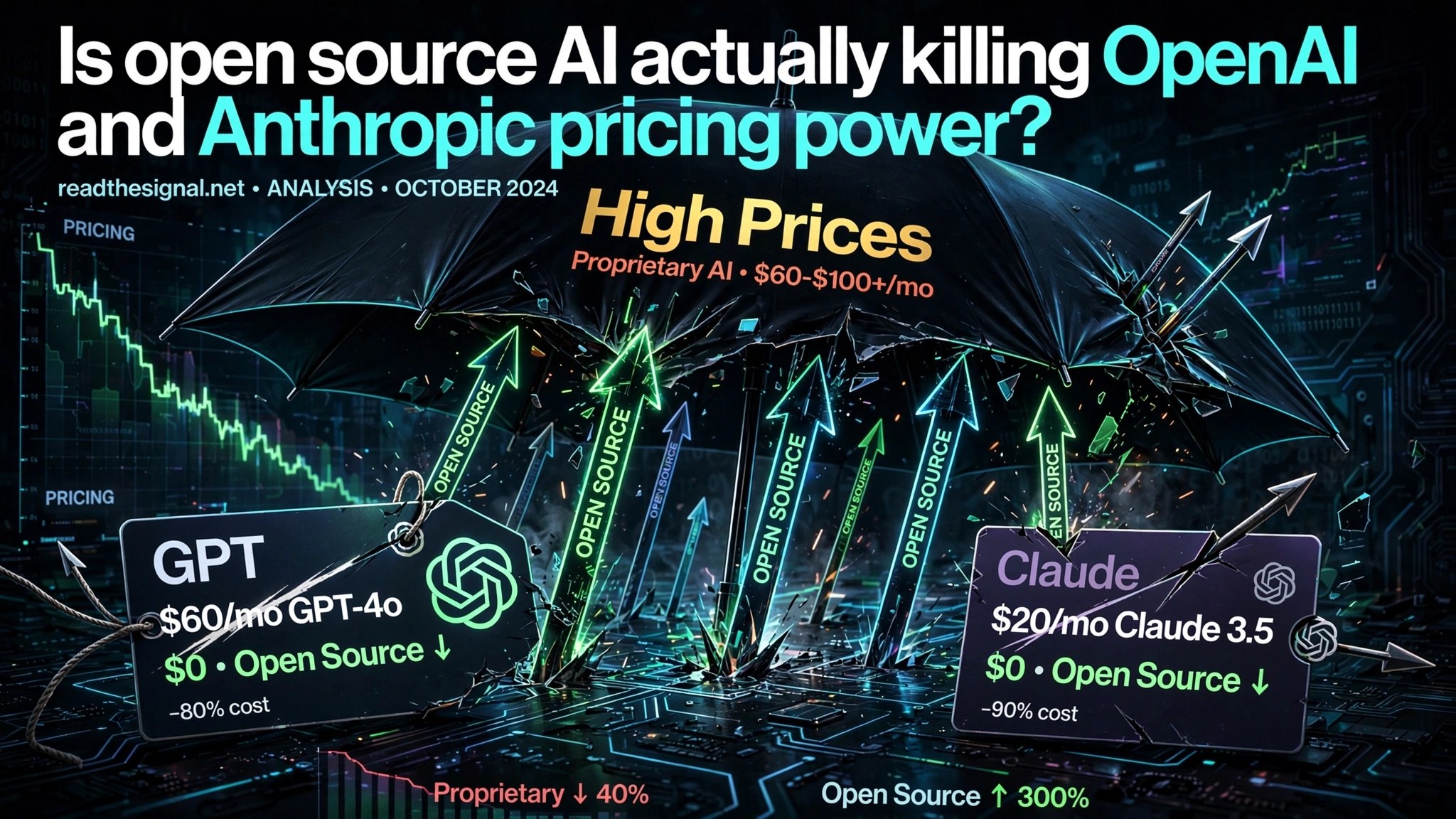
In the last twelve months OpenAI has cut GPT-4o pricing by more than 70 percent on input tokens and Anthropic has had to match with Haiku and Sonnet price drops to keep enterprise renewals. On paper that looks like competition working, but the real driver is not each other — it is open source. When Meta released Llama 4 and then DeepSeek V3 and Qwen 2.5 showed you could run a frontier-class model for under two dollars per million tokens on your own cluster, the floor fell out.
The Math Is Now Brutal for Closed Labs
A mid-market SaaS company doing ten billion tokens a month was looking at a $50k to $80k dollar monthly bill with OpenAI. The same workload with a hosted Llama 4 or Mixtral endpoint through Together or Fireworks is now $8k to $12k. And if they self-host on H100s they own it drops to under $5k after hardware amortization. For coding, summarization, classification, and retrieval augmented generation — which is 80 percent of enterprise volume — the open models are good enough. And good enough at one tenth the price wins.
So Is Pricing Power Dead?
Not quite. And this is where it gets interesting for investors.
OpenAI and Anthropic still have pricing power at the top end. Enterprises will still pay a premium for the most reliable reasoning, for 99.99 percent uptime, for legal indemnity, for tool calling that does not break, and for distribution inside Microsoft, AWS, and Salesforce. That is why you still see $30 billion annual run rate estimates for OpenAI despite the price cuts — volume is growing faster than price is falling. They are becoming like Snowflake: they lose per-unit pricing but they gain massive consumption.
Where pricing power is actually dying is the middle. Any startup that built a wrapper around GPT-4 and charged a markup is getting squeezed to zero. Any model provider that tried to compete as a cheaper closed alternative without open source scale is also stuck. The market is splitting into two layers: a commodity inference layer where open source wins on price, and a premium reasoning and agent layer where OpenAI and Anthropic keep margin but have to earn it every quarter with better models.
The Real Signal for Investors
The winners of open source deflation are not the open models themselves. They are the picks and shovels that let you run them cheaply: Arista networking, Broadcom custom silicon, Micron HBM memory, and the neoclouds like CoreWeave. The losers are closed model wrappers with no distribution moat.
Open source is not killing OpenAI and Anthropic. It is forcing them to become infrastructure companies, not software companies. That is a much lower margin business unless they keep creating a gap that open source cannot cross. Right now that gap is shrinking from twelve months to about four months — and that is the real signal to watch.
Disclosure: The Signal editorial team holds no positions directly in OpenAI or Anthropic (both privately held). This article is for informational purposes only and does not constitute financial advice. Positions may change. This is not financial advice.