
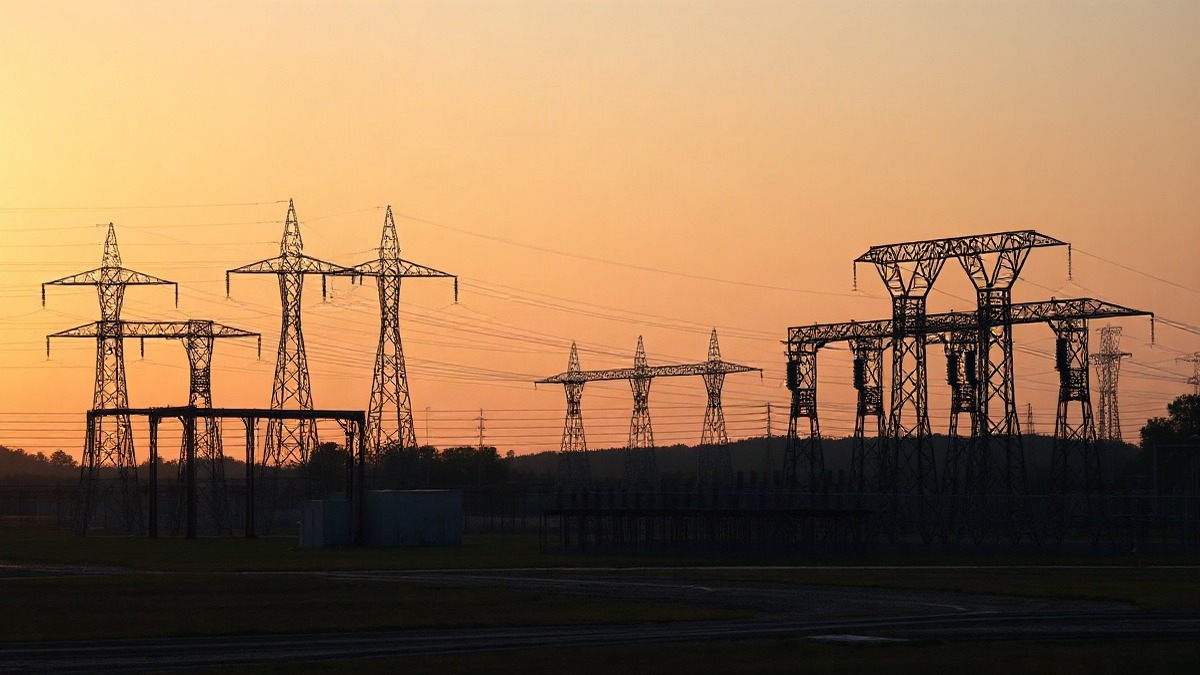
Power stories get told from the reactor outward. Here is the version from the line: Oklo spent the summer fighting for a spot in a queue, and on September 24 it lost.
Oklo builds small nuclear plants, fast reactors it calls Aurora powerhouses and sizes between 15 and 75 megawatts. The business is selling electricity, not reactors, to buyers with an around-the-clock appetite: data centers, industry, the U.S. military.
| Price LIVE | $38.04 |
| Market Cap | $7.1B |
| Forward P/E | n/a |
| Total Revenue (TTM) | $1.2M |
| 52-Week Low | $34.38 |
| 52-Week High | $193.84 |
| Analyst Consensus | Buy (20 analysts) |
| Analyst Target Mean | $76.43 |
PJM's interconnection queue is the line outside a nightclub. The door opens when the operator says so and everyone inside is studied in one batch. Get bounced and you don't sneak back to the front. You wait for the next opening.
That is why this reads as an AI story wearing legal clothes. The reactors get the press, but the grid sets the schedule, and every hyperscaler chasing firm, carbon-free power is stuck behind the same rope.
What Oklo lost was no pilot: 750 megawatts broken into 150 MW of advanced nuclear, 300 MW of fuel cells and 300 MW of gas, sited at two Dominion Energy substations in Virginia. PJM pulled it from the cycle on August 3, Oklo filed a complaint on August 27 and revised it on September 1, and FERC declined on September 24.
The backdrop is bigger than one company. PJM's first reformed study cycle drew 811 requests totaling more than 200 GW, and the operator says nearly 90% cleared the application gate. That leaves roughly 80 rejected projects, and six of those developers have now taken PJM to FERC. Oklo's case, docket EL26-101, is the first decided.
FERC found Oklo never showed PJM broke its own tariff, and left application flaws unresolved. The denial came with a lecture, telling PJM to collaborate with developers before, during and after the process. The commission sided with the queue and scolded the bouncer.
Tucked into the order is the part coverage skipped. FERC pointed Oklo to PJM's Expedited Interconnection Track, a faster lane open through December 31, 2027. For a project Oklo says slips by more than a year, that door is the ballgame.
So what has to happen for this to re-rate? A filing. Oklo needs those megawatts visible in the Expedited Track or the next study cycle, because that turns a pipeline of announcements into a construction calendar. Until then, investors are paying for a schedule they cannot audit, and the market is right to wait.
Be fair to the bull case. Oklo has an approved NRC design-criteria report for its Idaho reactor, a DOE site permit and a HALEU fuel award from Idaho National Laboratory. Meta is prepaying for fuel and development on a 1.2 GW Ohio campus, and Groves, its isotope test reactor, went critical in under a year.
Now read it the way a short seller would. Oklo has never sold a commercial kilowatt: trailing revenue is about $1.2 million, all of it from two small engineering acquisitions this June. That is a stock trading near 5,800 times sales.
The real bear case is the funding model. The share count went from about 138 million to 185 million in 18 months, and three at-the-market programs are stacked behind it, including a fresh $1 billion one from September 11.
Free cash flow was roughly negative $142 million last quarter against negative $19 million a year earlier, about five years of runway on $3 billion of cash. First power on that Meta campus is targeted for as early as 2030, and gas turbines get built in about two years.
Competitors don't wait that long. A 1.2 GW campus of 15-to-75 MW modules needs dozens of reactors, not one.
Wall Street is repricing too. UBS cut its target to $41 from $55 on September 25, the same day the FERC news landed. Consensus still reads buy with a mean in the high $70s, so the dispersion is the story.
What proves the bears right is checkable. If the Virginia project is not in either PJM lane by the middle of next year, the delay stops being a missed cycle and becomes the operating model.
Two dates matter. Watch whether Oklo re-files the 750 MW project into the Expedited Track before December 31, 2027, or into PJM's next cycle. Then read the third-quarter 10-Q in early November to see how much of that $1 billion has been drawn.
Oklo's problem is no longer reactor engineering. It is a queue run by an operator that keeps score in paperwork, and the fix is a filing, not a breakthrough. Until those Virginia megawatts reappear in a PJM lane, this stock is a bet on a calendar.
Disclosure: The Signal holds no position in OKLO. Positions may change. This is not financial advice.