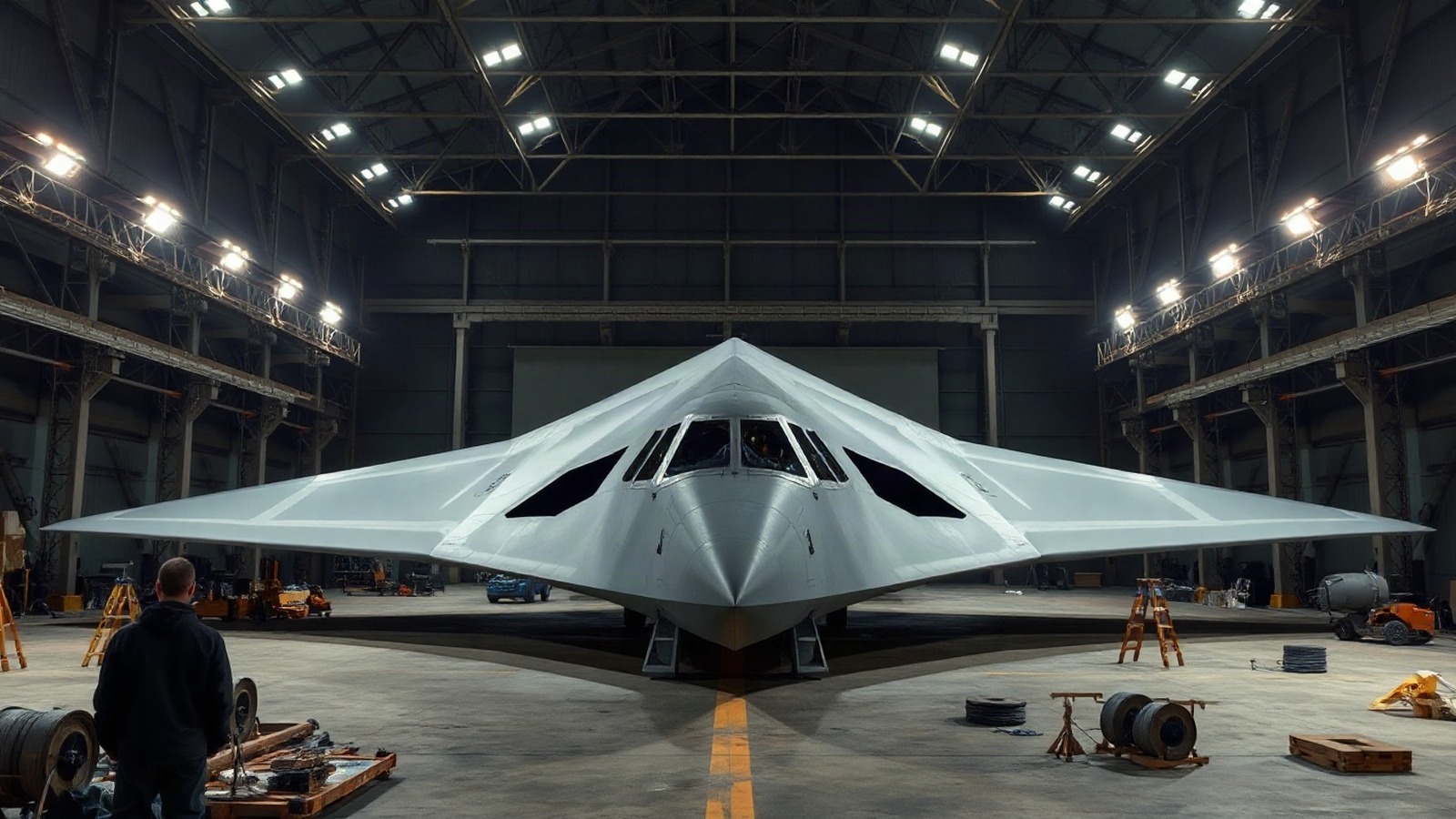
If artificial intelligence ever fights a real-world war, it will not happen inside a pristine data center in northern Virginia. It will happen on physical hardware moving at Mach speed through freezing air, contested seas, or hostile orbit. That physical hardware belongs to Northrop Grumman. As one of five mega-primes supplying the American military, Northrop constructs the B-21 Raider stealth bomber, builds the Sentinel intercontinental ballistic missile, stamps out fuselage sections for the F-35 fighter, and launches military satellites. Its client list is virtually just the Pentagon, the Air Force, and the Navy.
| NOC Price | $510.65 |
| Market Cap | $72.5B |
| Forward P/E | 17.7 |
| Total Revenue (TTM) | $43.59B |
| 52-Week Low | 470.06 |
| 52-Week High | 774 |
| Analyst Consensus | Buy (24 analysts) |
| Analyst Target Mean | 619.08 |
Think of Northrop as the general contractor pouring reinforced concrete and laying hardened fiber for an autonomous battlefield. Silicon Valley writes the smart algorithmic code, but Northrop builds the physical nervous system and the long-range fists. Its Space Systems division is currently assembling the Space Development Agency’s orbital transport network, a mesh constellation designed to route targeting data across oceans in milliseconds. When autonomous drone swarms and naval destroyers need to coordinate instant missile strikes without human latency, Northrop's orbital relays handle the traffic.
Investors saw the immense scale of that national priority on Oct. 20 when Northrop revealed a record $109.6 billion order backlog. That mountain of work represents roughly two and a half years of steady factory production, up 20% from a year ago. Yet there is a critical funding mechanism hidden behind that headline figure that everyday investors miss. Only $50.1 billion of that backlog is formally funded by Congress today. The remaining $59.5 billion sits as unfunded commitments, meaning it still depends on future legislative appropriations before a single dollar reaches the factory floor.
Northrop's third quarter beat Wall Street profit estimates by roughly 10%, propelled by 14% growth in its aeronautics arm and 12% expansion in defense systems. But pay attention to how management adjusted its full-year guidance. The company kept its full-year sales guidance completely untouched at $43.75 billion to $44.25 billion, while lifting segment operating income to between $4.94 billion and $5.04 billion and raising adjusted earnings targets. In plain terms, Northrop is squeezing fatter margins out of its existing factory lines rather than suddenly booking a flood of new revenue.
Short sellers will counter that order backlogs do not pay bills or fund dividends; cash does. Through the first nine months of 2026, Northrop generated just $965 million in adjusted free cash flow against a full-year target of $3.1 billion to $3.5 billion. That creates a brutal mathematical crunch, leaving management needing to produce more than two billion dollars in pure cash during the fourth quarter alone. Even the third-quarter cash surge looked artificial, boosted by $371 million from selling equipment to a customer rather than pure operating collections.
At the same time, Northrop is entering a cash-draining capital spending cycle just as public markets demand cold liquidity. Capital expenditures will climb to roughly $2.1 billion next year as the company tools up factories to accelerate B-21 stealth bomber production. Meanwhile, revenue growth across its mission and space systems segments crawled along at just 2% this quarter. Because the company's biggest Q3 win was $4.6 billion in classified work, shareholders are forced to trust massive black-budget programs they can never actually inspect.
To see why the equity trades around 18 times forward earnings—a discount to peers like RTX—you have to understand how defense stocks get valued. Wall Street refuses to award premium valuations to future missile designs; it re-rates an equity only when contracted backlogs turn into visible cash in the bank. For Northrop to rally toward its prior highs, it must hit its 2027 free cash flow target of $3.3 billion to $3.7 billion while absorbing peak capex. It also needs its forecasted 10 to 20 basis points of margin expansion to show up as earnings growing faster than sales.
The game for Northrop is no longer about winning new press releases; it is about converting paperwork into hard dollars. We are watching whether fourth-quarter cash collections clear the high hurdle needed to achieve the $3.1 billion annual floor. If cash lands cleanly and full-year book-to-bill holds above 1.3, this order book begins to close the valuation gap. If collections miss, that record backlog looks less like a fortress and more like a delayed promise.
Disclosure: The Signal holds no position in NOC. Positions may change. This is not financial advice.