
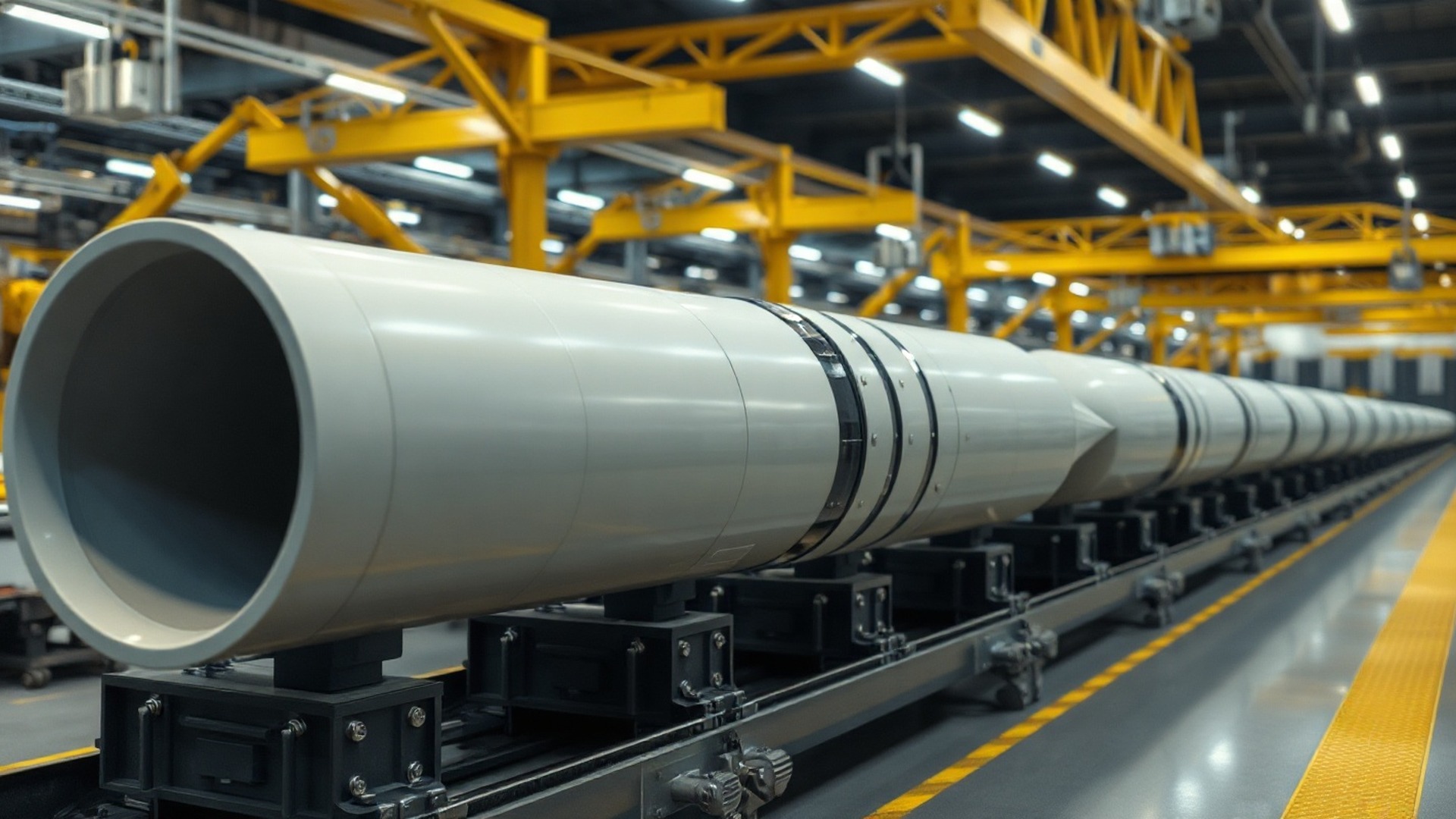
Every defense budget conversation eventually collides with the same two questions: how does the military win the electromagnetic spectrum, and where do the missiles come from? L3Harris Technologies has quietly positioned itself as the answer to both. After years as a defensive conglomerate story — a merger of convenience between L3 and Harris, then a stretched acquisition of Aerojet Rocketdyne — the company has re-emerged as the purest large-cap vehicle for the two structural shifts reshaping Pentagon spending: the race for spectrum dominance in electronic warfare, and the rearmament supercycle now driving munitions production to levels not seen since the Cold War.
| Price LIVE | $291.82 |
| Market Cap | $54.3B |
| Forward P/E | 21.7x |
| Total Revenue (TTM) | $22.9B |
| 52-Week Low | $262.68 |
| 52-Week High | $379.23 |
| Analyst Consensus | Buy (1.65) |
| Analyst Target Mean | $343.27 |
The second-quarter print, reported on July 29, showed the transformation in motion. Revenue rose 8% year over year to $5.88 billion, GAAP earnings per share jumped 28% to $3.13, and segment operating income reached $942 million, a 16.0% segment margin. Free cash flow came in at $771 million. Management used the quarter to raise full-year guidance, now calling for revenue of $23.2 to $23.7 billion and roughly $3.0 billion of free cash flow. The numbers are solid. The structure underneath them is the real story.
The company's new segment structure, effective this fiscal year, makes the thesis legible. Communications & Spectrum Dominance — the software-defined radios, tactical networks, and electronic warfare payloads that soldiers carry into combat — posted $1.94 billion of second-quarter revenue on a 26.9% operating margin. That is the margin fortress of the defense industry, and it rests on something close to sole-source incumbency. These are radios and jammers spec'd into platforms for decades, hardened in real-world use, and certified into programs that are effectively impossible to displace. It is a toll road on the electromagnetic spectrum.
The other leg is Missile Solutions, built on the Aerojet Rocketdyne acquisition that analysts once called overpriced. Revenue grew 14% to $1.05 billion in the quarter, and the segment now carries the munitions supercycle. On July 27, L3Harris announced a seven-year framework with the Department of War and Lockheed Martin covering the two-pulse solid rocket motor, attitude control motors, and lethality enhancer for PAC-3 MSE interceptors — the largest PAC-3 propulsion award in company history. National PAC-3 output is slated to more than triple, from roughly 600 to about 2,000 interceptors a year, and a companion seven-year framework will quadruple THAAD propulsion production — the largest award of its kind ever.
Together they explain the record $42.0 billion backlog, up more than $1 billion quarter over quarter and roughly 1.8 times trailing twelve-month revenue. Book-to-bill ran at 1.2x in the quarter after 1.4x in the first. Management notes that about $20 billion of additional backlog sits under negotiation — enough to roughly triple Missile Solutions' backlog on its own — and the CFO expects high-teens segment growth for the foreseeable future.
The most distinctive part of the story is how the government now underwrites capacity directly. In April, the Department of War closed a $1 billion investment in Missile Solutions — convertible preferred that converts to common equity at the planned minority IPO — under its first "direct-to-supplier" initiative. The government takes no board seat; it is simply paying to stand up the solid rocket motor capacity the entire industrial base needs. L3Harris planned to sell a minority stake in the segment in the second half of 2026 while retaining more than 80%, but on the July 29 call management paused the offering — arguing that public markets are undervaluing the franchise — and said it will revisit an IPO in mid-2027.
All of this is happening while shares sit near the bottom of their 52-week range, below the 200-day moving average, and roughly flat for the year. The market is still pricing the old L3Harris — a low-margin conglomerate stitching together acquisitions — rather than the new one: a compounding franchise where the customer writes the capex check, margins grind higher, and backlog converts into visible multi-year revenue. At roughly 22 times forward earnings, it remains one of the cheapest, most out-of-favor large defense names in a sector that has otherwise rerated.
The balance sheet supports the patience. Net debt of roughly $9.5 billion against $1.5 billion of cash is manageable next to a $3.0 billion free cash flow guide and a $5.00 annual dividend. And a catalyst sits deferred in the wings: the Missile Solutions IPO, paused on the second-quarter call when management judged that public markets were undervaluing the franchise, will be revisited in mid-2027. When it lands, it will put a public market price on the segment — and, in all likelihood, drag the parent's valuation along with it.
Disclosure: The Signal holds no position in LHX. Positions may change. This is not financial advice.