
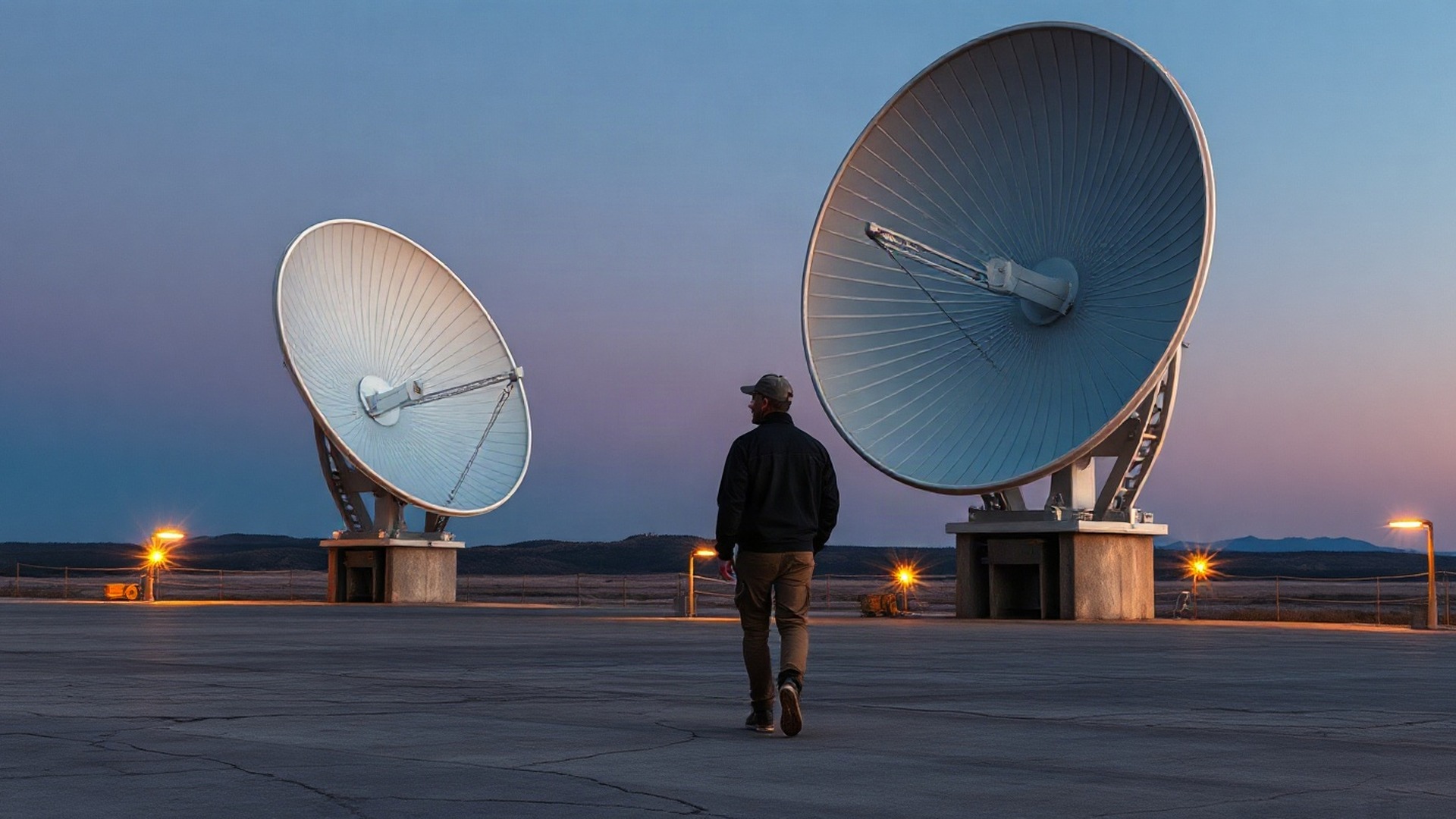
Somebody at the Pentagon finally said it out loud. "The United States now has on-orbit space control weapons capable of defending the joint force against hostile adversary action," Air Force Secretary Troy Meink said on September 14. "Today, Guardians operate on-orbit weapons that can defend the joint force against space-enabled attacks," General Douglas Schiess, the Chief of Space Operations, said a day later.
L3Harris sells defense electronics, and its customers are governments: the US military, the Missile Defense Agency and allied militaries. The catalog is the unglamorous tissue of a modern military: tactical radios, satellite jammers, missile-warning satellites and rocket propulsion. If a defense prime is the armored fist, L3Harris is the nervous system.
| Price LIVE | $250.46 |
| Market Cap | $46.6B |
| Forward P/E | 18.5 |
| Total Revenue (TTM) | $22.9B |
| 52-Week Low | $244.76 |
| 52-Week High | $379.23 |
| Analyst Consensus | Buy |
| Analyst Target Mean | $342.36 |
Missile defense is now a sensor-fusion problem: infrared satellites watch the ground, software fuses that with radar tracks, and a targeting decision falls out seconds later. Decision speed is the product, and machine learning buys it. Electronic warfare is tracking the same curve, since jamming is increasingly software-defined. If you've watched hyperscalers pay up for power, this is the same pattern in a different uniform.
L3Harris owns the acknowledged end of that business. For years, the only anti-satellite capability the United States publicly admitted to was the Counter Communications System, a ground-based satellite jammer. L3Harris was prime on the CCS upgrade and is prime on Meadowlands, its more mobile, more compact successor.
Space Force Combat Forces Command accepted Meadowlands for operational use on June 8, and the service announced it on June 26. It jams satellite communications from the ground, and production is now aiming at roughly one unit a month.
None of that proves L3Harris built anything in orbit. Meink and Schiess named no weapon, no builder and no quantity, and outside analysts say the nature of the on-orbit system is unclear. CCS and Meadowlands sit on the ground; what changed is the register.
L3Harris also sits on the space-based half, where the numbers get bigger. In mid-July the Space Development Agency awarded it up to $955 million to build 18 missile-tracking satellites for Golden Dome. The company says it has more than 70 missile tracking and defense satellites on order and five already on orbit.
It has already spent $225 million on capacity for that work, between Fort Wayne, Indiana and Palm Bay, Florida. That money went into buildings before the contracts arrived.
So what re-rates this equity? Mix. L3Harris still earns most of its money from tactical radios, propulsion and services, and the market prices it accordingly at about 18.5 times forward earnings. If Space & Mission Systems keeps compounding and a $955 million satellite award becomes a production line, the revenue base changes shape and the multiple should follow.
Here's how a short seller reads the same facts. Space control is a sliver of a $22.9 billion revenue company, and Meadowlands ships in units per month, not billions. The $955 million is a potential ceiling spread across years of deliveries, not a check.
The stock sits near a 52-week low and roughly a third below its March high even as the space story accelerates. Either the market doesn't believe the numbers, or it's pricing something the bulls haven't found. And the company changed chief executives in August, so execution risk rides on a business whose entire case is execution.
The funding question is the cleaner falsifier. General Schiess warned that a budget impasse imperils about one in ten Space Force programs, and Golden Dome only exists if appropriators write the checks. If the budget lands late, or a continuing resolution freezes new starts, the satellite revenue everyone is modeling never arrives.
Watch two things from here. November's UN disarmament meeting will test how loudly this gets debated, since the 1967 treaty bans nuclear weapons in orbit and says nothing about conventional ones. Beijing and Moscow objected within a day. Then watch the Space & Mission Systems line in the next quarterly print, expected in late October, where satellite revenue has to show up.
Which way to lean? The Pentagon stopped keeping quiet about what it has in orbit, and the ground-segment vendor just got a free endorsement. L3Harris trades near the bottom of its range while the space budget it sits inside keeps growing. The market is still pricing a radio shop.
Disclosure: The Signal holds no position in LHX. Positions may change. This is not financial advice.