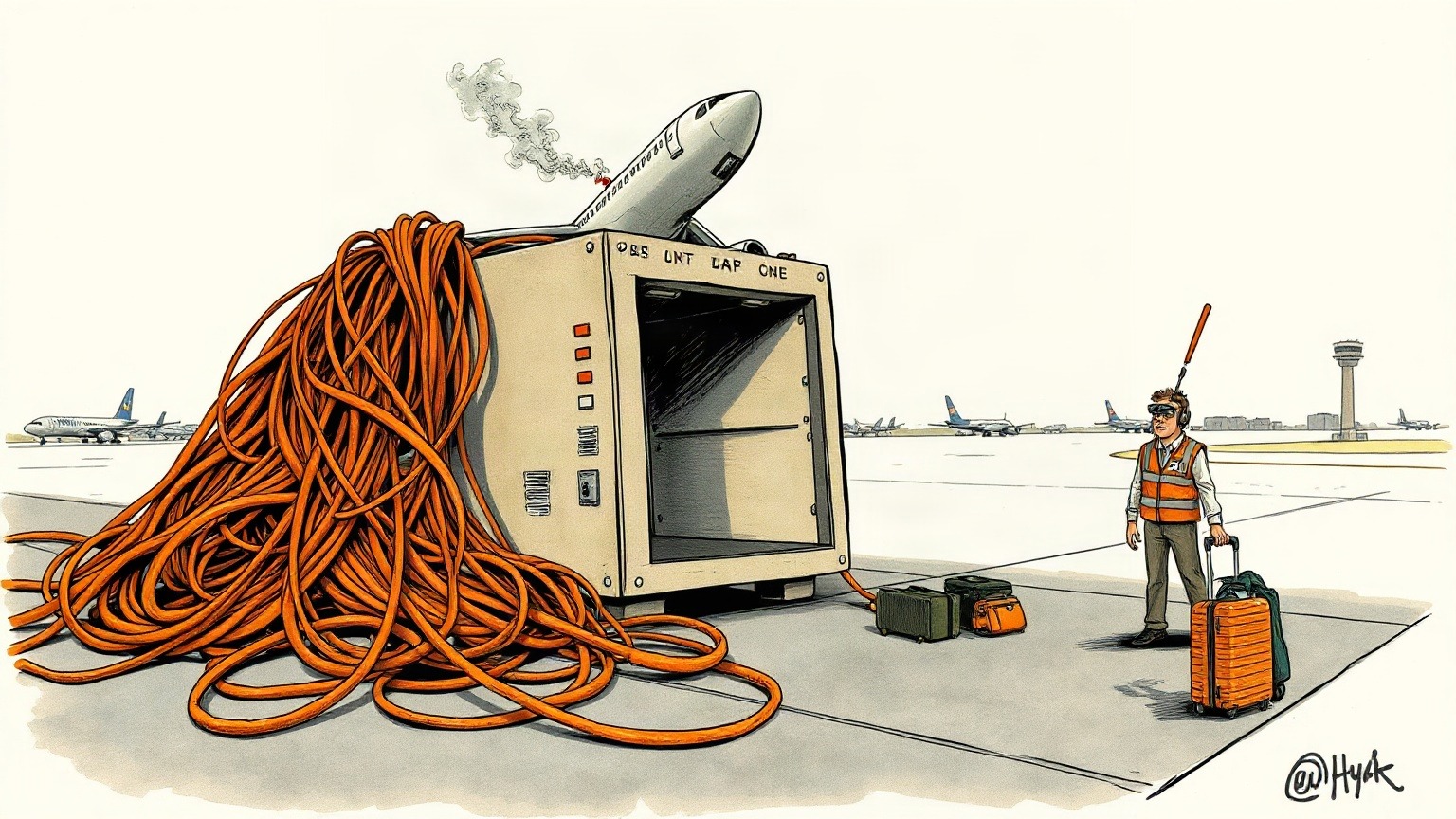
American aviation suffered its longest nationwide ground stop since September 11, 2001 on Nov. 13. A single router in El Dorado, Arkansas began firing more than a thousand frantic connection requests every four seconds. The jam spilled across 17 regional control centers, officials disabled broadcast functions on 69 routers, and more than 20,000 flights were disrupted. By Sunday, Transportation Secretary Sean Duffy was on television asking whether the culprit was technician incompetence or faulty hardware. Then he admitted the punchline: he cannot cancel the contract, because L3Harris owns the network.
Washington is furious and completely immobilized. The reason sits in what L3Harris actually builds. While household names like Lockheed Martin assemble the fighter jets, L3Harris Technologies makes the unglamorous plumbing of American power. The Melbourne, Florida contractor manufactures the encrypted tactical radios soldiers carry, night-vision sensors, satellite payloads and rocket motors. It also runs the telecommunications web that air traffic controllers talk across.
| Price LIVE | $272.35 |
| Market Cap | ~$50.7B |
| Forward P/E | 19.9 |
| Total Revenue (TTM) | $23.33B |
| 52-Week Low | $232.34 |
| 52-Week High | $379.23 |
| Analyst Consensus | Buy (21 analysts) |
| Analyst Target Mean | $336.33 |
That footprint runs on a commercial model that makes firing them nearly impossible. The FAA Telecommunications Infrastructure program was structured as an enterprise managed service when L3Harris won it in 2002. The company bought and installed the equipment across 4,400 federal facilities, kept legal ownership of the hardware, and leased the data stream back to Uncle Sam. Think of it like renting an office where the landlord owns not just the building, but the wiring inside the drywall. Even if the tenant despises the property management, walking away without a new building ready means sitting in the dark.
That dynamic makes this week's selloff—with shares down roughly 2.6% in midday trading—look misdirected. Investors are panicking over a customer relationship that was already transitioning out the door. The government handed the replacement network to AT&T in August, with the cutover targeted for the end of 2028. Revenue from this legacy arrangement was already fading from long-term models.
FAA Administrator Bryan Bedford called the aging setup one of the government's worst-kept secrets, and noted the system has no backup to the backup. The political fallout pushed Duffy to demand $50 billion from Congress for emergency modernization. That is a spending wave aimed at L3Harris' wheelhouse, where it already locked up an airspace surveillance franchise through 2045.
L3Harris says more than 70% of the planned copper-to-fiber conversion is already done. What the FAA work is worth annually is unknown outside the company. L3Harris does not break it out, and no analyst covering the stock has published an estimate.
The piece that is still growing is a separate contract. In March the FAA awarded L3Harris the surveillance and broadcast program that runs the national aircraft tracking network, worth up to $1.117 billion with all options. It covers 700-plus ground stations and carries a program horizon through 2045.
The real threat to the equity is not a cancelled telecommunications lease, but a toxic paper trail inside federal procurement offices. Just fourteen months ago, a fiber outage in Dallas prompted the FAA to issue a formal finding that L3Harris failed to ensure its system redundancies functioned properly. Two systemic failures in barely a year transform a defense of aging infrastructure into a documented track record of poor vendor performance. In federal contracting, that is the lethal vocabulary that leads to formal suspension reviews and debarment inquiries across a $23 billion defense portfolio. Congressional leaders are now calling for inspector general probes. Executives under oath would land at the worst possible moment, right as L3Harris prepares to price the carve-out of its lucrative Missile Solutions business.
For the stock to re-rate higher, management must prove this public relations disaster will not impair its core defense pipeline while successfully executing that missile unit spinoff. The underlying business is executing at an institutional peak: the company just raised full-year financial guidance, posted a 33% surge in quarterly earnings per share, and expanded its backlog to a record $53.2 billion. Trading at roughly 20 times forward earnings with more than $3.6 billion in trailing free cash flow, the valuation is pricing in operational catastrophe where there is mostly political theater.
We are watching whether the formal root-cause investigation by federal engineers uncovers a systemic installation flaw or isolated component failure. Washington may hate writing the checks, but it cannot fire the contractor holding the keys to the airspace.
Disclosure: The Signal holds no position in LHX. Positions may change. This is not financial advice.