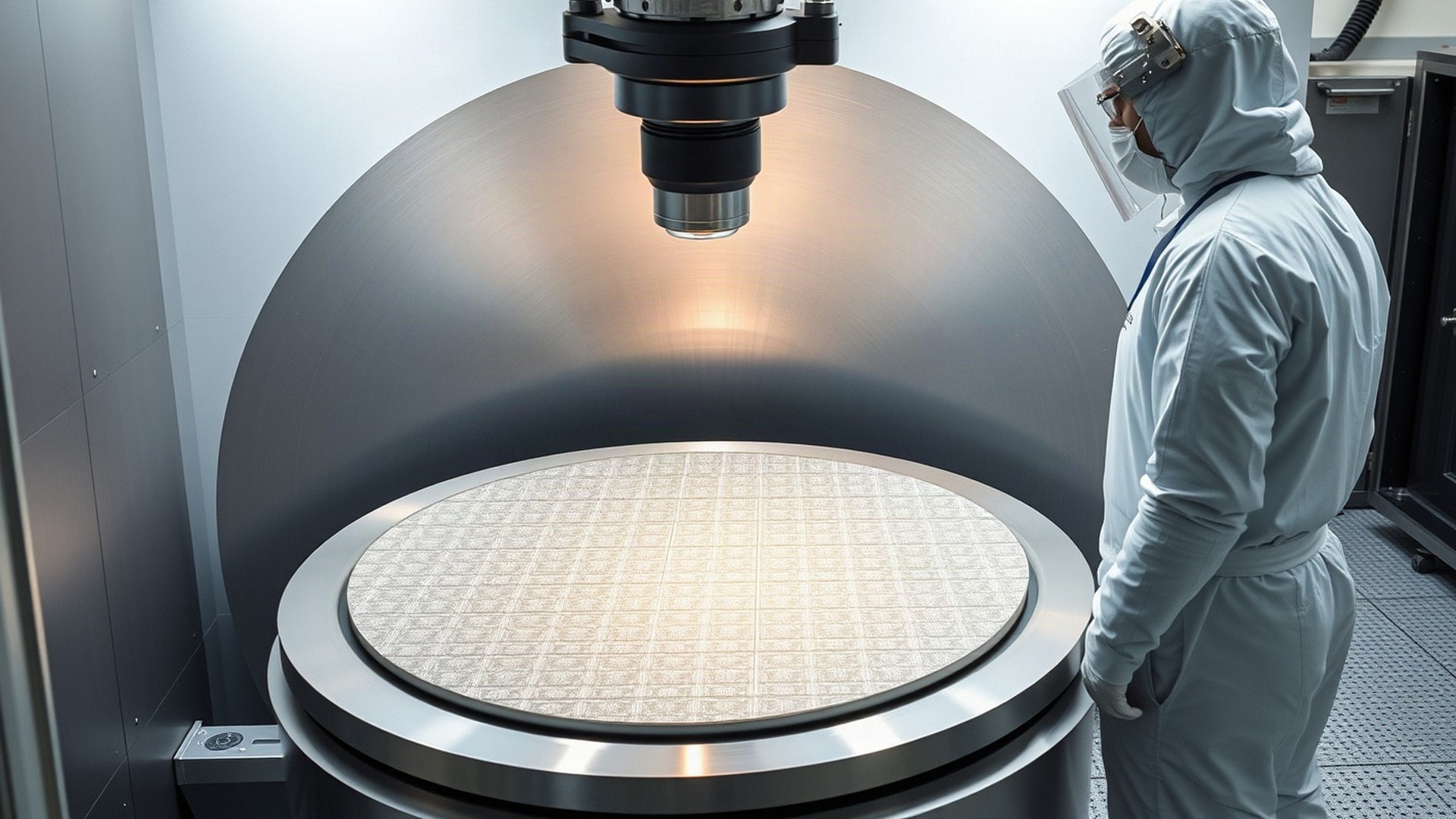
Every modern microchip is an intricate skyscraper with over a hundred layers printed onto silicon. If a stray speck of dust lands on floor twelve, the entire structure fails. KLA builds the machines that inspect those floors.
| Price | 145.61 |
| Market Cap | $190.0B |
| Forward P/E | 26.7x (FY27) |
| Total Revenue (TTM) | $13.58B |
| 52-Week Low | 107.2 |
| 52-Week High | 307.37 |
| Analyst Consensus | Buy (30 analysts) |
| Analyst Target Mean | 232.38 |
The Milpitas company makes the defect inspection and metrology tools that check wafers after nearly every processing step. In the most demanding manufacturing operation on earth, they act as the ultimate quality-control checkpoint, catching microscopic flaws before a bad die moves downstream.
Lithography giant ASML gets the magazine covers for etching circuit patterns, but KLA is the unrelenting health inspector standing behind every station. If KLA’s sensors do not sign off on a layer’s exact thickness and alignment, that wafer gets scrapped.
Over ninety percent of the company’s business comes directly from semiconductor process control. Services supply the shock absorber: they are roughly a fifth of revenue, and about eighty percent of that is contract-based. That predictable cash flow gives the business real ballast when chipmakers hit a cyclical bump.
The market panicked before KLA said a word. Big tech spending anxieties triggered a sharp selloff across semiconductor hardware names. Lam Research delivered a record quarter, only to plunge nearly twelve percent in a single trading session. KLA dropped more than nine percent that same afternoon on twice its typical volume, finishing the week down about twelve percent without reporting a single number.
Wall Street decided that if toolmakers could not ship machines on schedule, the artificial intelligence cycle was finally peaking.
That reaction misreads the unforgiving physics of cutting-edge computing. When your phone updates its apps, you take a tiny, efficient processor for granted. But AI accelerators and high-bandwidth memory chips are massive physical slabs. As die size expands, yields fall off a cliff.
Run a production line at normal defect density, and roughly half of your one-centimeter chips will turn out flawless. Double that die size to two centimeters, and your flawless yield plunges to barely eleven percent. When defective chips cost thousands of dollars, process control turns into an existential bottleneck.
The friction holding back shipments is not missing demand, but an inability to ship fast enough. CFO Bren Higgins noted that lead times across the portfolio sit near twelve months, with specialized systems stretching to twenty-four months. The primary bottleneck involves optical parts like calcium fluoride lenses, which take up to two years to expand supplier capacity.
KLA sits on a twelve-and-a-half billion dollar backlog, representing roughly eleven months of work already booked. Lam Research flagged identical holdups, confirming that delayed shipments simply slip into early next year because parts are caught in a queue.
For KLA’s stock to re-rate higher, management must prove its technology is capturing a larger slice of chipmaker spending. During the July earnings call, TD Cowen analyst Krish Sankar raised the critical challenge. KLA’s revenue has held steady at roughly eleven percent of total wafer fab equipment spending rather than outrunning it.
While KLA expects advanced packaging revenue to surge over seventy percent to roughly one point one billion dollars this year, that segment accounts for only eight percent of sales. If process control intensity merely matches broad equipment spending instead of compounding faster, investors will refuse to pay a premium multiple.
A short-seller dissecting this setup sees a valuation stretched far beyond its margin for error. Just weeks ago, Morgan Stanley raised its future earnings projections for KLA while cutting its target valuation multiple to twenty-eight times, signaling that peak optimism is already priced in. In hardware cycles, a delayed order and a canceled order look identical on an income statement for ninety days.
Clean-room space shortages are often a polite excuse for chipmakers quietly deferring deliveries. Meanwhile, gross margins face pressure from component inflation and tariffs, with zero room to raise prices on installed tools. Add in tightening export controls—with the U.S. Affiliates Rule snapping back on November 10 to squeeze Chinese sales—and any pause in order momentum exposes an expensive equity to an abrupt de-rating.
The verdict arrives on October 28 when KLA reports fiscal first-quarter results. Wall Street already expects KLA to clear the midpoint of its guidance, making the headline numbers a sideshow. The critical signal rests on the revenue guidance for the December quarter.
If management projects December sales near four and a half billion dollars alongside a growing backlog, the supply bottleneck was the truth and the selloff was an overreaction. But if guidance stalls near four point two billion and blames optics, nobody will be able to tell whether tools were delayed or buyers quietly walked away.
Disclosure: The Signal holds no position in KLAC. Positions may change. This is not financial advice.