The 115-year-old company that built the mainframe is assembling the machine that could make today's supercomputers look like abacuses. On August 19, IBM announced it had connected and cooled two modular cryogenic quantum systems into a single ultra-cold environment — the first time it's ever linked modular quantum hardware this way, and a genuine milestone on the road to fault-tolerant quantum computing.
Quick primer, because IBM does a lot: it sells the software, services and big-iron infrastructure that keep the world's banks, airlines, hospitals and governments running — and it builds the quantum computers that a growing list of customers are betting will power the next era of computing. Think of IBM as the enterprise backbone of the AI boom, quietly building the hardware for whatever comes after it.
| Price LIVE | $231.04 |
| Market Cap | ~$217.7B |
| Forward P/E | 17.6 |
| Total Revenue (TTM) | $69.1B |
| 52-Week Low | $199.19 |
| 52-Week High | $332.46 |
| Analyst Consensus | Buy |
| Analyst Target Mean | $244.91 |
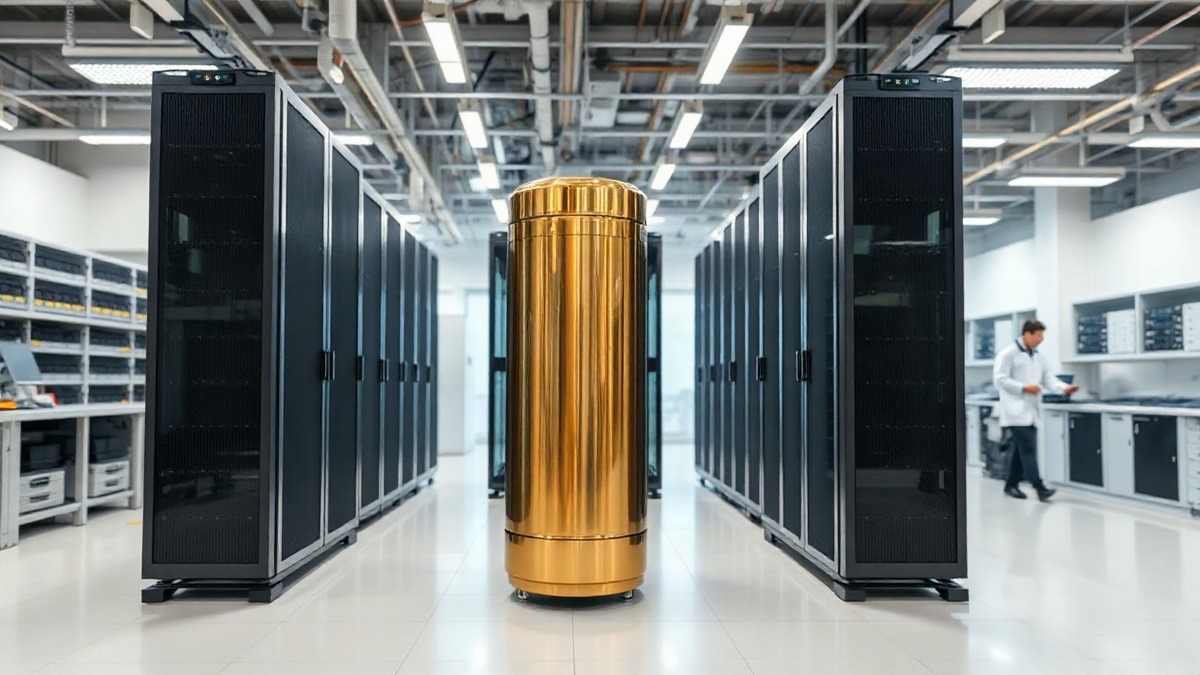
Here's what actually happened. IBM took two of its modular cryogenic quantum systems — think room-sized fridges for quantum chips — and joined them into a single ultra-cold environment, cooled to below 15 millikelvin. That's more than 180 times colder than deep space. The new box-shaped architecture, built around what IBM calls L-coupler technology, is designed to link hundreds of quantum chips into one fabric. Each module's vacuum enclosure offers up to 12 times more wiring space than IBM's most widely used quantum systems, and the combined stack stands more than eight feet tall and eight feet wide. Initial tests reached 4 Kelvin in under five days.
Why modular? Because quantum has always hit a wall: you can't just keep adding qubits to a single chip before the whole thing drowns in noise. Modularity is the escape hatch — link chips together the way data centers link servers, and scaling becomes an engineering problem instead of a physics miracle.
And why should you care? Because quantum is the next compute era, and IBM is one of a handful of companies on Earth with a credible shot at it. Fault-tolerant machines promise to crack problems today's best supercomputers can't touch — designing new materials and drugs at the molecular level, optimizing supply chains and portfolios in minutes instead of millennia. The security angle cuts the other way, too: post-quantum cryptography is why banks and governments are already scrambling to future-proof their encryption, and IBM's quantum-safe security practice is a revenue line today, not a fantasy.
The roadmap is concrete. Nighthawk processors land later this year, IBM targets at least 1,000 programmable qubits by 2027, and IBM Quantum Starling — its first fault-tolerant quantum computer — is scheduled for 2029. CEO Arvind Krishna has said quantum will have a measurable impact on earnings by 2028 or 2029. That's not a hockey-stick fantasy anymore; it's a dated milestone.
The company is loading up for it. On July 23, IBM agreed to acquire HRL Laboratories, the storied research outfit, to power the future of quantum. A week later it demonstrated quantum advantage alongside the University of Chicago, Algorithmiq and Qedma. It's been stacking AI chips, too: an OpenAI partnership for secure enterprise AI deployment landed August 13, and a multi-year agreement with Together AI worth $240 million — for open-source AI inference on NVIDIA infrastructure — came two days before. Wall Street took notice: IBM shares climbed nearly two percent on the day of the cryogenic announcement.
None of this is a quarterly earnings story, and that's the point. The financials are solid — trailing revenue around 69 billion dollars, a forward P/E in the high teens, analyst consensus at Buy — but the reason to pay attention is the trajectory, not the tape. IBM is spending the AI boom building the infrastructure for the compute era after it.
The verdict: this is how you buy a call option on the next era of computing without leaving the enterprise. IBM is the rare legacy giant that keeps showing up at the frontier — mainframes, then AI, now quantum. The cryogenic milestone is one step on a long road, and fault-tolerant machines still have years of engineering ahead. But the road now has a date on it — Starling in 2029 — and the company that built the mainframe has a habit of getting there.
Disclosure: The Signal holds no position in IBM. Positions may change. This is not financial advice.