Wall Street spent the week repricing enterprise software. High-multiple cloud platforms got punished, and one recurring-revenue darling lost nearly thirty percent. Meanwhile a century-old shipbuilder on the Gulf Coast quietly ripped double digits higher, up roughly 13% after its third-quarter report.
It was not because building warships suddenly turned into a software business. It was because the market got a stark reminder. In an economy obsessed with digital automation, the hardest things to build still need physical muscle, institutional memory, and a blowtorch.
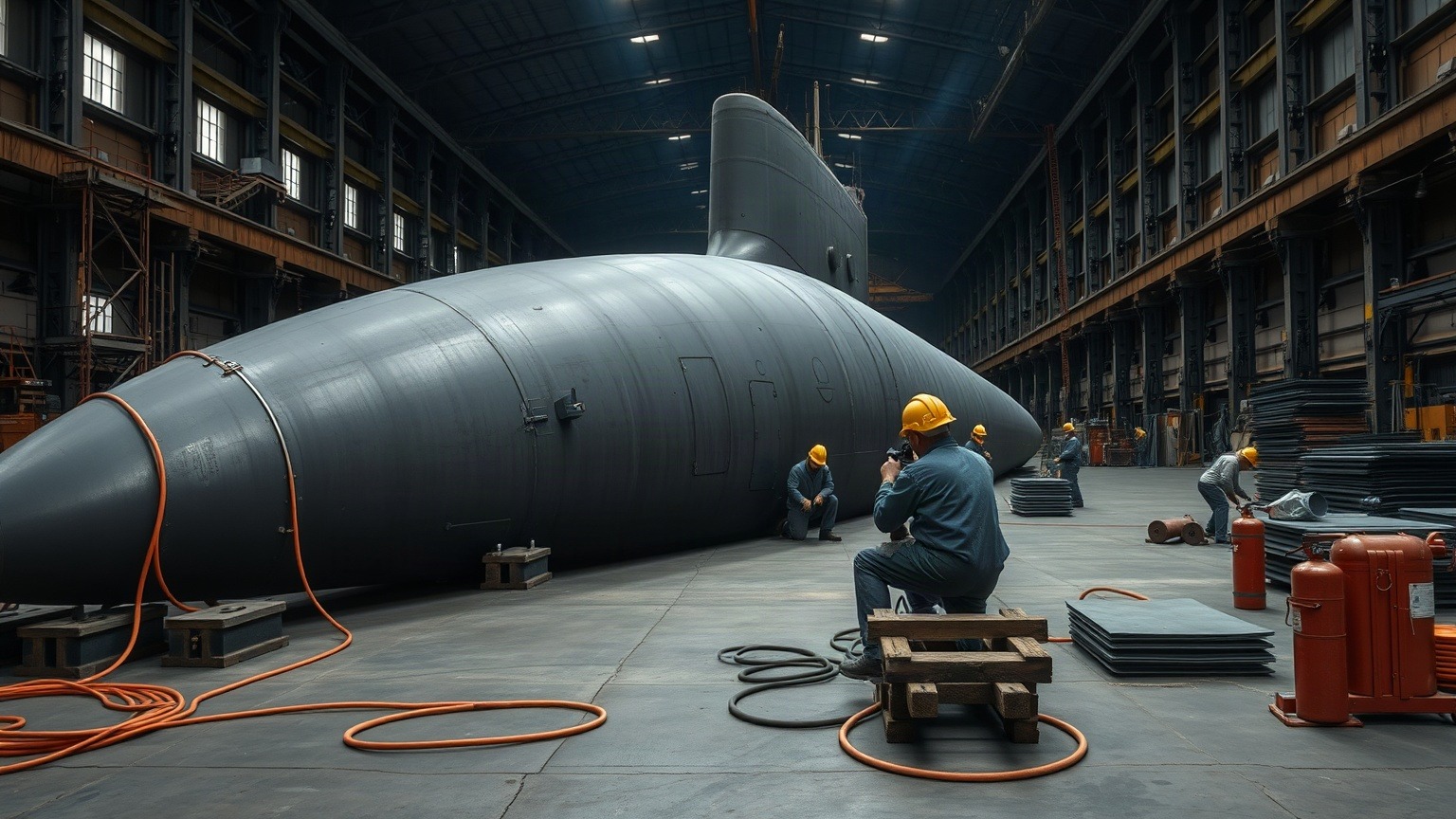
Huntington Ingalls Industries is America's sole builder of nuclear-powered aircraft carriers. It is also, alongside General Dynamics, one of only two yards making nuclear submarines. At Newport News in Virginia and Ingalls in Mississippi, roughly 46,000 workers cut, weld, and assemble the heaviest military hardware in the West.
Think of defense tech startups as the engineers sketching shiny new flight software. Huntington Ingalls is the heavy industrial foundry pouring the concrete basement. Mission Technologies, its third arm, builds unmanned submersibles and fleet electronics, but the equity story lives in the dry docks.
Understanding why the stock spent years lagging the market means understanding how shipbuilding makes money. Contracts are priced years ahead off estimated costs at completion. If labor runs slower than expected, or a junior recruit takes twice as long to weld a pipe joint, HII absorbs the overrun.
In defense accounting that triggers a cumulative catch-up adjustment, which lands straight in reported operating profit. Over three years those adjustments have swung operating margin violently between 5% and 8%. You can cancel a software subscription in two clicks. When labor productivity stalls on an attack sub, the contractor eats the bill.
| Price | $316.21 LIVE |
| Market Cap | $12.46B |
| Forward P/E | 15.1x |
| Total Revenue (TTM) | $13.53B |
| 52-Week Low | $255.36 |
| 52-Week High | $460.00 |
| Analyst Consensus | Buy (12 analysts) |
| Analyst Target Mean | $356.42 |
That makes HII the mirror image of the generative AI boom. Every dense data center, every advanced chip, every grid expansion ultimately leans on naval deterrence to keep maritime corridors open. You cannot prompt a model to weld HY-80 steel to a submarine standard.
The moat is not a proprietary algorithm. It is two generational shipyards, an apprentice pipeline training tradespeople since 1919, and a supply chain where 70% of critical submarine vendors are sole-source. Scarcity has migrated from code to craft.
The third quarter offered the first proof the labor bottleneck is starting to loosen. HII hired more than 6,000 shipbuilders year to date and lifted apprentice enrollment 14%, to over 800 students per yard. At Ingalls it booked a net gain of 576 shipbuilders, the first positive headcount quarter in two and a half years.
Backlog swelled to $86.2 billion on awards for Block VI Virginia-class attack subs and Columbia-class ballistic missile boats. Those contracts secure roughly 90% of expected shipbuilding revenue through 2030. In a country where attack sub production has drifted to about 1.1 boats a year against a Navy target of two, any pulse in the yards gets treated like an oasis.
For the equity to re-rate permanently, paper awards have to become cash. Full-year shipbuilding margin must hold the guided 6.0% to 6.5% through real shop-floor efficiency, not another favorable accounting revision. And the cash must show up.
HII burned $182 million of free cash flow through nine months. Hitting the low end of its full-year commitment now requires up to $782 million in the fourth quarter alone. Operationally, Ingalls faces a delivery squeeze it has not seen since it was spun off: LPD 30 by year-end, then two surface combatants in early 2027.
Short sellers call the print an accounting mirage, not an operating turn. Strip out a single $65 million favorable catch-up on the Columbia-class program, and underlying operating margin fell 33 basis points year over year. At Ingalls, where labor turnover bites hardest, segment margin dropped 112 basis points on weak surface combatant execution. And 56% of that record backlog is still unfunded by Congress.
Newport News alone carries tens of billions in orders that depend on future appropriations. Venture-backed rivals are pouring billions into automated yards, and a few hundred net workers does not close a generational industrial deficit. A fourth-quarter margin below 5% excluding catch-ups, or free cash flow missing the $500 million floor, proves the bears right.
The milestone to watch is whether Ingalls delivers LPD 30 before December 31 without another charge. You cannot defend an ocean with an API.
Disclosure: The Signal holds no position in HII. Positions may change. This is not financial advice.