Huntington Ingalls just gave you the single best summary of where American defense spending is headed over the next decade, and it comes down to one number: 57.3. That's the shipbuilder's backlog in billions of dollars. The company that runs the only yard in America capable of building a nuclear-powered aircraft carrier obliterated Wall Street's second-quarter estimates — $5.27 per share against the $3.82 analysts expected, a 38% beat, on revenue of $3.42 billion that landed about 8% ahead of consensus. This wasn't a quarter. It was a statement.
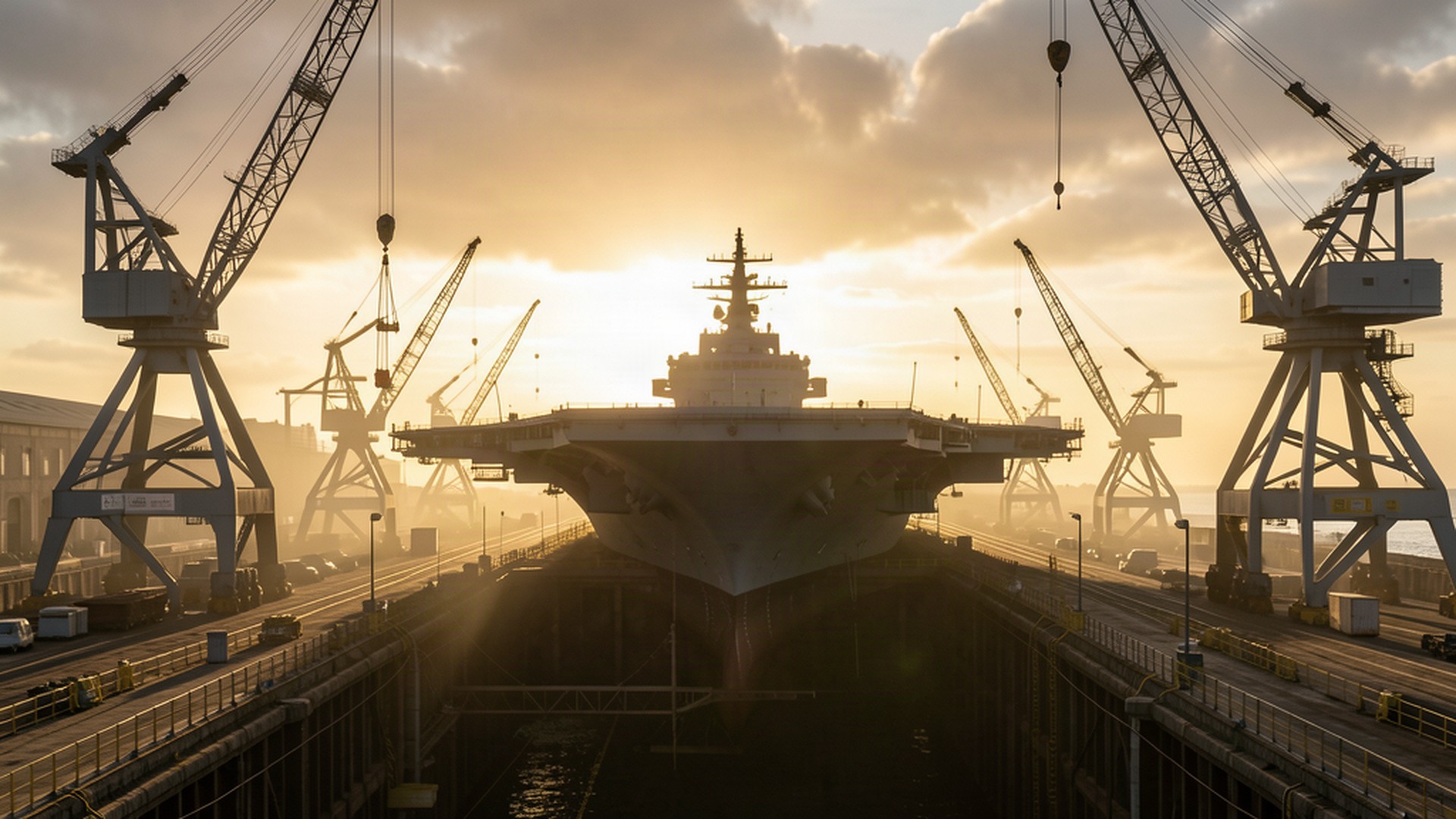
The engine of the beat was Newport News Shipbuilding, the crown jewel of the U.S. naval industrial base. Revenue there jumped 15.3% year over year as aircraft carriers and Virginia-class submarines move through the yard at a pace the Pentagon hasn't seen in decades. Newport News isn't just HII's biggest division — it's the strategic center of gravity for the entire U.S. Navy's nuclear fleet. Every carrier, every submarine hull that matters to the American undersea deterrent eventually passes through its dry docks. The yard is running hot, and the demand curve behind it is only bending up.
Why now? Because the Navy is racing toward a 355-ship fleet that it is nowhere close to having, the FY2026 budget contained the largest shipbuilding request in two decades at roughly $47.3 billion, and the strategic clock is ticking louder every quarter. China's naval expansion is the backdrop for all of it — Beijing is outbuilding the U.S. on hull count, and the Pentagon's answer is more submarines, more carriers, and more money funneled into the yards that build them. Then there's AUKUS. Australia is buying three Virginia-class submarines, and delegations from Canberra have been walking the halls of Newport News to watch how the work gets done. That's not a photo op; it's a supply-chain commitment that runs for decades.
The numbers behind the numbers are just as telling. Backlog hit $57.3 billion, with $6.7 billion in new awards landing in the quarter alone. Management raised full-year shipbuilding revenue guidance to $10.2 billion to $10.4 billion and lifted the margin floor to 6.0%. That floor matters more than the revenue range: it tells you management expects the work to get more profitable, not less, even as volume climbs. Companies don't raise margin guidance in this industry unless they see pricing power and schedule stability, and HII is now signaling both.
Here's the part that matters for the stock. HII had been de-rated hard after a February guidance stumble, leaving shares trading well off their highs while the market treated the company like a project-management risk rather than a strategic monopoly. This quarter rewrites that narrative. HII is the bottleneck that cannot be bypassed. There is no second supplier for nuclear-powered carriers. There are only two yards in the country that build nuclear submarines, and HII owns one of them. You cannot route around a chokepoint like that; you can only pay it. And when a monopoly prints a quarter like this one, the re-rating tends to stick.
Now the honest part, because no defense contractor story is without one. Free cash flow went negative — minus $150 million in the quarter against a positive $730 million a year earlier — and cash on hand sits at a razor-thin $12 million. The company carries fixed-price contract exposure on first-of-class work, which is exactly the kind of risk that has burned other defense primes when inflation and labor shortages bite. Shipbuilding is a lumpy, capital-hungry business, and HII's balance sheet is not as muscular as its backlog. It's worth watching closely — but it's also worth remembering that lumpy quarters are the norm in this industry, not the exception.
But step back and weigh the two sides. The cash-flow quarter is a snapshot. The backlog is the trajectory. The Navy cannot reach its 355-ship goal without HII's yards running at full tilt. Australia cannot get its submarines without HII. China is not slowing down, and neither is the demand curve for American hulls. When a company that is structurally irreplaceable beats estimates by 38%, raises guidance, and piles $6.7 billion of new work onto a $57 billion backlog, the market has a choice: keep pricing it like a troubled contractor, or price it like what it actually is — the chokepoint of the world's most important naval buildup. This quarter made the answer obvious.
Disclosure: The Signal holds no position in HII. Positions may change. This is not financial advice.