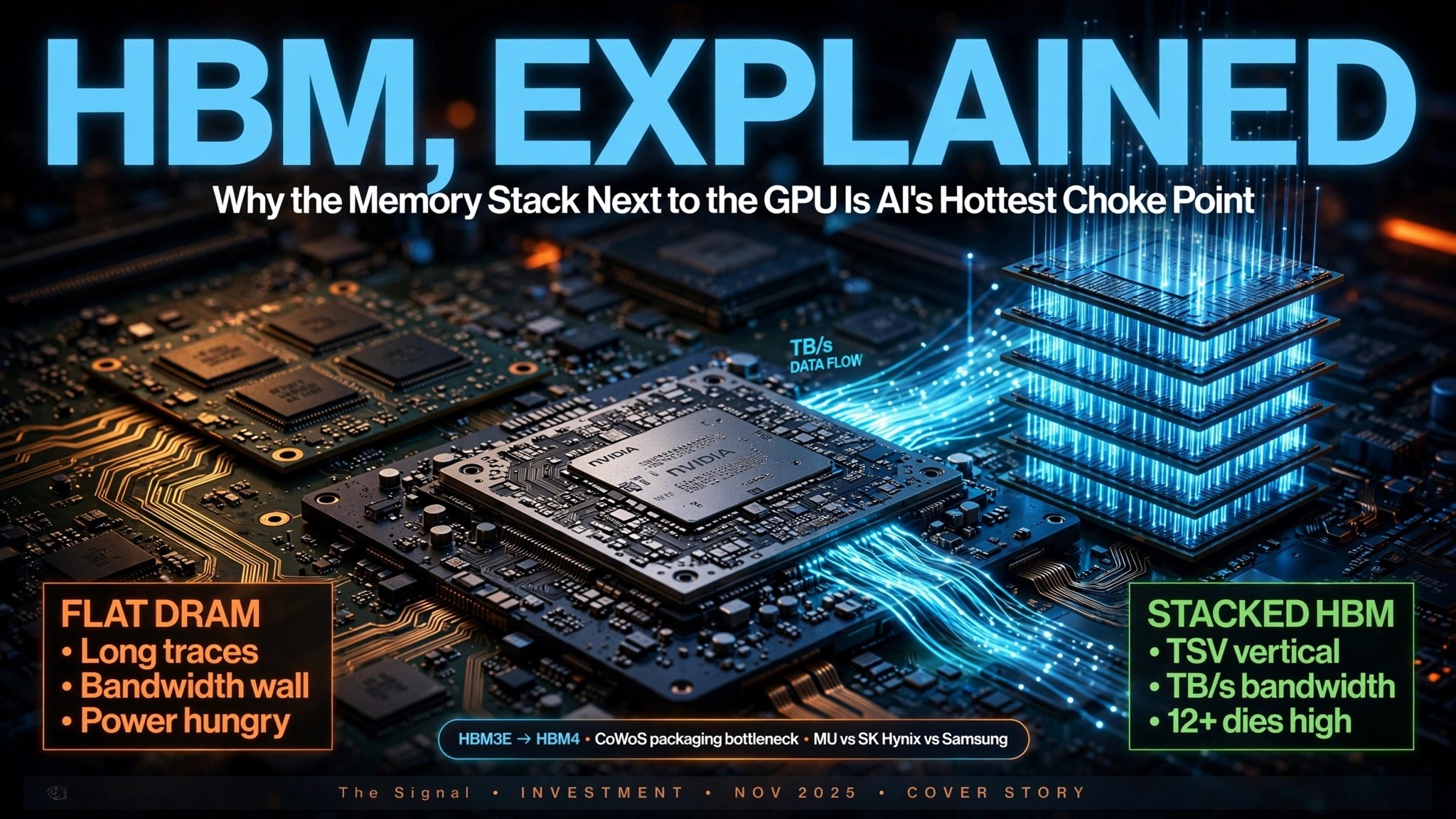
Ask most people what's limiting the AI buildout and they'll say GPUs. The deeper answer is more interesting: the memory stacked on top of them. Every accelerator at the heart of the AI boom — from the NVDA and AMD chips that lead the market to the custom silicon the hyperscalers are designing in-house — is only as fast as the High Bandwidth Memory bolted to its package. And that memory is one of the most difficult things in the world to make.
Here's the problem AI created. A large language model doesn't just need a chip that can do math; it needs to pull billions of parameters out of memory, over and over, for every token it generates. Compute gets faster every generation, but the data pipe between processor and memory has historically been the wall. Engineers solved it the way cities solve land scarcity: they built up. Instead of laying one flat chip of DRAM on a motherboard and running data across long traces, HBM stacks layers of memory vertically — up to a dozen or more dies — and drills thousands of microscopic holes, called through-silicon vias, straight through the stack so data moves up and down in a fraction of the distance.
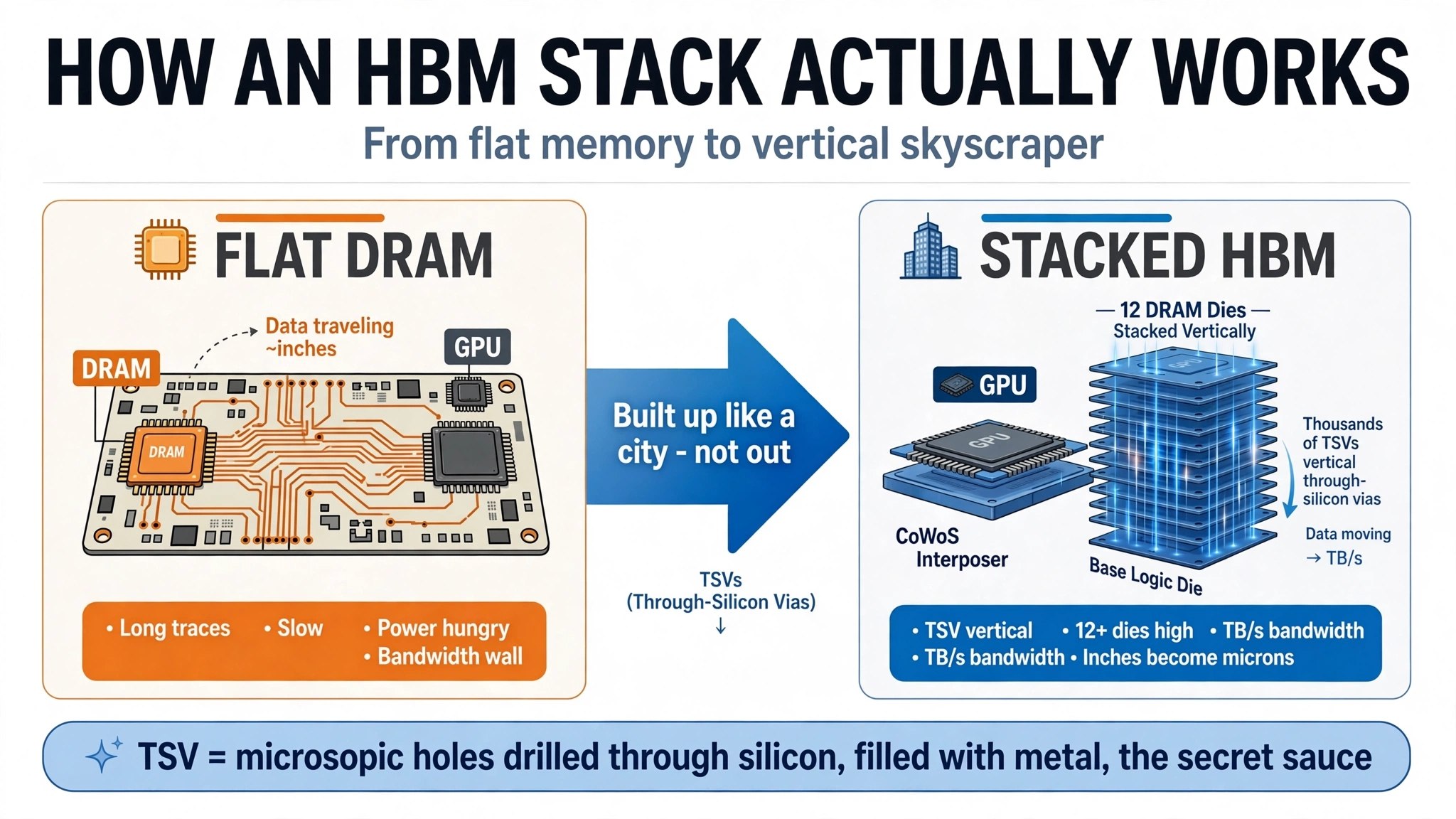
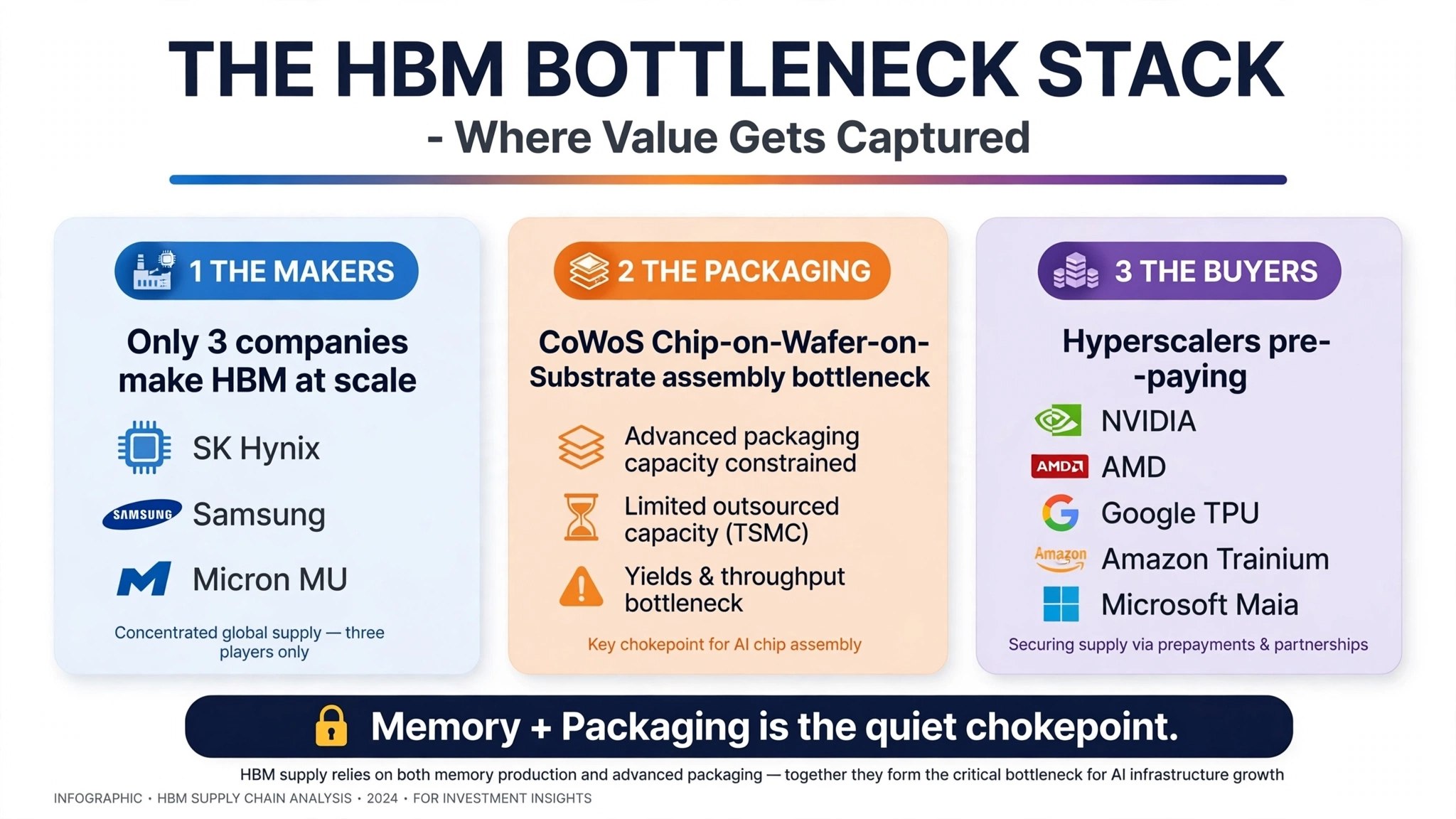
The result is breathtaking by the numbers. A single HBM stack can move terabytes of data per second, orders of magnitude more than traditional memory, while sipping far less power per bit. But the manufacturing is brutal. Every layer of the stack has to be perfectly aligned and bonded; yields are hard-won, and the test and packaging steps are among the most expensive in the semiconductor industry. This is why only three companies on Earth make HBM at scale — SK Hynix, Samsung, and Micron — and why every gigabyte of it is spoken for.
That scarcity has changed the deal-making in the AI supply chain. GPU buyers used to pay for silicon; now they sign multi-year contracts for memory capacity before the wafers are even planned. The hyperscalers, who hold most of the negotiating power in this industry, are effectively pre-paying to lock in stacks. That includes the ones building their own silicon — Google's TPUs, Amazon's Trainium, Microsoft's Maia — because custom chips don't escape the memory bottleneck, they just buy HBM direct. Another reason the memory makers' order books now run years deep. For the memory makers, that turns a historically boom-and-bust commodity business into something with the revenue visibility of a toll road — which is why the sector has been repriced as a growth story rather than a cyclical one.
The packaging layer is the second bottleneck hiding inside the first. HBM doesn't just plug in; it sits on an interposer alongside the GPU die, connected through advanced packaging technology. That packaging capacity — the lines that do chip-on-wafer assembly — is finite, and it's been a constraint for years. Even with ample memory wafers, the industry can only assemble so many GPU-and-stack packages per quarter.
None of this means the cycle is risk-free. Memory has a long history of overbuilding, and every boom has eventually been followed by a glut. The bullish case rests on AI demand being durable enough to absorb capacity that's already been contracted. The bear case is that these contracts are real but the end-market math changes — models get more efficient, training demand softens, and the toll road suddenly has traffic.
For investors, the takeaway is simpler than the technology. The AI trade used to be a one-chip story. Today it's a stack — silicon, memory, and packaging — and the companies that own the scarce layers in that stack are capturing a growing share of the value. The Signal's reports on MU, NVDA, and AMD break down the moats, the margins, and the risk factors in detail.
Disclosure: This article is for informational purposes only and does not constitute investment advice. The Signal maintains public analysis of the companies mentioned; no positions are held by the editorial team.
HBM is the quiet chokepoint of the AI trade. The memory trio controls supply, packaging capacity constrains everyone, and the buyers are locked into contracts years ahead — which is why memory makers' order books are the closest thing the AI buildout has to a visible pipeline.