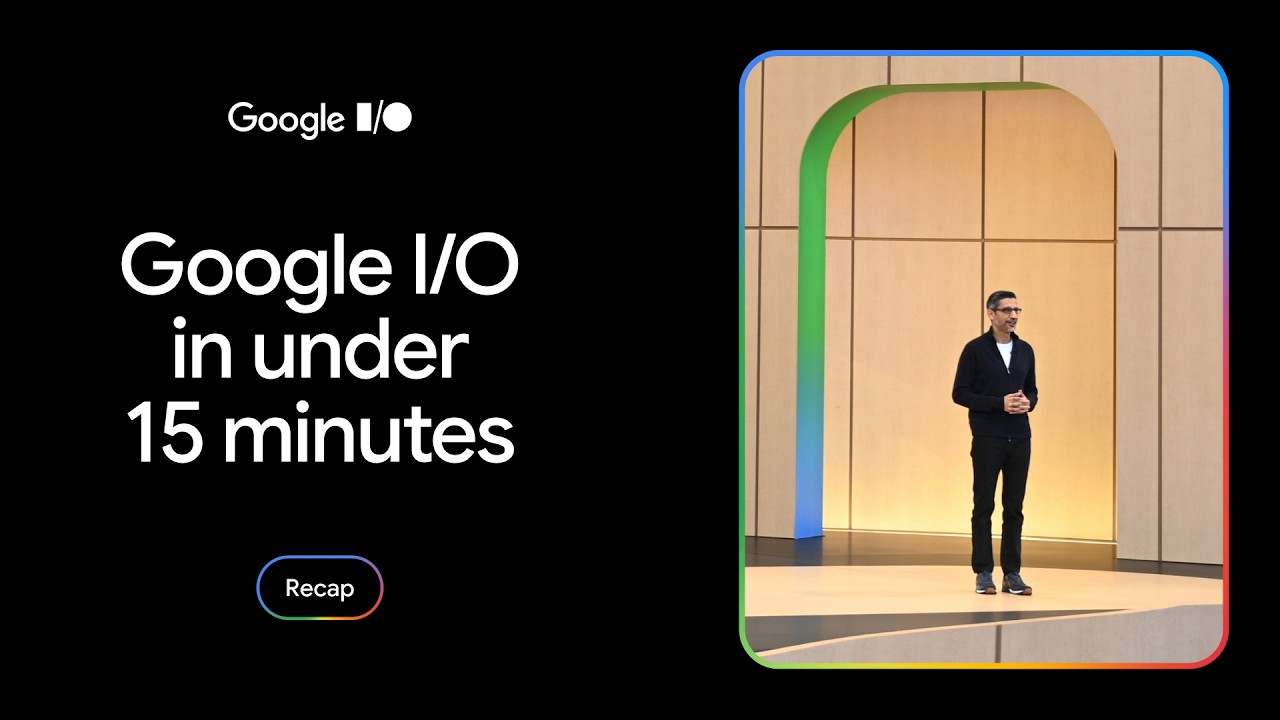
Google I/O 2026 was the most consequential developer conference in Alphabet's history — a full-spectrum declaration that the AI wars are entering their platform phase. From Gemini 3.0 closing the capability gap with GPT-5 to an AI-native Search overhaul and Android's deepest-ever integration of on-device AI, Alphabet ($GOOGL) made clear it is no longer playing catch-up. It's leading.
For investors, five announcements define the competitive landscape going forward.
1. Gemini 3.0 Closes the Gap
Google DeepMind launched Gemini 3.0, its first model to match or exceed GPT-5 on MMLU-Pro, HumanEval-X, and the AI2-Reasoning suite. Three architectural innovations drive the leap:
- Mixture of Sparse Experts 2.0 activates only 15-20% of parameters per inference, delivering 4x better token efficiency than GPT-5 and slashing serving costs
- Unified Multimodal Attention processes text, images, audio, and video in a single mechanism — 60% lower latency than Gemini 2.5 on multimodal tasks
- Internal Monte Carlo Tree Search reduces hallucination by 40% on factual queries by simulating multiple response paths before committing
Key insight: Demis Hassabis claimed "PhD-level reasoning" on domain-specific science benchmarks — a claim OpenAI has not matched with GPT-5. For investors, this closes the capability gap that dogged Google since ChatGPT's debut.
Gemini 3.0 Pro pricing — $2.50/M input tokens, $10/M output — undercuts GPT-5 by ~40%. Enabled by Google's proprietary TPU v6 infrastructure, this creates a structural cost moat: competitors running on NVIDIA hardware cannot match these margins.
2. AI Search Goes Default
Project Magi — the AI-first search stack previewed in 2024 — is now the default for all Google searches globally. AI-organized SERPs replace the classic "10 blue links" with structured answer cards, comparison tables, and cited sources. Conversational follow-ups are native. Early internal metrics show a 12% increase in search session engagement.
Crucially, Magi monetizes. Google confirmed native ad placements within AI answers — sponsored comparisons, promoted listings, and contextual ad units alongside follow-ups. Early CPM data shows ad rates on AI-organized results are 15-20% higher than traditional search ads, and click-through rates on AI-enhanced SERPs are up 0.3%.
Key insight: The fear that AI search would "destroy" Google's $180B+ ad business appears overblown. Magi increases monetization surface area while improving user satisfaction. Perplexity, You.com, and SearchGPT now face an incumbent with 90%+ market share and matching AI quality.
3. Android 17: AI at the OS Level
Android 17 embeds Gemini Nano system-wide. AI-powered notification triage, native Screen Context API for app awareness, and Gemini-powered code completion in Android Studio all run on-device via the Tensor G6 TPU — zero cloud latency, zero data leaving the phone.
This challenges Apple Intelligence (limited to iPhone 15 Pro+). Android 17's AI capabilities span the broader ecosystem — roughly 3.5 billion active devices versus Apple's 1.3 billion. The installed-base advantage is enormous.
4. Google Cloud: Vertical Integration Wins
Google Cloud disclosed an $18B+ annual AI revenue run rate, growing 78% YoY — outpacing Azure AI (~50%) and AWS AI (~35%). TPU v6 pods are generally available, delivering 2.3 exaflops per pod at 35% lower cost than NVIDIA B200 clusters. Vertex AI Agent Builder 2.0 and a $200M startup fund signal serious platform ambition.
Key insight: Only Google has a mature, in-house AI chip on its sixth generation. In a cloud pricing war, Google can cut AI compute prices without destroying margins — AWS and Azure cannot match this on NVIDIA-dependent hardware.
Enterprise commitments now exceed $200B in cumulative cloud AI contract value — multi-year production workloads, not pilot volume. At current growth rates, Google Cloud could capture 25%+ of the enterprise AI market by 2028 (up from ~12% today).
5. Competitive Fallout
- OpenAI: Capability gap closed, 40% pricing disadvantage, no distribution moat. The $40B+ valuation faces new scrutiny.
- Microsoft ($MSFT): Copilot strategy is formidable, but Google Workspace's Gemini Sidekick undercuts on price and Android AI weakens Copilot+ PC value proposition.
- Meta ($META): Llama 4 will likely compete on capability, but no cloud platform or mobile OS means Meta cannot compete on distribution.
- Amazon ($AMZN): AWS remains AI revenue leader, but TPU v6 + Gemini makes Google Cloud the most compelling alternative to NVIDIA hardware lock-in.
Investment Thesis: Three Numbers
- $200B+ in cloud AI enterprise commitments — production contracts, not pilots
- Search revenue stability — 5-7% growth projected for FY2027 as Magi improves ad targeting and user engagement
- Cost advantage widening — $30B+ TPU v6 CapEx creates structural inference cost advantages no competitor can replicate
The bottom line: Google I/O 2026 closed the AI capability gap, proved AI search monetization, and demonstrated that vertical integration — TPU silicon to Gemini models to Android distribution — is a compounding competitive advantage. For $GOOGL investors, the primary risk is regulatory, not strategic. On product and strategy alone, Alphabet has never been stronger.