Eight years ago, GlobalFoundries surrendered. The foundry walked away from its race against TSMC, tore up its seven-nanometer roadmap, and decided bleeding-edge logic was a game for balance sheets twice its size. Wall Street treated the move like a permanent demotion to the silicon minor leagues.
Now, the world's premier chipmaker has shown up in upstate New York with a contract. Under a multi-year, $2 billion manufacturing agreement, GlobalFoundries will expand its Malta, New York fabrication facility to build silicon interposers for TSMC. The company that quit the leading edge is suddenly being paid to solve the leading edge’s biggest operational bottleneck.
Strip away the cleanroom jargon and GlobalFoundries operates as a contract manufacturer for the unglamorous guts of the modern economy. It does not design processors. Instead, it runs sprawling factories in New York, Vermont, Germany, and Singapore that manufacture workhorse silicon: radio frequency chips for smartphones, sensors for automotive braking systems, power controllers, and optical switches. If a chip manages heat, connects to a cell tower, or regulates an electric vehicle's battery, GlobalFoundries probably makes it.
| Price LIVE | $48.07 |
| Market Cap | $26.8B |
| Forward P/E | 19.0x |
| Total Revenue (TTM) | $6.94B |
| 52-Week Low | $32.02 |
| 52-Week High | $92.55 |
| Analyst Consensus | Buy (22 analysts) |
| Analyst Target Mean | $74.68 |
The new agreement gives TSMC access to those workhorse lines. Under an initial five-year term, GlobalFoundries will provide manufacturing services directly into TSMC's CoWoS packaging ecosystem, with commercial volume production scheduled to ramp during the first half of 2028.
The Interstate Under the Processor
To understand why TSMC is outsourcing work to a former rival, you have to look underneath the artificial intelligence processors powering modern data centers.
Everyone focuses on the processor die itself—the massive slab of computing logic designed by Nvidia or AMD. Yet that logic processor cannot train a model on its own. It needs rapid, unbroken access to mountains of memory. High-bandwidth memory stacks sit right alongside the main computing engine, but connecting them across a standard green computer motherboard is physically impossible. Motherboard traces are too wide, the copper paths are too long, and the electrical resistance creates suffocating heat and transmission lag. It is the data center equivalent of running an eight-lane highway into a dirt road.
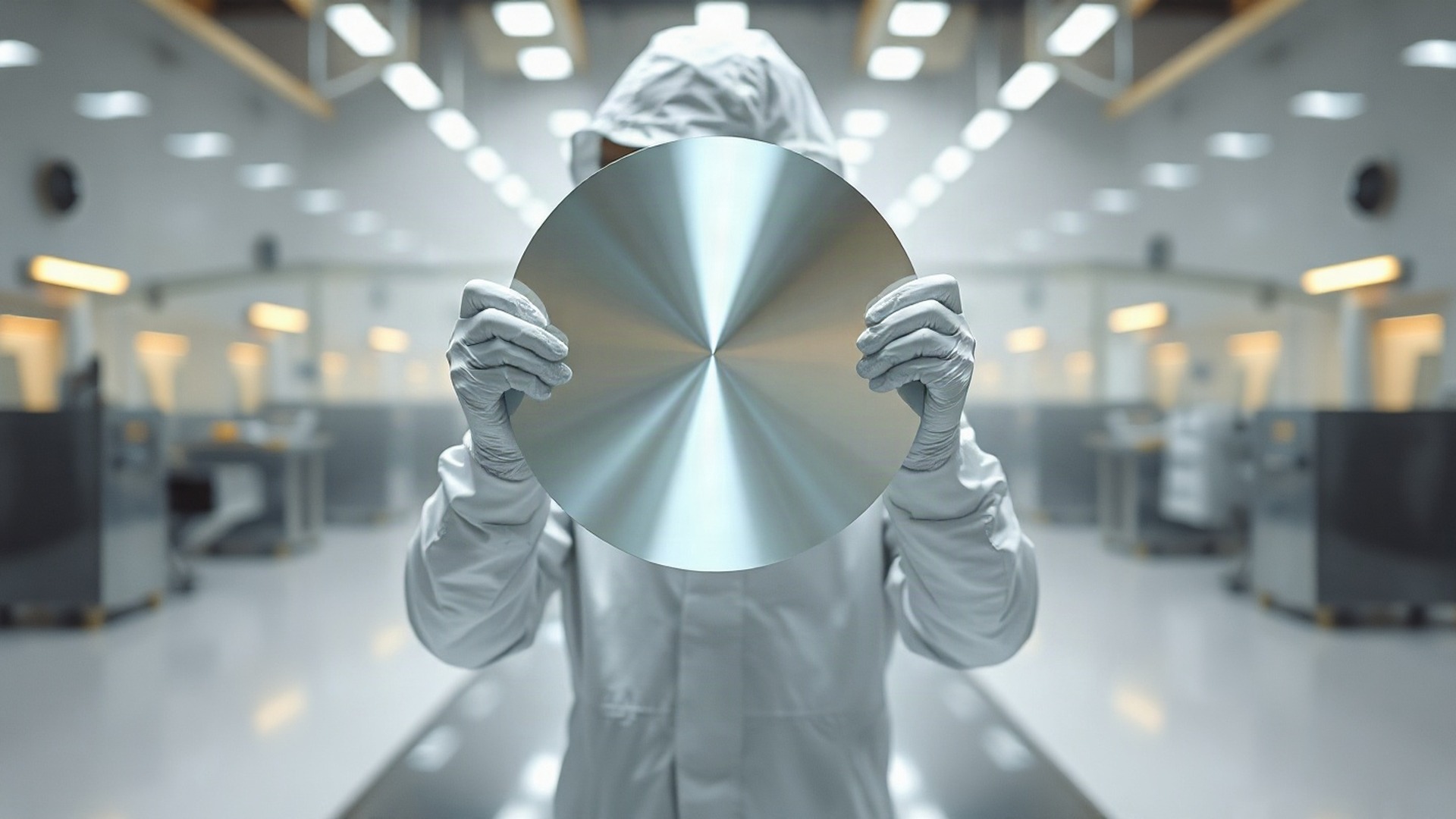
Enter the silicon interposer. Think of the interposer not as a computer chip, but as a microscopic multi-tier highway bridge. It is a thin sliver of silicon placed flat beneath both the processing core and the memory stacks. Etched with tens of thousands of hair-thin metallic interconnects, the interposer lets electrical signals shuttle back and forth across millimeter distances in fractions of a nanosecond.
TSMC packages this assembly together using a proprietary architecture called Chip-on-Wafer-on-Substrate, or CoWoS. For two straight years, CoWoS has been the single tightest choke point in the entire AI supply chain. TSMC's packaging lines ran roughly 70,000 wafers a month in 2025. While internal output is climbing toward 140,000 wafers monthly by late 2026, industry demand is racing from 1.4 million wafers this year toward 2.7 million in 2027. Outside packaging houses add another 50,000 to 60,000 wafers a month, but that still leaves an estimated shortfall of 10% to 20%.
TSMC's leadership has been unusually blunt about the problem. Chief executive C.C. Wei told investors in July that packaging limits customer growth. Until now, silicon interposers have been trapped inside logic foundries. TSMC, Samsung, and Intel build them for their own production runs, meaning there has been no true merchant supply market.
The Malta agreement changes that structure. GlobalFoundries is creating the first domestic, commercial source of silicon interposers in the United States. Crucially, the Malta plant will integrate embedded deep trench capacitors into the silicon. These are energy-smoothing reservoirs etched vertically into the interposer itself. Instead of drawing power from a distant capacitor on a circuit board, the processor gets stable, instantaneous voltage delivered directly beneath its hottest transistors.
"Advanced packaging is becoming increasingly critical to delivering the performance, power efficiency and scale required for next-generation AI systems," Ed Kaste, senior vice president of CMOS Business at GlobalFoundries, said when announcing the deal. "By providing manufacturing service using GF's trusted U.S. manufacturing footprint, we are creating a secure, scalable source of essential advanced-packaging elements." Kaste added that the arrangement should help customers move faster and strengthen the semiconductor supply chain.
Escaping the Smartphone Drag
For GlobalFoundries, the deal represents something more urgent than industry prestige: an escape hatch from consumer electronics.
The company's core business remains weighted down by legacy markets. Smart mobile devices accounted for roughly 36% of net revenue in the second quarter of 2026, and that segment shrank 6% year over year. The smartphone replacement cycle has stretched out. When consumers upgrade their handsets less often, foundries that press cellular radio chips feel the chill immediately.
Total second-quarter revenue grew 6% year over year to $1.786 billion, supported by an IFRS operating margin of 9.7% and adjusted EBITDA of $587 million. Those are healthy, steady numbers, but they reflect a legacy foundry profile rather than a hypergrowth hardware play.
The growth engine sits inside the Communications Infrastructure and Data Center division. That segment generated roughly 16% of total revenue in the second quarter, but it surged 62% year over year. Management recently lifted its full-year growth target for the group to between 50% and 60%, marking seven consecutive quarters of double-digit expansion.
GlobalFoundries is achieving that momentum by repurposing mature fabrication tools for specialized data center physics. The company expects silicon photonics revenue—chips that transmit computing data using light rather than electrical current—to more than double in 2026. Its manufacturing capacity for Silicon-Germanium (SiGe) radio-frequency and optical nodes is completely sold out through 2027.
The TSMC contract is the latest in a rapid sequence of commercial expansions. In mid-September, GlobalFoundries signed an expanded optical connectivity agreement with Marvell, committing dedicated SiGe production lines at its Burlington, Vermont fab. Days earlier, it inked a power-semiconductor partnership with Monolithic Power Systems targeting 300mm wafer output in Singapore by early 2027. Washington has taken notice, too. Beyond a $375 million quantum research award finalized in September, the Commerce Department's CHIPS program has earmarked $1.587 billion in direct funding. That money anchors roughly $14 billion of planned capital spending across New York and Vermont.
The Re-Rating Math
Shares jumped roughly 4% following the TSMC announcement, reaching a one-month high. Even with that bounce, the equity remains roughly 45% below its May peak, when enthusiasm for broad-based hardware outpaced industrial reality.
What has to happen for this stock to re-rate? The answer lies in multiple expansion through revenue mix, not the headline size of the contract.
GlobalFoundries trades at a forward earnings multiple near 19, against a trailing multiple around 39. The market assigns that discount because investors still view the company as a cyclical metal-bender tied to car factories and handset shipments. Automotive chips and smartphone radios are low-margin, boom-and-bust products where fab owners have limited pricing leverage during industry downswings.
A valuation multiple re-rates upward when higher-margin, mission-critical product lines outgrow commodity lines. If communications infrastructure, silicon photonics, and CoWoS interposers expand to a commanding slice of total revenue, the market has to price GlobalFoundries as an AI infrastructure bottleneck rather than a foundry of last resort.
The $2 billion headline figure does not move the needle overnight. Spread across a five-year framework, it equals roughly $400 million in annual baseline volume—about 6% of the company’s $6.9 billion trailing revenue base. But high-margin manufacturing service fees carry vastly different cash flow profiles than low-end mobile silicon. If the data-center division keeps expanding at a 50% clip while mobile drops below a quarter of sales, investors will stop pricing GlobalFoundries like a car-parts supplier.
The Short Seller’s Ledger
The bears, however, see a dangerous trap masked by headline enthusiasm.
Start with the calendar. Commercial volume from the TSMC arrangement will not ramp until the first half of 2028. That puts first revenue roughly eighteen months away, with zero disclosed take-or-pay volume commitments, zero unit pricing disclosures, and no guaranteed operating margin thresholds.
To collect that future revenue, GlobalFoundries has to spend cold cash today. That reality hits the balance sheet at an uncomfortable moment. During the second quarter, capital expenditures climbed to $411 million, outstripping operating cash flow of $405 million. Free cash flow was essentially flat to negative. The company closed the quarter with $3.3 billion in cash and marketable securities against $1.7 billion in debt, adequate liquidity for now. But burning cash reserves to build capacity for an uncommitted 2028 ramp is a gamble.
More fundamentally, GlobalFoundries is stepping into a structurally subordinate role. TSMC owns the customer relationships, holds the patents for the CoWoS architecture, and controls system-level pricing. GlobalFoundries is functioning as an outsourced machine shop, bearing the upfront capital equipment expense while TSMC captures the premium profit margins.
The operational risk is real. GlobalFoundries burned billions of dollars attempting to manufacture seven-nanometer chips before abruptly abandoning the project in 2018. If TSMC expands its own internal packaging capacity faster than expected in Taiwan or Arizona, Malta could end up with expensive cleanrooms. If AI accelerator packaging constraints loosen before 2028, utilization rates suffer.
What proves the bears right is simple: watch capital spending relative to segment growth. If quarterly capex remains above operating cash flow while Communications Infrastructure revenue decelerates below the company's 50% target, GlobalFoundries will have built speculative capacity without pricing power.
The Operational Hurdle
For long-term investors, the path forward comes down to flawless cleanroom execution.
The industrial challenge of packaging silicon cannot be overstated. Etching deep trench capacitors into silicon wafers requires cleanroom tolerances measured in single-digit nanometers. If yield rates stumble during qualification, the anticipated margin premium evaporates into scrap silicon.
What we are watching closely is the third-quarter earnings report, specifically whether the company tracks toward its $1.885 billion revenue guidance midpoint while keeping the communications segment above its 50% growth pace.
GlobalFoundries stepped out of the leading-edge spotlight nearly a decade ago to pursue profitable specialization. By carving out a vital role in the physical plumbing of AI hardware, the company has found a way back to the frontier on someone else's balance sheet.
GlobalFoundries trades on the Nasdaq under the ticker GFS.
Disclosure: The Signal holds no position in GFS. Positions may change. This is not financial advice.