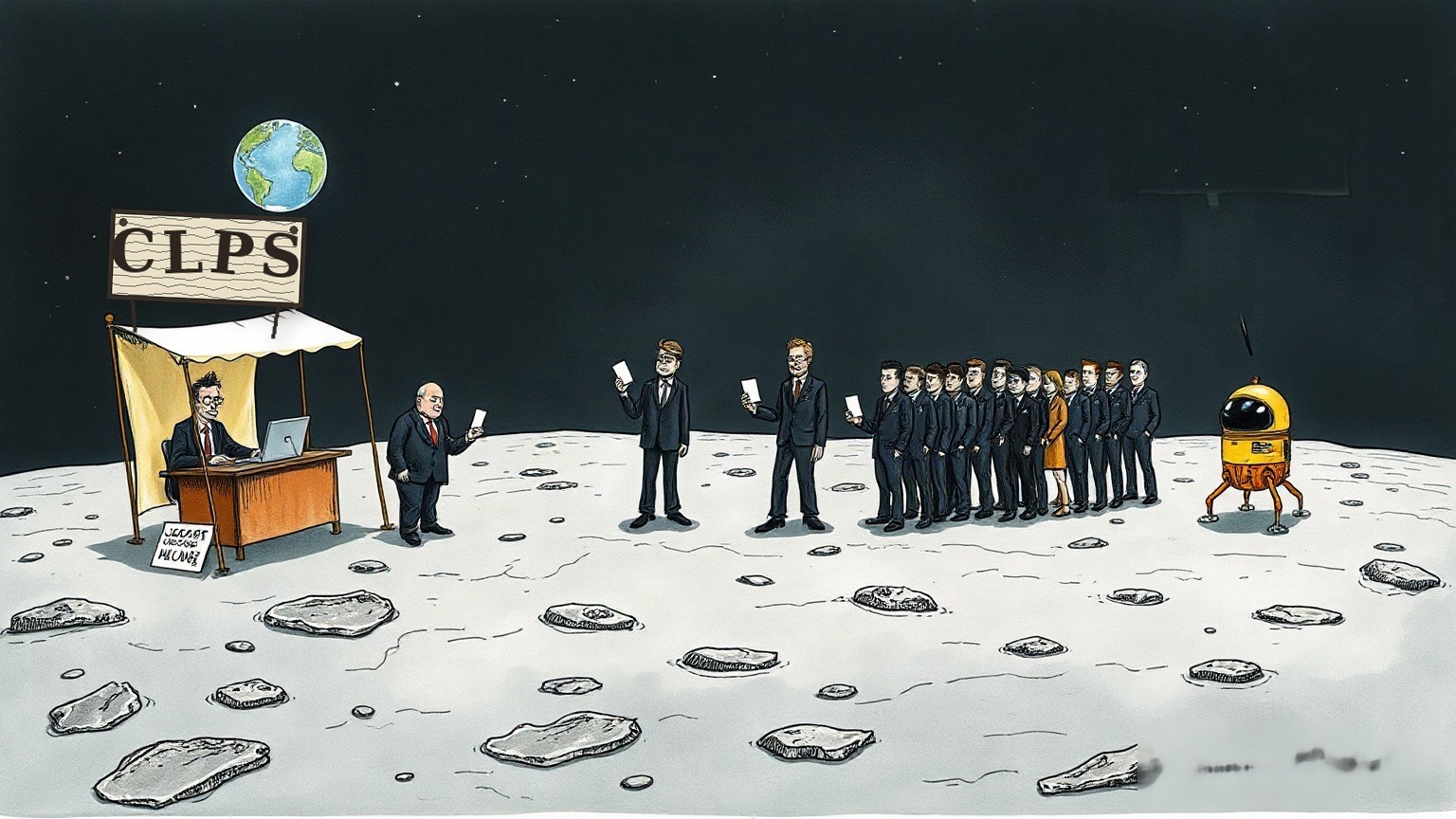
Getting onto a government vendor list is like scoring an invitation to an exclusive wholesale club. It gives you the right to walk through the doors and bid on whatever hits the shelves, but nobody hands you groceries at the door. On November 7, NASA placed Firefly Aerospace on an eight-vendor roster for CLPS 2, its flagship commercial lunar delivery program. The headline number attached to the press release was an eye-watering $10 billion spread over a decade. Yet Firefly did not win a single dollar.
Based in Cedar Park, Texas, Firefly builds the heavy machinery required to launch cargo into orbit and land scientific gear on the Moon. Think of the company as an industrial freight carrier that moonlights as a boutique military contractor. It builds the Alpha rocket, constructs the Blue Ghost lunar lander, and manufactures mission-critical sensor systems for the US Space Force.
In March 2025, Firefly became the first commercial operator to pull off a fully successful soft lunar landing, keeping ten NASA payloads operational on the surface for two weeks. That operational track record got Firefly invited to NASA's new vendor pool. But Firefly walked away with a hunting license. Blue Origin walked away from the very same announcement with a firm $94 million task order to haul a nuclear rover to the lunar South Pole.
| Price LIVE | $20.76 |
| Market Cap | ~$3.48B |
| Forward P/E | N/M |
| Total Revenue (TTM) | $287.0M |
| 52-Week Low | $14.45 |
| 52-Week High | $62.17 |
| Analyst Consensus | Buy (11 analysts) |
| Analyst Target Mean | $35.73 |
Treating that $10 billion master ceiling as actual business misunderstands how government procurement works. Under the first iteration of the program, NASA set a $2.6 billion ceiling, and in the same announcement that created CLPS 2 it lifted that contract's maximum value to $4.2 billion. Even so, an internal watchdog found the agency had budgeted only $2.19 billion through 2028, and the eight delivery orders awarded through early 2024 carried a combined value of just $984 million. Two initial vendors collapsed entirely—one canceled within two months, and another went bankrupt. Across the board, delivery schedules slipped by an average of fourteen months, and costs swelled by 26%. A federal ceiling is merely a spending cap, not a pipeline of checks.
Here is the twist that casual observers miss: the Moon is not where Firefly makes its living. Lunar missions provide spectacular marketing, but defense hardware pays the bills. In the second quarter of 2026, Firefly generated $117.7 million in revenue. Rockets contributed just $9.4 million, or 8% of the total.
A staggering 92%—$108.3 million—came from its spacecraft and space-systems division. That business is powered by defense electronics and satellite software from SciTec, an acquisition that came with a $259 million Space Force contract. Add in an agreement announced November 6 with AST SpaceMobile worth more than $1.3 billion for 36 rocket engines, and the operational reality becomes clear. Firefly is quietly morphing into an aerospace propulsion and military electronics supplier wrapped inside a lunar explorer costume.
That distinction matters directly to the stock. Firefly trades at roughly twelve times trailing sales and about eight times the midpoint of its reiterated full-year revenue guidance of $420 million to $450 million. That multiple prices the equity as an elite high-growth defense platform rather than a speculative deep-space lottery ticket. For the stock to re-rate higher, Firefly cannot rely on romantic press releases about deep space. It must prove that its roughly 20% gross margins can expand as military software and engine manufacturing dilute lower-margin launch services. It must also prove that its $1.5 billion backlog can convert steadily into cash without dilutive capital calls, especially since half of AST SpaceMobile's upfront payment arrives as equity rather than liquid cash.
Short sellers see a company that chronically overpromises on delivery while burning through cash. Blue Ghost 2 was supposed to launch in late 2026; missing propulsion hardware pushed it into 2027. Its Alpha rocket failed twice in 2025, losing a payload in April. A booster was destroyed in a ground test that September, and the stock fell more than 20% in a session. Launch cadence was cut to just three attempts this year.
Firefly burned $326.5 million in free cash flow over the trailing twelve months, leaving it with $635.3 million in liquid assets. At that burn rate, the company has about six quarters of breathing room before needing outside cash. Competing vendor Intuitive Machines already books nearly double Firefly's quarterly revenue. And Firefly must now bid against giants like SpaceX and Lockheed Martin, which can lose money on a bid without batting an eye. Another flight failure or schedule slip would prove the bears right.
We are watching third-quarter financial results, scheduled for release after the market closes on Tuesday, November 10. That earnings report offers the first concrete look at whether cash burn is narrowing and how management plans to fund operations until those engine contracts start generating steady cash.
Disclosure: The Signal holds no position in FLY. Positions may change. This is not financial advice.