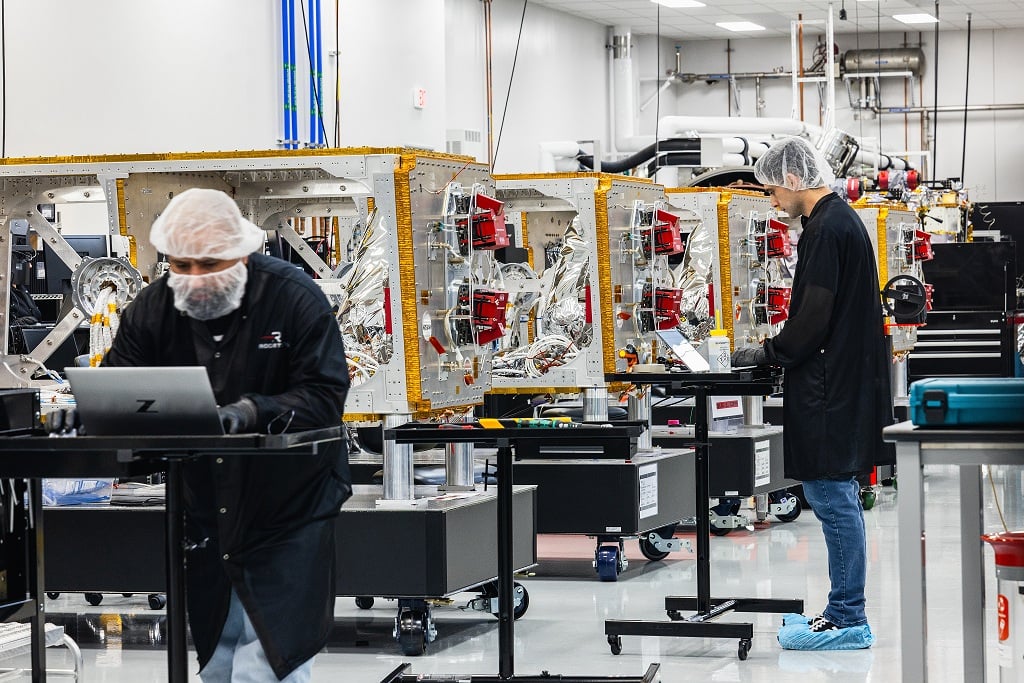

Credo Technology just did something almost unheard of in semiconductors: its fiscal fourth quarter alone generated more revenue than its entire previous fiscal year. The $437 million quarter, reported in early June and up 157% year over year, topped the $436.8 million Credo booked across all of fiscal 2025 — a full year that itself looked aggressive at the time. The AI buildout has turned the company's interconnect silicon into the closest thing to a mandatory toll on the road between GPU, memory, and switch.
| Price LIVE | $282.82 |
| Market Cap | $48.5B |
| Forward P/E | 28.6 |
| Total Revenue (TTM) | $1.34B |
| 52-Week Low | $86.49 |
| 52-Week High | $308.67 |
| Analyst Consensus | Buy |
| Analyst Target Mean | $279.29 |
Full-year revenue reached $1.34 billion, up 206%, with non-GAAP net income of $661.5 million — roughly five times the prior year — and non-GAAP earnings per share of $3.46 on a full-year gross margin of 68.1%. Management guided the current quarter to $465–475 million and told investors to expect more than 80% growth in fiscal 2027, a bar the Street has already quietly marked down to roughly 61%. Shares trade well below the record they set in June — after a volatile pullback that took them down double digits at last week's close — yet still roughly triple their 52-week low. It is a volatility profile that a beta near 3.2 makes easy to explain. The balance sheet is an afterthought in the right way: roughly $1.4 billion in cash and short-term investments against about $25 million of debt leaves the company essentially net cash, with ample firepower for whatever comes next.
The most consequential development, though, has nothing to do with the income statement. In March 2025, Credo filed complaints with the ITC and in district court against Amphenol, Molex, TE Connectivity and Volex over active electrical cable patents that trace back to engineering work begun in 2017. Within roughly twelve months, the entire cable supply chain lined up to license rather than litigate: Amphenol settled in August 2025, Siemon licensed in November, 3M followed in January 2026, and Molex cross-licensed in March, with TE and Volex settling around the same time. All four original defendants are now licensees on confidential terms. That is a toll booth, and Credo built it with patents rather than market power.
The popular framing casts copper and optics as rivals — active electrical cables the short-reach champion, silicon photonics the eventual winner. Credo is quietly making that binary obsolete. The company now sells AECs, optical DSPs, transceivers, and, since closing the $750 million DustPhotonics acquisition in late May, silicon photonics PICs aimed at 1.6T and 3.2T optics including near-package and co-packaged configurations. Management targets more than $600 million of optical revenue in fiscal 2027. The data-movement-bottleneck thesis is intact; Credo is simply collecting tolls on both sides of the divide.
The bull case is straightforward. For in-rack links of roughly two meters or less, AECs beat optics on cost — about half the price — and consume roughly half the power, while Credo's ZeroFlap technology attacks link-flap, one of the top causes of GPU underutilization in real deployments. The addressable market scales with GPU count, not just switch ports, which is what makes the current growth rate possible at all. And every cable maker that chose to license rather than fight is a fresh validation that the intellectual property is foundational, not incremental. Sell-side conviction matches the story: nineteen analysts carry a consensus Buy, and the mean price target sits right around the current quote — constructive, but not exuberant.
The bear case deserves equal airtime. Copper reach shrinks as lane rates climb — 1.6T at 112G per lane pushes the boundary inward — while near-package and co-packaged optics threaten to absorb the very links AECs serve today. Growth is decelerating by design: 206% this year, more than 80% guided next, roughly 61% as the Street sees it. Two customers delivered 81% of revenue, a concentration that makes the model hostage to a single procurement decision. Broadcom, Marvell and Astera Labs — its most direct rival in AECs and retimers — are all spending heavily to contest the same sockets. And at roughly 36 times sales, with trailing earnings near 103 times, the multiple assumes near-perfect execution.
The honest read: Credo is the plumbing company of the AI buildout — structurally essential, competitively fortified, and priced for near-perfect execution. Own it for the thesis, size it for the volatility, and keep one eye on customer concentration and the fiscal 2027 optics ramp. The IP moat is real, the market is real, and the execution so far has been close to flawless. The question is not whether Credo wins; it is what you pay for a certainty that already looks priced in.
Disclosure: The Signal holds no position in CRDO. Positions may change. This is not financial advice.