
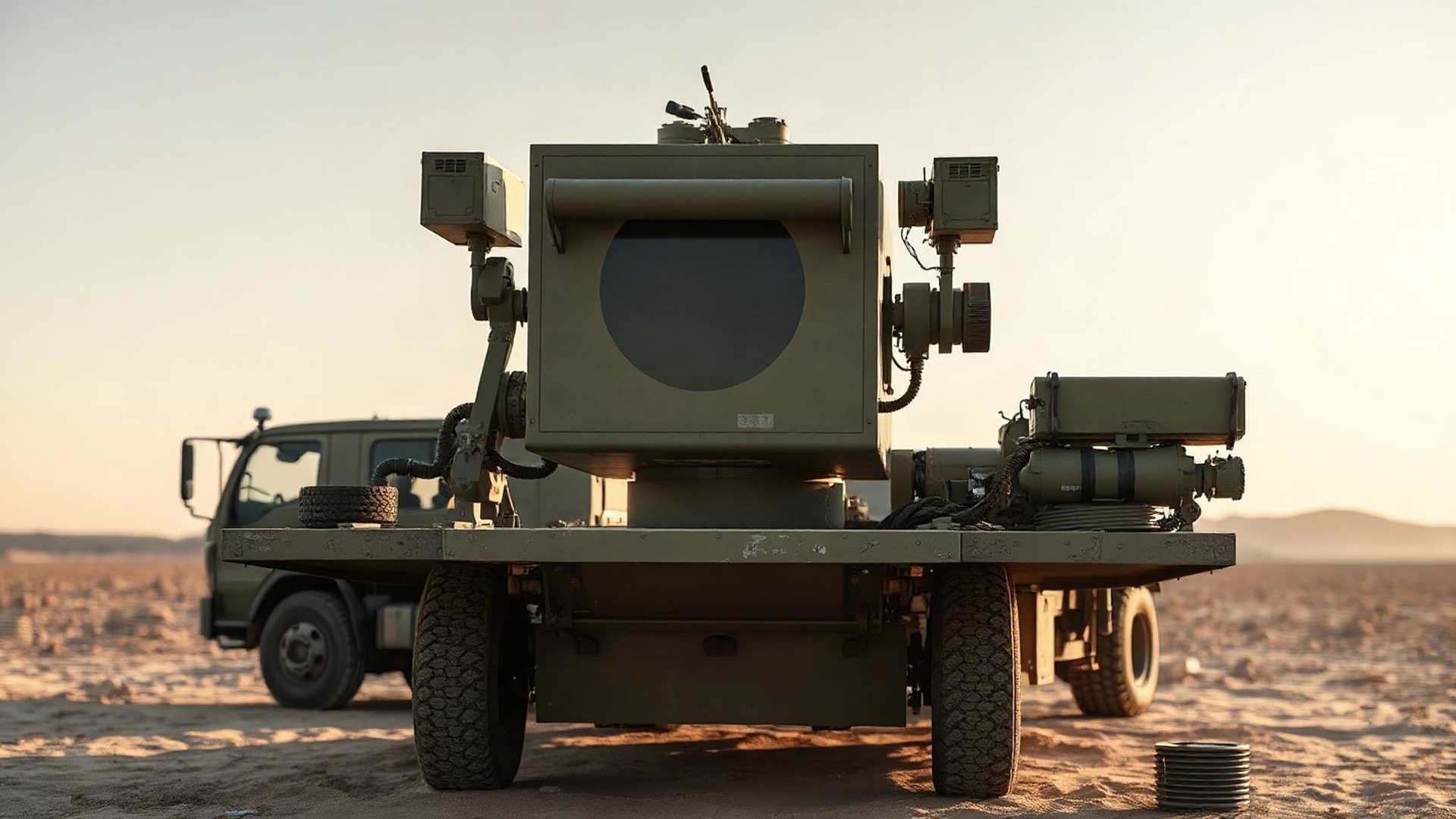
AeroVironment builds the machines that fight drones: small uncrewed aircraft, loitering munitions, counter-drone gear. Now it sells the last link in the chain, a weapon that burns a drone out of the sky with light.
| Price | 152.05 |
| Market Cap | $7.7B |
| Forward P/E | ~46-50x |
| Total Revenue (TTM) | $2.0B |
| 52-Week Low | 135.2 |
| 52-Week High | 417.86 |
| Analyst Consensus | Buy (19 analysts) |
| Analyst Target Mean | 219.35 |
Shooting a million-dollar interceptor at a cheap drone is like paying a valet a thousand dollars to park a twenty-dollar car. A laser is the parking space you own, and the meter runs on electricity.
That stopped being a metaphor on Sept. 2, when the Army awarded AeroVironment $464.8 million for its LOCUST X3 laser. The company calls it the first production contract for a laser weapon in American history, and the Army agrees. Six days later came the first export sale, above $50 million, to an undisclosed buyer.
The shares slid anyway, roughly two-thirds below their 52-week high. The market will not pay for a franchise that has not reached the income statement yet, and the moat underneath it is program position: real, and narrow.
Wahid Nawabi, the chairman and CEO, framed the trade at a Jefferies investor conference: a $150,000 Shahed drone against a $1 million to $10 million interceptor. He prices the laser shot under $10 — "as long as you have electricity, it gives you unlimited magazine" is how he puts it. The company's own figures move around, from about $3 in CBS reporting to 18 cents counting only the electricity.
A counter-drone fight is a perception problem before it is a weapons problem. Autonomy and detect-decide-deliver software — the layer AeroVironment sells as AV Halo — is the defense industry's AI story. Sailors with under an hour of training hit 17 of 17 targets.
LOCUST lives inside Space, Cyber and Directed Energy, the segment BlueHalo created. In the August quarter that segment booked $134.5 million of revenue, down 21%, and lost about $9 million on an EBITDA basis.
Fiscal 2027 guidance is a flat-margin year by design. Revenue is guided to $2.125 billion to $2.225 billion and adjusted EBITDA to $305 million to $325 million, a 14.5% margin unchanged from last year. The lift arrives later, through mix: more product, more firm-fixed-price work, more international sales.
CFO Sean Woodward said the company would "increase our international sales that typically yield a little higher margin than domestic sales" — the mix story. By fiscal 2030, management wants $3.5 billion to $4.0 billion of revenue at an 18% to 20% margin.
On guided fiscal 2027 non-GAAP earnings of $3.02 to $3.34 a share, the shares go for roughly 46 to 50 times. That prices the 2030 plan, not the flat year.
A short seller reads the same file differently. The $464.8 million award is spread over what the CFO calls roughly a four-year program, and nothing from it was recognized in the August quarter. Directed energy is not a disclosed line, so none of it can be checked in the filings. The international win is one order from one unnamed customer, with no unit count or delivery date.
Then the sharp one: third-party reporting, via Laser Wars and CBS News, puts a LOCUST unit at roughly $17 million to $25 million. Amortize the hardware and the per-shot miracle collapses. An $18 million machine firing $10 shots needs about 1.8 million of them to reach shot cost.
Ukraine already handles roughly 70% of its intercepts with interceptor drones costing a few thousand dollars each. You know the math from your own pocket: a dollar-a-month app, and a four-figure phone that runs it.
In June the audit committee said the January-quarter financials "require restatement and should no longer be relied upon" — a call that also carried a disclosed material weakness in internal controls. A securities class action followed, and the SCAR/BADGER termination drove $240.7 million of goodwill write-offs.
RBC's Ken Herbert downgraded the shares in July, on an implied 2028-to-2030 acceleration that "will likely keep investors on the sidelines until visibility on the upside improves" — the visibility problem, plainly.
What would prove the bears right is specific: Space, Cyber and Directed Energy returning to positive segment EBITDA, and directed energy earning a disclosed line. The next checkpoint is the fiscal second quarter, which closes at the end of October.
AeroVironment is building capacity for roughly $500 million a year of LOCUST volume — capacity, not backlog. A follow-on Army award or a second export customer is what turns that capacity into a franchise.
AeroVironment solved the physics of cheap air defense, and the shares already carry a bet that it solves the accounting. A $10 shot is a physics problem, solved. A $10 shot with a gross margin attached is a business problem, and it is still on the test range.
Disclosure: The Signal holds no position in AVAV. Positions may change. This is not financial advice.